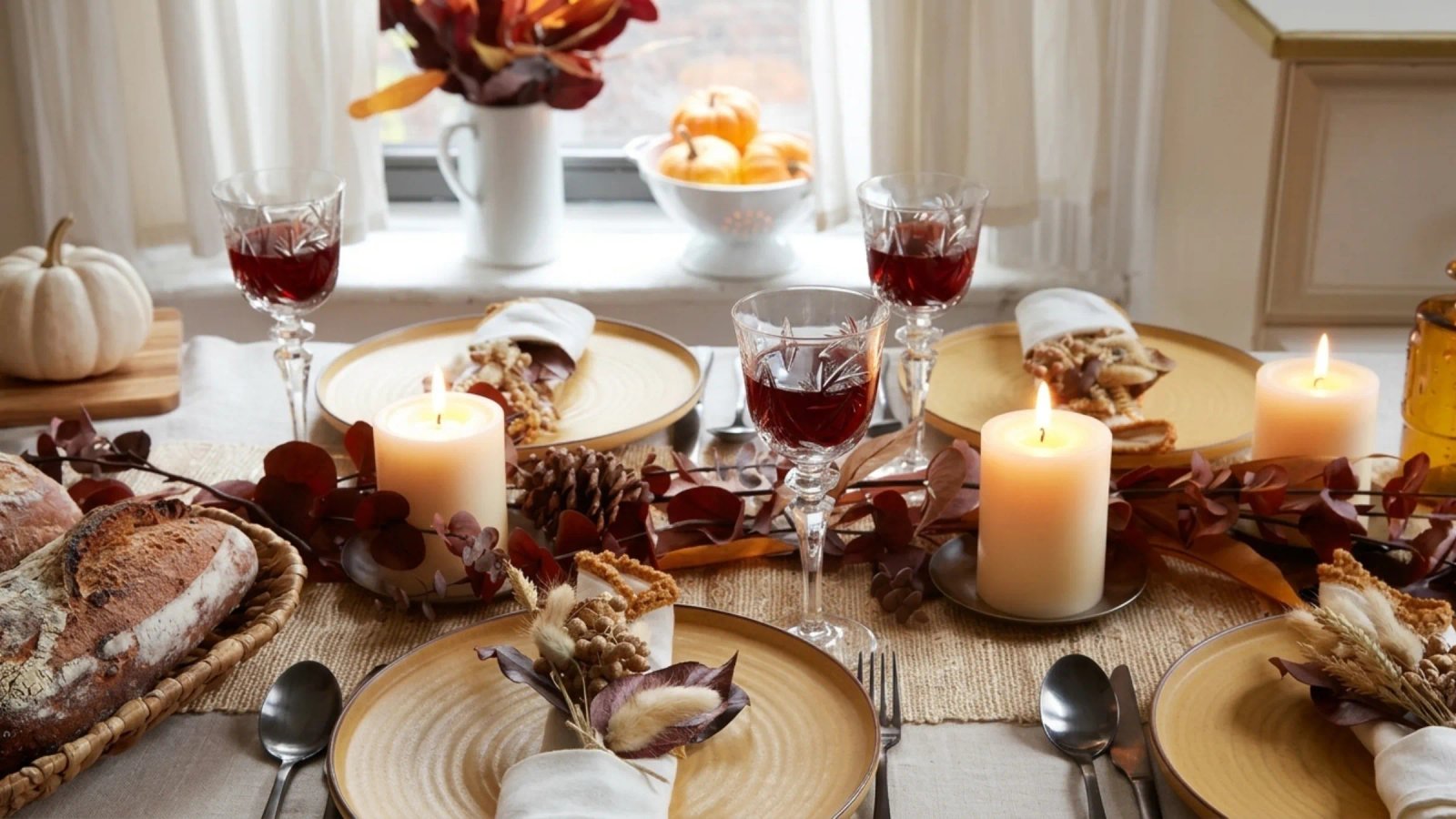
Every November there’s a wave of tablescape content showing a ten-foot farmhouse table with a dried-flower runner, three candle heights, individual place cards and a charger under every plate. It’s lovely. It is also not the problem most people have.
The actual problem is that nine people are coming and the table seats six, and nobody has written honestly about that.
This guide is arithmetic first and styling second. Work out what your table genuinely holds, find the inches you’re missing, and then set it in a way that looks deliberate rather than crowded.
First, work out what your table actually seats
The industry standard is 24 inches of table edge per person. That figure comes from furniture design practice and is a minimum, not a comfortable average — it gives each guest enough room for a place setting and an elbow without touching their neighbour. Thirty inches is the formal, genuinely comfortable figure.
Rectangular tables: divide each long side by 24. A 72-inch table takes three people per side. Add the ends if the table is at least 36 inches wide.
Round tables: multiply the diameter by 3.14 to get the circumference, then divide by 24.
48-inch round: 150 ÷ 24 = 6 people
60-inch round: 188 ÷ 24 = 7–8 people, though at 8 you’re down to 23.5 inches each and elbows will touch
Width matters more than people expect. You need 36 inches of table width for place settings plus serving dishes down the middle. Below 30 inches, there’s no room for anything in the centre at all. And to actually pass a dish across the table rather than around it, you need about 48 inches.
Now do the honest version of this sum for your table and write the number down. That’s your real capacity. Everything below is about closing the gap between that number and your guest count.
Check your table legs before you count seats
This is the detail that quietly ruins seating plans.
On a table with four corner legs, a leg frequently sits exactly where someone’s knees need to go. A 24-inch place setting is useless if there’s a table leg in the middle of it. Crouch down and look before you commit to a seating plan — you may find your “seats eight” table actually seats six with two people straddling a leg.
Pedestal and trestle tables don’t have this problem, which is why they fit more people than their dimensions suggest. If you have a choice of tables, the pedestal one wins for a crowd.
Table aprons — the horizontal rail under the tabletop — also eat knee clearance, and matter if you’re seating anyone tall.
Where to find the missing inches
Ranked roughly by how much they gain you.
Swap the chairs
This is the highest-impact change and costs nothing if you have alternatives.
Armchairs run 24 to 30 inches wide. Side chairs without arms run considerably narrower. Swapping four armchairs for four armless chairs can easily gain you a full extra seat, sometimes two.
Benches are better still. A bench along one long side removes the fixed spacing problem entirely — people simply shuffle along. You can fit four adults on a bench where four chairs would have fit three, and children take almost no space at all. If you’re buying anything for Thanksgiving, a dining bench is the single most useful purchase.
Add a leaf, or a table topper
Standard table leaves are 12 inches wide — half a place setting. Two leaves gain you one seat.
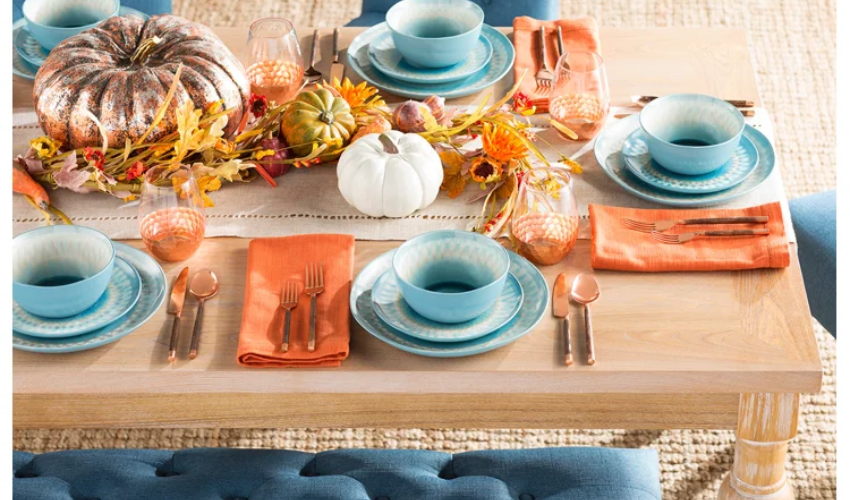
If your table doesn’t extend, a table topper — a flat board or folding panel laid over the existing top — is the cheap version. It overhangs the original table, adding both length and width. It needs a tablecloth over it, which you were probably using anyway.
Reduce the place setting depth
A standard place setting takes 12 to 15 inches of depth from the table edge. A formal setting with a charger, multiple glasses and a bread plate takes more.
Drop the chargers. They look good in photographs and they are pure consumed surface area — typically 13 inches across for something that holds another plate. On a tight table they’re the first thing to go, and nobody notices.
One glass per person, not three. Pour wine from a bottle on the table rather than pre-setting a water glass, a wine glass and a tumbler.
Skip the bread plate. Bread goes in a basket passed around, or a roll sits directly on the dinner plate.
Wrap the cutlery in the napkin, laid vertically above or on the plate rather than fanned out on both sides. This alone can narrow a place setting by three or four inches.
Reclaim the centre
This is the biggest single gain, and it changes the whole shape of the meal.
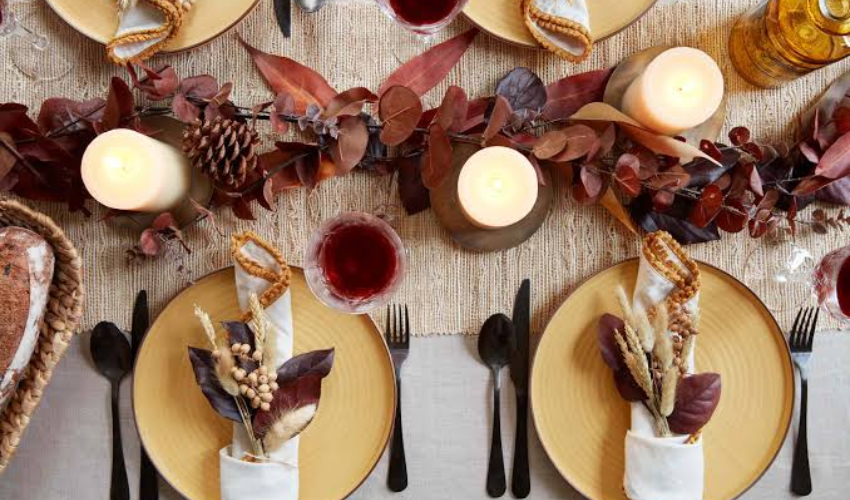
The traditional Thanksgiving layout puts every dish on the table at once — turkey, stuffing, potatoes, green beans, cranberry, gravy, bread. On a small table, that’s half the surface gone before anyone sits down.
Serve from a sideboard, kitchen counter or a separate side table instead. Guests plate up and sit down. The table carries only what’s needed: plates, cutlery, glasses, and whatever’s being passed.
If you want some dishes on the table for the look of it, choose narrow oval platters over round ones. An oval dish holds the same volume in substantially less width, and two ovals laid end to end down a narrow table look better than one round platter that dominates it.
Tiered stands are the other centre-saver — they take one dish’s footprint and hold two or three.
The seating plan on a tight table
Once you know your numbers, a few arrangements work better than others.
Put children at the ends. Smaller bodies need less edge, and a 24-inch allowance becomes 30 inches of effective room for the adults beside them.
Don’t seat anyone at a corner leg. Covered above, but it bears repeating — it’s the most common complaint after a crowded Thanksgiving.
Alternate the direction people face slightly. On a very tight table, angling settings a few degrees gives shoulders somewhere to go. It looks intentional.
Consider two tables. A card table or folding table set end-on to the main one, both under a single long tablecloth, reads as one table. This is far better than cramming nine people around a six-seater, and it’s what caterers do. The joint disappears under the cloth.
If you go this route, two tables of different heights is a problem — shim the lower one with books or furniture pads until the tops are level, then lay the cloth.
Clearance: the part people forget
You need 36 inches between the table edge and the nearest wall or furniture on any side with chairs. The absolute minimum to squeeze past someone seated is 24 inches.
This matters more at Thanksgiving than usual, because people get up repeatedly — to fetch things, to help, to take children out. A table that technically seats ten but traps four of them against a wall is worse than a table that seats eight comfortably.
If you’re adding chairs to a room that’s already tight, measure the walkway before you measure the table. And if you have a rug under the table, allow 24 inches from table edge to rug edge so chairs can pull out without catching.
What to put on it
With the arithmetic done, the styling gets easier, because the constraint makes most of the decisions for you.
Keep the centrepiece low. Below eye level, or guests spend the meal leaning around it. On a narrow table this is non-negotiable — a tall arrangement on a 36-inch-wide table blocks half the conversations at it.
A runner instead of a full cloth leaves more of the table visible and makes it feel less crowded, though a full cloth is the better choice if you’re joining two tables or using a topper.
Candles work, but check the height. Tapers are elegant and sit right in the sightline. Low votives scattered down the middle give you the same effect without the obstruction, and they take up almost no footprint.
Use the vertical. A hanging arrangement, or simply good overhead lighting dimmed down, does decorative work that costs no table space at all.
Resist place cards. On a tight table they’re another object competing for surface. Tell people where to sit instead.
One more thing worth saying: a table set simply and comfortably looks better than a table set elaborately and crowded. Guests notice whether they have room to eat. They do not notice whether there was a charger.
A worked example
Say you have a 60 × 36-inch rectangular table with corner legs, and ten people coming.
Long sides: 60 ÷ 24 = 2 people per side (not 2.5 — you can’t seat half a person)
Ends: 36 inches wide, so one each
Real capacity: 6, and check whether the corner legs interfere
You’re four short. So:
Swap armchairs for armless side chairs down one side, and put a bench on the other: gains 1–2
Add a 36-inch card table end-on under a single long cloth: gains 3
Serve from the kitchen counter rather than the table, since a 36-inch width has no room for platters anyway
Drop chargers and bread plates, one glass each, cutlery wrapped in the napkin
Children at the ends
That gets you to ten, with everyone able to eat. It is not what the magazine photo looks like. It works.
Frequently asked questions
How much space does each person need at a table?
Twenty-four inches of table edge is the standard minimum; 30 inches is comfortable. Below 20 inches people are genuinely cramped.
How many people fit at a 60-inch round table?
Six comfortably, eight if everyone accepts touching elbows. The formula is diameter × 3.14 ÷ 24.
Can I put two tables together for Thanksgiving?
Yes, and it’s the best solution for a big gap. Level the heights first, then cover both with a single long cloth — the joint disappears.
What should I cut first when the table is tight?
Chargers, bread plates and extra glassware, in that order. Then move the serving dishes off the table entirely.
How much clearance do I need behind the chairs?
Thirty-six inches is the proper figure; 24 inches is the minimum for squeezing past someone seated.
Is a bench better than chairs for a crowd?
Usually yes. Benches have no fixed spacing, so people adjust along them, and you typically gain a seat per bench.
The short version
Measure your table, divide by 24, and believe the answer. Check your legs. Then close the gap with narrower chairs or a bench, a second table under one cloth, and by moving the food off the table and onto a counter.
Strip the place setting back to a plate, wrapped cutlery and one glass, keep the centrepiece below eye level, and let the room do the decorating.
A small table set with room to move beats a large one set beautifully and jammed. Guests remember the elbow room.
Leave a comment