
Most people buy pillows on feel. They press one in a shop, decide it’s soft or firm enough, and take it home. Then they wake up with a stiff neck and conclude they need a softer one.
Research in this area points consistently in a different direction: pillow height is the single most important variable in keeping your neck aligned while you sleep — more important than the fill material, the firmness or the shape. A study published in Applied Ergonomics found height to be the most significant factor in cervical spine alignment during sleep, and a later meta-analysis in Clinical Biomechanics similarly found that shape and height influence cervical alignment more than fill material does.
And the right height isn’t a matter of preference. It’s determined by how you sleep and how wide your shoulders are — two things you can measure.
Here’s how.
The short version
Side sleepers need a high, firm pillow — typically 4 to 6 inches of loft, more if your shoulders are broad. This is the position where people most often buy wrong, because a soft pillow feels nicer in the shop and collapses under the head at night.
Back sleepers need medium loft, around 3 to 5 inches, firm enough to support the neck’s natural curve without pushing the head forward.
Stomach sleepers need very little — under 3 inches, soft, or no pillow at all.
Then choose a fill that holds that loft all night. A pillow that’s correct at 10pm and flat by 3am is the wrong pillow regardless of what it cost.
What loft is, and why it decides everything
Loft is the height of the pillow when it’s resting naturally — and more usefully, the height it maintains with your head on it.
The job of a pillow is to keep your head, neck and spine in a straight line. That line is different in each sleep position, which is why the required height differs so much.
Side sleeping creates a gap. Your shoulder holds your torso off the mattress, and your head needs to be supported at roughly that same height to keep the neck straight. The gap is approximately the width of your shoulder. A pillow that doesn’t fill it lets the head drop, bending the neck toward the mattress all night.
Back sleeping needs much less. Your head is already close to the mattress; the pillow only needs to support the natural curve of the neck. Too much loft pushes the chin toward the chest, which is the opposite error and just as uncomfortable.
Stomach sleeping needs almost none. The head is already turned sideways, which is hard on the neck before a pillow is involved. Adding height hyperextends it. This is the position where the right answer is often no pillow, or the thinnest one you can find.
How to measure the loft you need
Two tests, both free.
For side sleepers — the shoulder gap test. Lie on your side on the bed you actually sleep on, with no pillow. Have someone measure the vertical distance from the side of your neck to the mattress, or from the outside of your shoulder to where your head hangs. That distance approximates the loft you need.
Measure on your own bed, not standing in a shop, because the mattress matters (see below).
For back sleepers — the chin angle test. Lie on your back with the pillow you’re considering. If your chin is tilting down toward your chest, the pillow is too high. If your head is tipping back and your chin is pointing up, it’s too low. You want your face roughly parallel to the ceiling.
For either — the alignment check. Have someone look at you from the side or take a photo. Your nose should line up with the centre of your chest, and your neck should continue the line of your spine rather than kinking in either direction.
Shoulder width is the variable nobody adjusts for
This is the strongest determinant of side-sleeping loft, and almost no pillow is sold with reference to it.
Broad shoulders hold the head further from the mattress, which means a bigger gap to fill and a higher pillow required. Narrow shoulders need less. Two side sleepers of the same height can need pillows that differ by two inches of loft.
To approximate your shoulder width, measure across the back of a shirt that fits you well, seam to seam.
The practical consequence is that adjustable pillows suit side sleepers particularly well, because the correct height varies so much between people and so little guidance accounts for it. A shredded-fill pillow you can open and remove handfuls from lets you tune the loft rather than guess it.
Your mattress changes the answer
This interaction catches people out when they buy a new mattress and their pillow suddenly stops working.
A softer mattress lets your shoulder sink in, which reduces the gap between your head and the surface. On a soft mattress you need less loft than you’d think.
A firmer mattress holds your shoulder up, which increases the gap. On a firm mattress you need more.
So when you change mattresses, re-run the measurement. The pillow that was right on your old bed may be wrong on the new one, and the discomfort is easy to blame on the mattress.
Fill types, and whether they hold loft
Fill matters less than height — but it determines whether the pillow keeps its height through the night, which is the second half of the problem.
Fill | Loft retention | Adjustable | Temperature | Lifespan |
Solid memory foam | Excellent | No | Runs warm | Long |
Shredded memory foam | Good | Yes | Better than solid | Long |
Latex | Excellent | No | Cool | Longest |
Down / feather | Poor | Somewhat | Cool | Moderate |
Polyester | Poor | No | Warm | Short |
Latex holds its loft reliably, is springy rather than sinking, and sleeps cooler than memory foam. The Clinical Biomechanics meta-analysis cited above found latex pillows significantly reduced neck pain and neck disability among the materials studied. It’s the most durable option and priced accordingly.
Solid memory foam maintains consistent height all night and contours closely, which is why it suits side sleepers well. The costs are heat retention and that the loft is fixed — what you buy is what you get.
Shredded memory foam is the practical compromise. It breathes better than solid foam, and crucially you can open it and remove fill to lower the loft. For anyone unsure of their required height, this is the most forgiving purchase in the category.
Contoured or cervical foam pillows have raised edges and a lower centre, so the neck is supported while the head sits lower. These work well for some people and badly for others, and they’re difficult to assess without trying — but they do hold their shape.
Down and feather feels luxurious and is the wrong choice for side sleepers. It collapses under weight and needs constant fluffing, which means the loft you measured in the evening isn’t the loft you have at 2am. For stomach sleepers, where low and soft is the goal, down is genuinely good.
Polyester is cheap and compresses quickly. Fine for a guest room; a false economy for nightly use.
The mistake side sleepers keep making
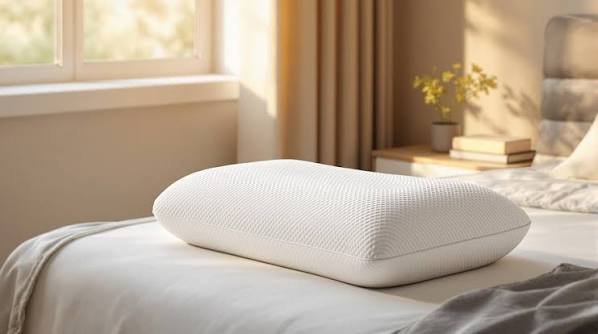
It’s worth isolating, because it’s the most common failure in the category.
A side sleeper wakes with neck pain, concludes the pillow is too hard, and buys a softer one. The softer pillow collapses further under the weight of their head, the gap goes unfilled, the neck bends more, and the pain gets worse.
A softer pillow for a side sleeper usually makes neck pressure worse, not better. What’s needed is a pillow that is both high and firm enough not to compress — one that holds the head at shoulder height all night.
If you sleep on your side and your pillow feels comfortable when you lie down but you wake up stiff, the problem is almost always loft retention, not firmness.
What goes wrong, by position
Side sleeper, loft too low: head drops toward the mattress, neck bends sideways. Shows up as morning neck and shoulder stiffness on the down side.
Side sleeper, loft too high: head pushed up, neck bends the other way. Less common but equally uncomfortable.
Back sleeper, loft too high: chin pushed toward chest, head out of neutral. Often causes upper back and neck tension, and can worsen snoring.
Back sleeper, loft too low: head tips back, neck hyperextends.
Stomach sleeper, any real loft: the neck is already rotated; adding height extends it too. This is the position most likely to cause pain, and the fix is usually a very thin pillow or none.
Mistakes worth avoiding

Buying on softness. Feel in a shop tells you almost nothing about how the pillow performs with your head on it for eight hours.
Ignoring shoulder width. For side sleepers it’s the main variable, and almost no product guidance accounts for it.
Keeping the same pillow through a mattress change. Mattress firmness changes the loft you need.
Buying down for side sleeping. It collapses. You’ll have the right loft at bedtime and the wrong one by the middle of the night.
Using two pillows to get height. It creates an unstable, angled surface rather than a consistent one. Buy one pillow at the right loft.
Keeping a pillow too long. Foam and latex last years; polyester and down compress out of usefulness much faster. If it no longer returns to shape when you fold it, it’s done.
Assuming an expensive pillow is the right pillow. A £15 pillow at the correct loft beats a £120 one at the wrong loft every night.
Frequently asked questions
What pillow loft do I need?
Side sleepers typically 4–6 inches, more if broad-shouldered. Back sleepers 3–5 inches. Stomach sleepers under 3 inches or none. Measure on your own bed rather than guessing.
Does pillow material matter more than height?
No. Research in this area consistently finds height and shape affect cervical alignment more than fill material. Material matters mainly for whether the pillow holds that height all night.
Why do I wake up with neck pain?
Most often the loft is wrong for your sleep position, or the fill collapses overnight. Side sleepers in particular often buy too soft.
What’s the best pillow for side sleepers?
High loft, firm enough not to compress. Latex, solid memory foam, or shredded foam you can adjust. Avoid down.
Should stomach sleepers use a pillow at all?
Many are better off without one, or with the thinnest soft pillow available. The position already rotates the neck; height makes it worse.
How often should I replace a pillow?
When it stops returning to shape. Latex and foam last years; polyester and down considerably less.
Do adjustable pillows work?
They’re the most forgiving option, especially for side sleepers, because required loft varies so much with shoulder width. Being able to remove fill is a genuine advantage.
The recommendation
Start by measuring, not shopping. Lie on your own bed in your usual position and work out the gap you need to fill.
Then buy high and firm if you sleep on your side — 4 to 6 inches, in latex or memory foam — medium and supportive if you sleep on your back, and thin and soft, or nothing, if you sleep on your front.
If you’re unsure of the number, buy a shredded-fill adjustable pillow and remove fill until the alignment check looks right. It’s the cheapest way to find your correct loft, and once you know it you can buy on that number for the rest of your life.
The pillow aisle is organised by softness. Your neck is not.



Leave a comment