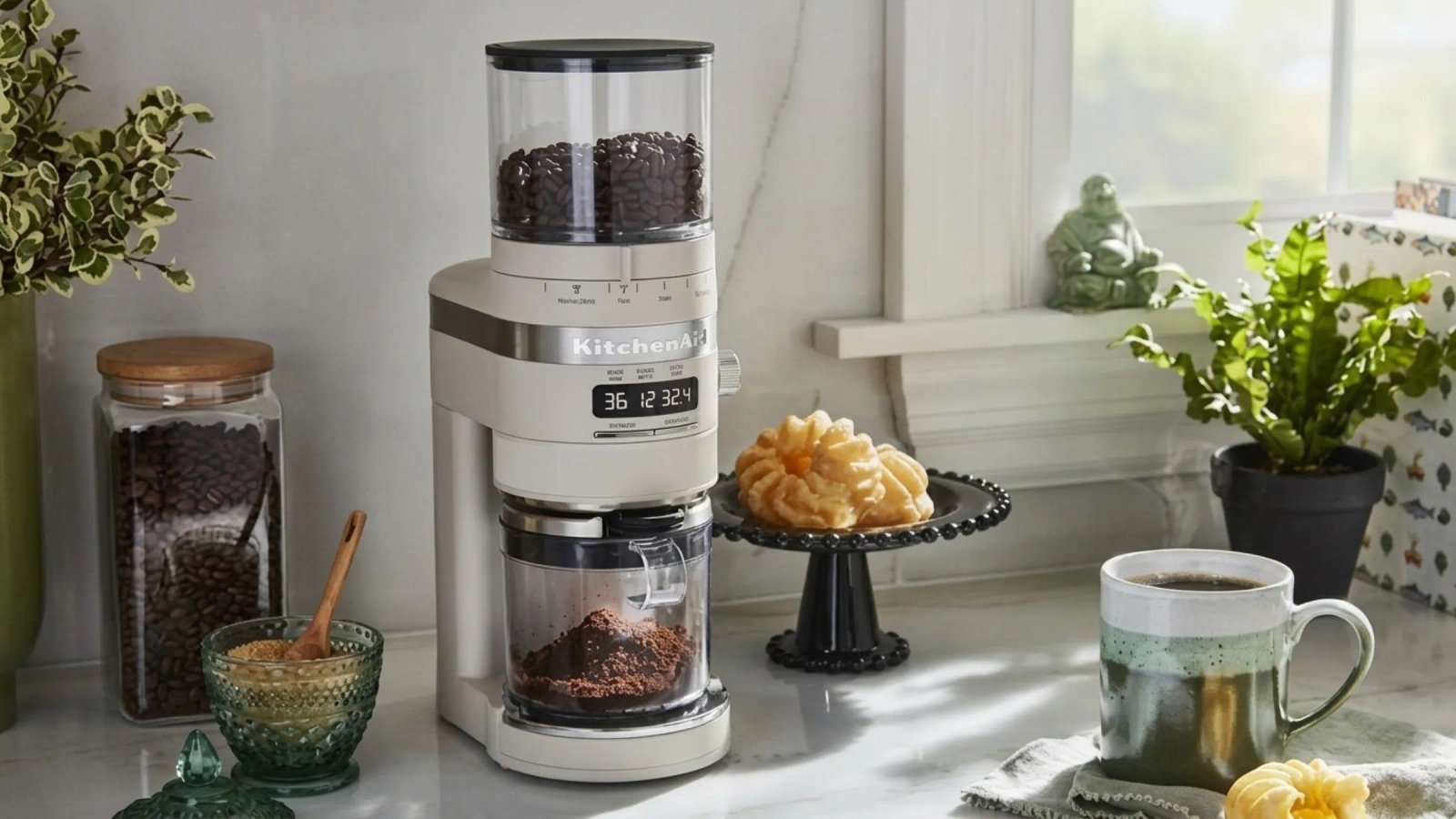
If you buy good beans and grind them in a blade grinder, you’ve wasted the money on the beans.
That sounds like enthusiast snobbery and it isn’t. A blade grinder has no grind setting at all — only a run time. It spins a blade that chops beans into progressively smaller pieces, which means at any moment you have dust, boulders and everything in between, all in the same batch.
That matters because of how coffee extracts. Fine particles give up their soluble compounds fast and over-extract into bitterness. Coarse particles under-extract and taste sour and thin. A blade grinder gives you both in the same cup, every time, and no brewing technique can separate them afterwards.
A burr grinder does something fundamentally different: it crushes beans between two surfaces set a fixed distance apart, so particles come out at a size you chose and can repeat.
Burr is the requirement, not the upgrade. Here’s what to look at once you’ve accepted that.
The short version
Buy a burr grinder. Any burr grinder beats any blade grinder, and the gap is large enough that people with no coffee experience can taste it.
Burr diameter is the under-discussed spec. 48mm and above generally grinds faster and more consistently than smaller burrs, because larger burrs need fewer rotations to do the same work.
Conical or flat matters less than burr quality and alignment. Conical runs cooler, quieter and retains less; flat gives a more uniform grind favoured for espresso and light roasts.
If your budget is tight, buy a good hand grinder rather than a cheap electric one. Premium manual grinders use genuinely good burr sets at a fraction of the price of equivalent electrics.
Burr diameter: the spec nobody publishes
This is the most useful thing to know and the hardest to find.
Larger burrs have more cutting surface, so they process beans in fewer rotations. Fewer rotations means less time, less heat, and a tighter particle distribution — the beans spend less of their journey getting knocked around and re-cut.
As a rough threshold, 48mm and above outperforms smaller burrs on both speed and consistency. Entry-level electric grinders often use burrs in the high 30s; good home grinders sit at 40–64mm; commercial machines go larger still.
Manufacturers who’ve invested in large burrs will tell you the diameter. Those who haven’t often don’t — one commercial buying guide notes bluntly that no catalogue filter publishes burr diameter and you have to request it from the spec sheet.
What to do: look for the burr diameter in the specifications. If it isn’t listed anywhere and the grinder is cheap, assume it’s small. If two grinders are similarly priced and one states a larger burr diameter, that’s a meaningful difference.
Conical or flat
Both are burr grinders. They differ in geometry and in what that geometry does to the grind.
Conical | Flat | |
Shape | Cone inside a ring | Two parallel rings |
Particle distribution | Bimodal — two size peaks | Unimodal — one tight peak |
In the cup | More body, more forgiving | More clarity and separation |
Speed | Slower | Faster |
Noise | Quieter | Louder |
Heat | Lower | Higher |
Retention | Lower | Higher |
Cost | Generally lower | Generally higher |
Conical burrs use gravity: the grounds fall through naturally. The motor runs at lower RPM, which means less noise, less heat and less static — and static is what makes grounds stick inside a grinder.
The particle distribution is bimodal, meaning two peaks in particle size rather than one. That sounds like a flaw and isn’t entirely. The mix produces more body and a more forgiving brew, which suits darker roasts and immersion methods like French press.
Flat burrs are two parallel rings grinding against each other, driven at higher RPM by a bigger motor. The output is unimodal — a tighter band of particle sizes — which produces more clarity and flavour separation. That’s why serious espresso operations and light-roast filter drinkers tend to favour them.
The costs are noise, heat, and retention. Higher RPM generates more static, and more static means more grounds clinging inside the burr chamber.
The honest conclusion, repeated across sources that have no stake in selling one or the other: burr quality and alignment matter more than shape. A well-made, well-aligned conical grinder produces better coffee than a poorly made flat one. Don’t let the shape be your primary filter.
Retention: why your first shot tastes wrong
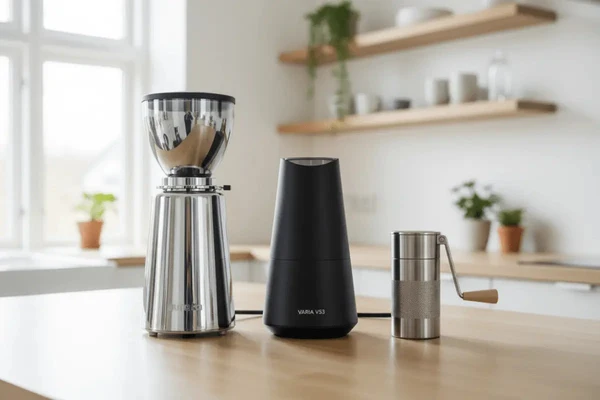
Grind retention is coffee left inside the grinder after it runs. It causes two problems.
Dosing inconsistency. You put 18 grams in and get 16.5 out, with the rest sitting in the chamber. The amount varies, so your dose varies.
Stale contamination. The grounds that come out today include some that were ground last week. Ground coffee goes stale fast, and stale grounds in a fresh dose are a real taste penalty.
Conical grinders naturally retain less than flat ones, for the gravity and static reasons above. Manufacturers address it in various ways: bellows or puffers on the hopper that you squeeze to blow residual grounds through, anti-static coatings, and single-dose designs built to be loaded one dose at a time and emptied completely — the Niche Zero being the best-known example, marketed on effectively zero retention.
How much this matters depends on how you drink coffee. If you grind the same bean every morning in the same amount, a few grams of carry-over barely registers. If you switch beans frequently, or you’re dialling in espresso where dose precision matters, retention becomes genuinely annoying.
If retention matters to you: look for single-dose designs, bellows, or conical burrs. A practical workaround on any grinder is to run a few beans through and discard when switching coffees.
Stepped or stepless adjustment
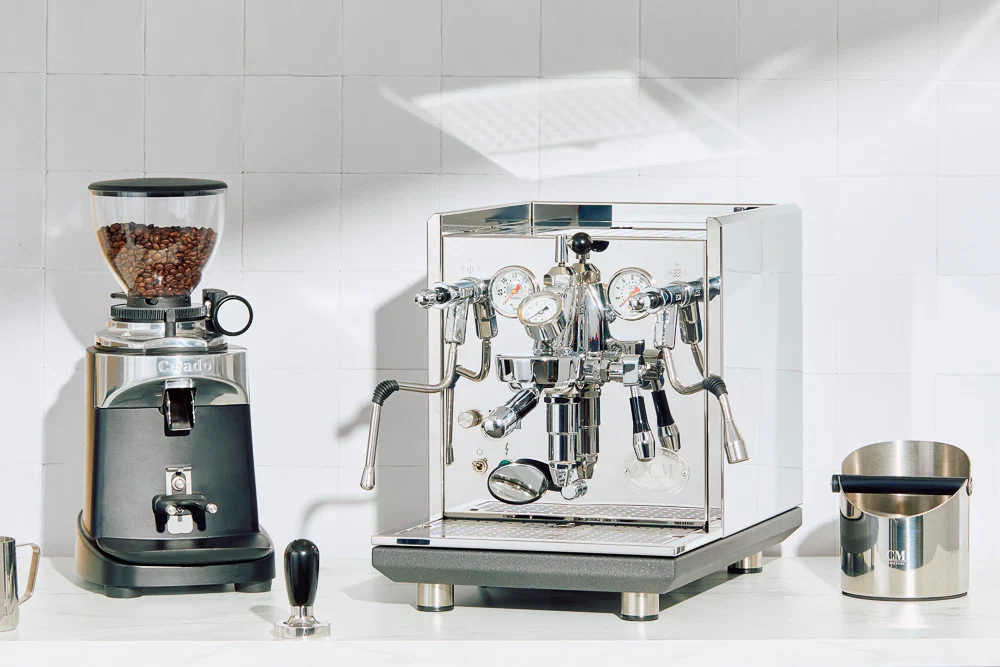
This one is decided by what you brew.
Stepped adjustment moves in fixed clicks. The advantage is repeatability — you can return to setting 14 and know what you’ll get. Around 18 settings is plenty to cover every filter brewing method comfortably.
Stepless adjustment is continuous, letting you land anywhere between what would have been two clicks. This matters for espresso, where the difference between a good shot and a choked one can be smaller than one step on a filter grinder.
The rule:
Filter only — drip, pour-over, French press, AeroPress: stepped is fine and easier to live with
Espresso — stepless, or very fine-stepped, is close to necessary
Both — stepless, with a way of marking your settings
A grinder sold for filter use often simply cannot grind fine enough for espresso, so check the range as well as the adjustment type.
Match the grinder to how you brew
Brew method | Grind | What to prioritise |
French press, cold brew | Coarse | Any decent burr grinder |
Drip, pour-over | Medium | Consistency; flat burrs if you like light roasts |
AeroPress | Medium-fine | Range and flexibility |
Espresso | Very fine | Stepless adjustment, large burrs, low retention |
Turkish | Powder-fine | Specialist grinder or hand grinder |
Espresso is the demanding case. It needs the grinder to go fine, to adjust in tiny increments, and to be consistent under the pressure of a tightly packed puck. A grinder that’s excellent for pour-over may be useless for espresso. The reverse is less often true.
If you only drink filter coffee, the problem is much easier and much cheaper. Almost any competent burr grinder will serve you well, and you don’t need to spend espresso money.
Hand grinders are seriously good value
This deserves its own section because it’s the best advice for anyone on a budget.
Premium manual grinders use genuinely high-quality burr sets — often better than those in electric grinders at twice the price — because there’s no motor, housing or electronics to pay for. The grind consistency available from a good hand grinder sits well above what a cheap electric delivers.
The trade-offs are real: it takes effort and about a minute per dose, and grinding fine enough for espresso by hand takes noticeable force.
Buy a hand grinder if: you make one or two cups at a time, your budget is under what a decent electric costs, or you want good coffee while travelling.
Buy an electric if: you make coffee for several people, you’re grinding espresso daily, or you simply won’t use something that requires effort before your first coffee of the day.
Other things worth checking
Build of the adjustment mechanism. Cheap grinders drift — the setting moves on its own as the machine vibrates. Look for a positive, firm adjustment.
Burr material. Stainless steel is standard and fine. Ceramic burrs stay sharp longer and generate less heat but are more brittle. Both work.
Hopper versus single dose. A hopper holds beans ready; the beans sitting in it go stale and it adds retention. Single-dose grinders are loaded per use, which keeps beans fresher and makes switching coffees easy.
Noise. Flat burr grinders at higher RPM are genuinely loud. If you grind early while others sleep, this matters more than the spec sheet suggests.
Cleanability. Burrs need occasional cleaning, and some grinders make burr removal straightforward while others need tools and patience.
Mistakes worth avoiding
Buying a blade grinder to save money. It can’t produce an even grind at any setting. Better beans in a blade grinder is money spent in the wrong place.
Buying a cheap electric over a good manual. At the same price, the hand grinder almost always has the better burrs.
Buying a filter grinder for espresso. Many can’t go fine enough, and stepped adjustment is too coarse for espresso dialling.
Choosing on burr shape alone. Quality and alignment matter more than conical versus flat.
Ignoring burr diameter. It’s the specification most tied to grind consistency and the one least often advertised.
Leaving beans in the hopper. They go stale. Keep beans in a sealed container and load what you need.
Never cleaning it. Coffee oils go rancid on the burrs and taint everything afterwards.
Frequently asked questions
Is a burr grinder really better than a blade grinder?
Yes, and it’s not a close call. Blade grinders chop randomly and produce dust and boulders simultaneously, which extract at different rates. Burr grinders crush to a set size you can repeat.
Conical or flat burrs — which is better?
Neither universally. Flat gives a more uniform grind and more clarity; conical runs cooler, quieter and retains less. Burr quality and alignment matter more than shape.
What burr size should I look for?
48mm or larger generally grinds faster and more consistently. Smaller burrs need more rotations, which adds heat and widens particle distribution.
Do I need stepless adjustment?
For espresso, effectively yes. For filter brewing, stepped adjustment with a reasonable number of settings is fine and easier to use.
What is grind retention and does it matter?
Coffee left inside the grinder after use. It causes inconsistent dosing and mixes stale grounds into fresh ones. It matters most if you switch beans often or make espresso.
Are hand grinders good enough?
Good ones are excellent — often with better burrs than electrics at the same price. The cost is effort and time per dose.
How often should I clean my grinder?
Brush out the burrs regularly and do a deeper clean every few weeks. Coffee oils go rancid and affect taste.
The recommendation
If you drink filter coffee, buy a burr grinder with the largest burrs you can find in your budget and stepped adjustment. Conical is fine and usually cheaper. This is a solved problem and doesn’t need to be expensive.
If you drink espresso, buy stepless adjustment, burrs of 48mm or larger, and give real weight to retention — single-dose designs or bellows. This is where the money goes.
If the budget is tight, buy a good hand grinder. You’ll get better grind quality than any cheap electric, and you can upgrade later without having wasted the money.
Whatever you do, don’t put good beans through a blade grinder. The grinder determines more about what’s in the cup than the beans do.


Leave a comment