Almost every argument about kitchen knives — German versus Japanese, heavy versus light, which brand is best — collapses into two numbers that most listings don’t put front and centre.
Rockwell hardness (HRC), which is how hard the steel is. And edge angle, which is how acutely it’s ground.
Those two figures determine how sharp the knife gets, how long it stays sharp, how easily it chips, and — the one nobody thinks about until it’s too late — whether you can sharpen it yourself at home or have to send it away.
Everything else is handle comfort and preference.
The short version
Hardness is a trade-off, not a quality ranking. Harder steel holds a sharper edge longer and chips more easily. Softer steel dulls faster and survives abuse. For most home cooks, 56–60 HRC is the useful range.
A thinner edge angle cuts better and breaks more easily. Around 20° per side is the Western standard; around 15° is Japanese.
If you won’t learn to sharpen, buy softer steel. A hard Japanese blade that chips usually needs professional grinding.
And don’t buy a set. One good chef’s knife, a paring knife and a bread knife covers almost everything. Sets pad the box with specialty knives you’ll never use.
Hardness, and what the number means
Rockwell C hardness measures how hard the steel is. Higher numbers mean harder steel, and hardness drives two opposing properties at once.
Harder steel holds an edge longer and can be ground to a finer angle without rolling over. That’s why hard blades cut so cleanly.
Harder steel is also more brittle. Where a softer blade would bend or roll on impact, a hard one chips. One bad angle into a chicken bone, a frozen edge, or a ceramic plate, and you have a visible nick.
HRC | Behaviour |
Below 56 | Dulls quickly, needs constant honing |
56–58 | Typical German range — easy to sharpen by hand, forgiving |
58–60 | The sweet spot for most home cooks |
60–63 | Typical Japanese range — excellent retention, chips more readily |
Above 63 | Specialist steels, demanding handling, professional sharpening |
The practical window for everyday kitchen work is 56 to 60 HRC. Below that you’re sharpening constantly; above it you’re being careful constantly.
The ownership consequence people miss: German steel in the 56–58 range is soft enough to sharpen by hand on a stone or a pull-through without much skill. Japanese steel at 60+ rewards whetstone technique, and a chipped hard blade generally needs professional grinding to repair.
So the honest question isn’t “which steel is better.” It’s “am I going to learn to sharpen?” If the answer is no, buy softer.
Edge angle
The second number is how acutely the edge is ground, measured per side.
Around 20° per side is the traditional Western standard. Thicker, more supported, more durable. It handles rocking cuts and the occasional bone without complaint.
Around 15° per side is the Japanese standard, and some go to 10–12°. Much less material behind the edge, so the blade meets less resistance and slices more cleanly — and there’s less steel supporting the edge when it meets something hard.
A thinner angle genuinely cuts better. It also means a knife you have to treat with more respect.
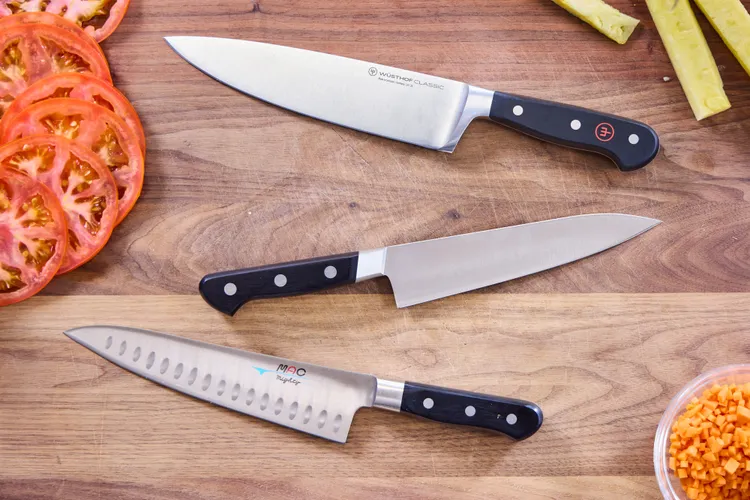
One caveat worth knowing: the German/Japanese distinction has blurred considerably. Several German manufacturers now grind to 15°, having adopted the thinner geometry while keeping their softer steel. So check the stated edge angle rather than assuming it from the country of origin.
German or Japanese, in practice
German | Japanese | |
Hardness | ~55–58 HRC | ~60–63 HRC |
Edge angle | ~20° per side | ~15° or less |
Blade profile | Curved belly | Straighter |
Cutting style | Rocking | Push-cutting, up-and-down |
Weight | Heavier | Lighter |
Edge retention | Shorter | Longer |
Chip resistance | Better | Worse |
Home sharpening | Straightforward | Needs skill |
Tang | Usually full | Often partial |
German knives are thicker, heavier and more forgiving. The curved belly suits a rocking chop — the blade stays in contact with the board while the handle pivots. They’re built to take abuse, and the softer steel means a dull edge is a ten-minute problem rather than a trip to a specialist.
Japanese knives are thinner, lighter and sharper. The straighter profile suits push-cutting, where the blade moves forward and down rather than rocking. They cut with noticeably less resistance, which is most obvious on delicate work — fish, herbs, thin vegetable slices.
Which to buy:
Rocking chopper, cooks a lot of meat, won’t sharpen often → German
Precise slicer, mostly vegetables and fish, willing to learn a whetstone → Japanese
Unsure → a German-made knife with a 15° edge, which is increasingly common and splits the difference sensibly
The full tang myth
The tang is the part of the blade extending into the handle. A full tang runs the entire handle length; a partial tang stops short.
Conventional wisdom says full tang equals quality. That hasn’t been true for a long time, particularly with Japanese knives, many of which are excellent and partial-tang by design.
What a full tang actually gives you is weight and balance toward the handle, and robustness. What a partial tang gives you is a lighter, more nimble knife with weight shifted forward into the blade.
They’re different design choices, not quality tiers. A partial-tang Japanese knife is not a cheap knife — it’s a knife designed to be light.
Where tang does still signal something is at the very bottom of the market, where a short stub tang in a moulded plastic handle is a cost-cutting measure. But that’s a general cheapness signal, not a reason to rule out partial tangs.
The steels you’ll see named
X50CrMoV15 — the German workhorse stainless, used by most Solingen manufacturers. Corrosion resistant, tough, around 56–58 HRC, easy to sharpen.
1.4116 — another German high-carbon stainless alloy with similar properties.
VG-10 — the most common Japanese premium stainless, around 60–61 HRC. Usually used as a core clad in softer stainless layers, which gives you a hard cutting edge with a more forgiving body.
SG2 / SPG2, Aogami Super, SLD — harder Japanese steels with longer edge retention and more demanding handling.
On Damascus: those rippling patterns are layers of softer steel clad around a harder core. The pattern is decorative — what cuts is the core steel, so check what that core is. A Damascus knife with an unnamed core is selling you the pattern.
Carbon steel (non-stainless) takes and holds a superb edge and will rust if you look at it wrongly. It needs drying immediately after every use and develops a patina. Worth it for people who enjoy maintaining tools; a mistake for everyone else.
What actually makes a knife good to use
Once hardness and angle are settled, the rest is ergonomics, and it can’t be assessed from a spec sheet.
Handle fit matters more than almost anything. A knife you don’t enjoy holding is a knife you won’t use. If you can hold one before buying, do.
Balance. The traditional test is whether the knife balances near the bolster — but what matters is whether it feels right to you. Blade-forward balance suits chopping; handle-heavy suits control.
Length. Eight inches is the default and suits most people. Six inches is easier for smaller hands and smaller boards. Ten inches is faster for bulk prep and intimidating for beginners.
Bolster. The thick junction between blade and handle. A full bolster adds weight and protects your fingers — and it blocks the heel of the blade when you sharpen, meaning you can never get the full edge on a stone. Half-bolster or no-bolster designs are easier to maintain.
Weight. Heavier knives do more of the work through momentum; lighter knives give more control. Neither is correct.
Don’t buy the set
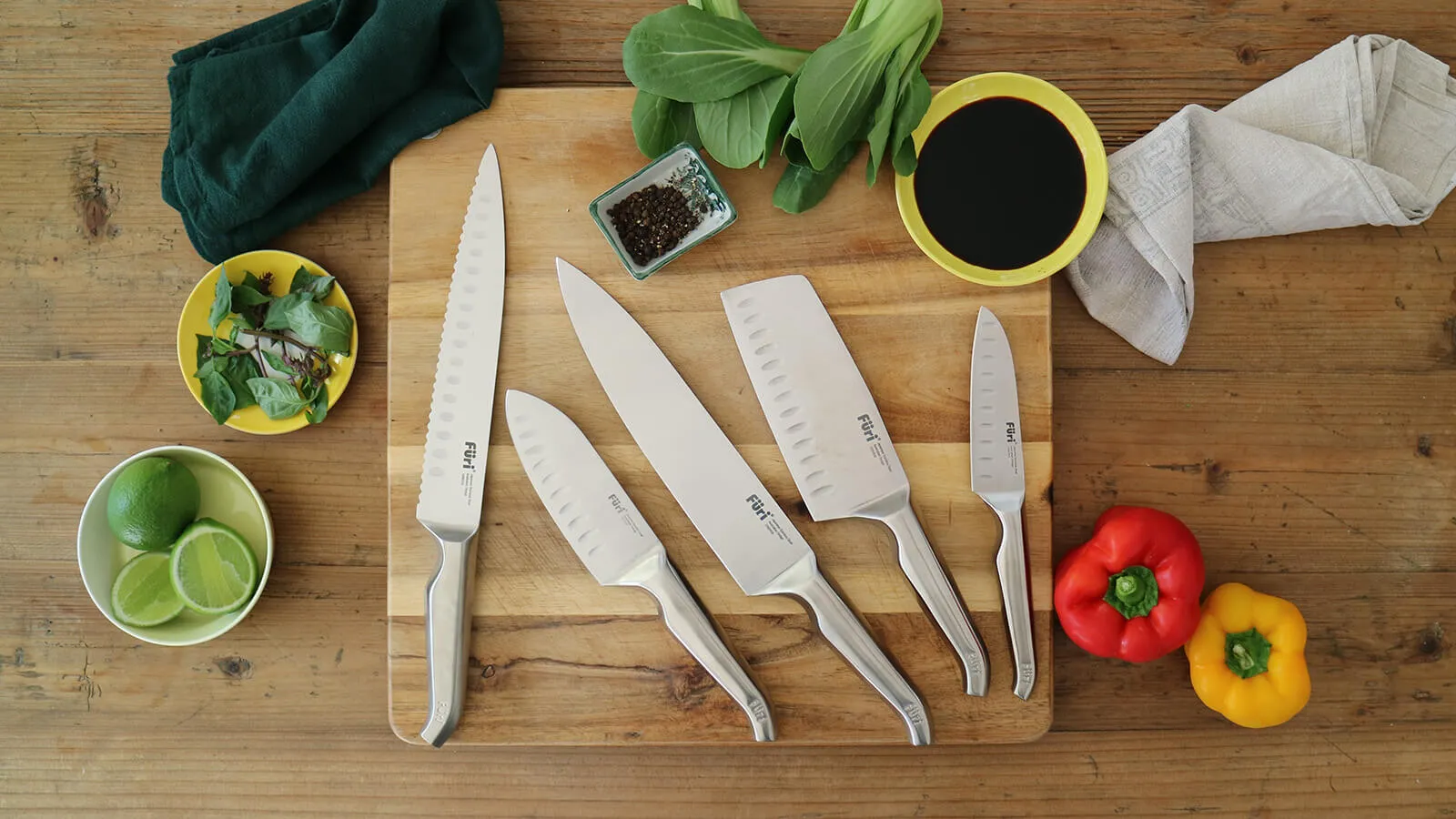
Knife blocks are sold on apparent value — fifteen pieces for the price of three. What’s actually in the box is a chef’s knife, a paring knife, a bread knife, a block, and eight or nine items you will use once.
The budget you’d spend on a set buys one genuinely good chef’s knife, and the chef’s knife does the overwhelming majority of kitchen work.
What you actually need:
An 8-inch chef’s knife — 90% of everything
A paring knife — small, cheap, replaceable
A serrated bread knife — nothing else cuts bread, and it doesn’t need to be expensive
That’s it. Add a boning knife or a santoku later if you find yourself wanting one.
Looking after it
Hand wash and dry immediately. Dishwashers are hard on edges and handles, and the detergent is corrosive even to stainless steel.
Hone regularly, sharpen occasionally. A honing steel realigns an edge that’s rolled over; it doesn’t remove metal. Sharpening removes metal and restores an edge that’s genuinely dull. Honing every few uses keeps a knife sharp far longer between sharpenings.
Use a wood or plastic board. Glass, stone and ceramic boards destroy edges, and they do it fast.
Never cut frozen food or bones with a thin Japanese blade. That’s what a cleaver or a heavier Western knife is for.
Store it protected. Loose in a drawer, blades knock against other metal. A block, a magnetic strip or an edge guard all work.
Mistakes worth avoiding
Buying the hardest steel available. Above about 62 HRC you’re buying fragility along with retention, and repairs become a professional job.
Buying a set. Pad and filler. One good knife beats fifteen mediocre ones.
Assuming full tang means better. It means heavier. Many excellent Japanese knives are partial tang by design.
Buying Japanese if you won’t sharpen. Hard steel holds an edge longer, but when it goes, it’s harder to bring back at home.
Judging Damascus by the pattern. The pattern is cladding. Find out what the core steel is.
Using a glass cutting board. It will ruin any knife, at any price.
Putting it in the dishwasher. The single most common way good knives get wrecked.
Frequently asked questions
What HRC should a chef’s knife be?
56–60 for most home cooks. Below 56 dulls quickly; above 62 chips more easily and needs professional sharpening.
Are Japanese knives better than German?
Neither is better. Japanese knives are sharper and hold their edge longer; German knives are tougher and far easier to sharpen at home. Choose by how you cook and whether you’ll maintain it.
What edge angle is best?
Around 20° per side for durability and rocking cuts, around 15° for cleaner slicing. Many German manufacturers now grind to 15°, so check the stated angle rather than assuming.
Does a knife need a full tang?
No. Full tang adds weight and robustness; partial tang makes a lighter, more agile knife. It’s a design choice, not a quality marker.
Is Damascus steel better?
The pattern is decorative cladding. What matters is the core steel underneath.
Should I buy a knife set?
Generally no. One good chef’s knife, a paring knife and a bread knife cover nearly everything. Sets spend your budget on knives you won’t use.
How often should I sharpen?
Hone every few uses to realign the edge; sharpen properly when honing stops restoring it — typically a few times a year for home use.
The recommendation
Buy one 8-inch chef’s knife in the 56–60 HRC range with an edge angle you’ve actually checked, and hold it before buying if you possibly can.
If you’re not going to learn to sharpen, go for the softer end — a German knife at 56–58 HRC with a 15° edge gives you most of the cutting performance and all of the forgiveness.
If you enjoy maintaining tools and cut mostly vegetables and fish, go Japanese at 60–61 HRC and buy a whetstone at the same time.
Then add a cheap paring knife and a serrated bread knife, skip the block, hand wash everything, and stay off glass boards. A £90 knife looked after properly outperforms a £300 knife that lives in the dishwasher.

Leave a comment