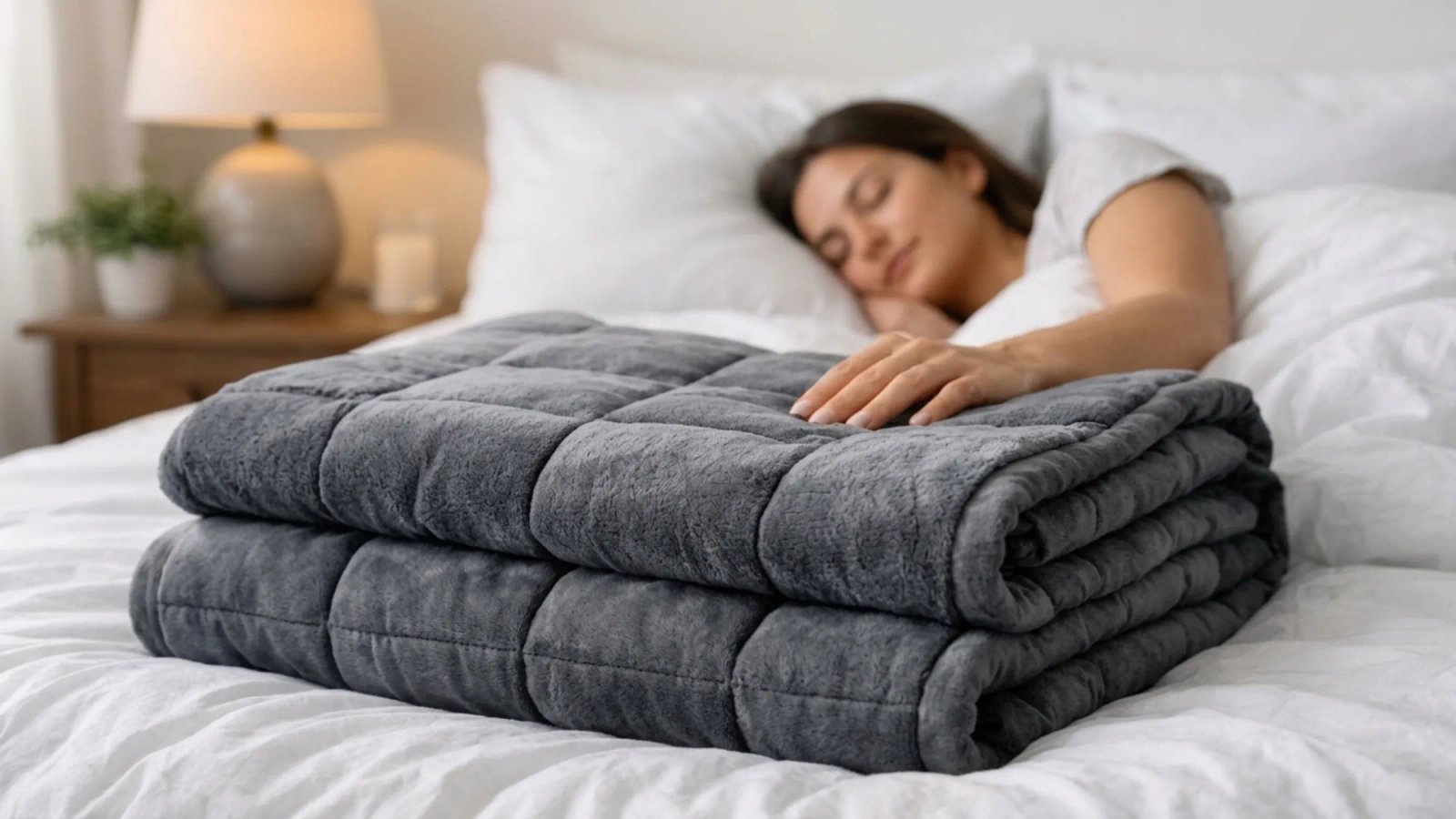
Weighted blankets are sold on sleep. The marketing promises deeper rest, faster sleep onset, relief from insomnia and anxiety.
The research is more cautious than that. Systematic reviews have found insufficient evidence that weighted blankets help with insomnia, and researchers note that investigating them has been hampered by inconsistent study design. In at least one study, participants enjoyed using the blankets and found them comfortable — but they didn’t fall asleep faster or stay asleep longer.
That doesn’t mean they’re worthless. Plenty of people find the deep pressure genuinely calming, and comfort is a real reason to buy something. But it’s worth going in understanding that you’re buying a comfort product with an uncertain evidence base, not a treatment.
With that framing, here’s how to choose one that actually works for you, and the safety limits that matter — particularly with children.
The short version
Weight: about 10% of your body weight. If you’re between sizes, go lighter.
Fill: glass microbeads. They’re smaller, denser, quieter and distribute more evenly than plastic pellets, and they make a thinner, cooler blanket.
Size: match it to your body, not your bed. A weighted blanket that overhangs the mattress slides off during the night.
Fabric: this is where most disappointment comes from. These blankets run hot. If you sleep warm, buy cotton, bamboo viscose or Tencel, not polyester minky.
Children: different rules entirely — see below. Never with infants or toddlers.
The 10% rule, and when to deviate
The industry standard is to choose a blanket weighing roughly 10% of your body weight. It’s the figure essentially every manufacturer uses, and reported satisfaction with it is high — the commonly cited figure is that around 97% of people find 10% about right.
Body weight | Blanket weight |
100–130 lb | 10–13 lb |
130–160 lb | 13–16 lb |
160–190 lb | 16–19 lb |
190–220 lb | 19–22 lb |
220 lb+ | 22 lb+ |
Most adult blankets sit between 12 and 20 lb.
The practical range people actually find comfortable is 5% to 12% of body weight, which gives you room to adjust. Two rules for deciding where in that range to sit:
If you’re between two available weights, buy the lighter one. This is near-universal advice from retailers and users alike, and the logic is straightforward — a blanket that’s slightly too light is pleasant and a blanket that’s too heavy is unusable. Returns in this category are overwhelmingly driven by people buying too heavy.
If you’re claustrophobic, buy lighter still. The sensation is enveloping by design. Some people find that calming and others find it trapping, and you won’t know which until you try.
Expect an adjustment period. Users commonly report taking several nights to get used to the weight. Don’t judge it on night one.
Sharing a bed
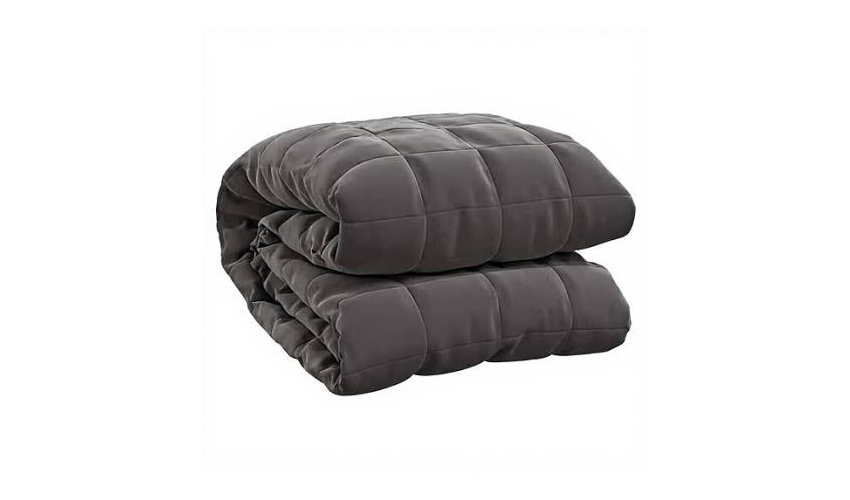
Weighted blankets don’t work well for couples. The weight is calibrated to one body, two people have different correct weights, and the mass makes the blanket hard to move — one person turning over drags it off the other.
Two separate blankets at individually correct weights works. One large shared blanket generally doesn’t.
The fill matters more than you’d expect
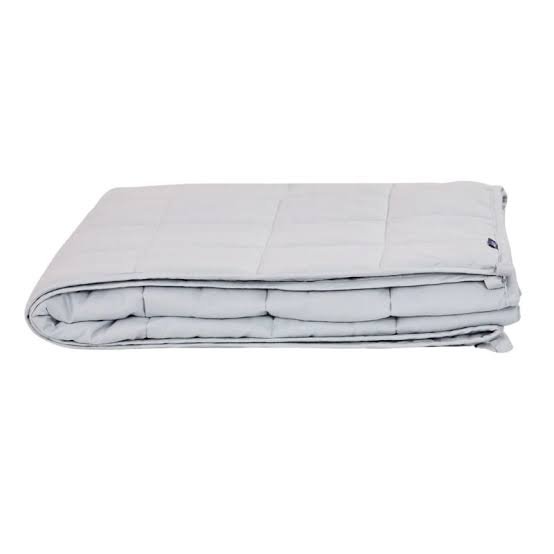
The weight comes from material sealed into small stitched compartments across the blanket. The compartments stop the fill migrating to the corners, and smaller compartments mean more even distribution — worth checking in the product photos.
Fill | Feel | Noise | Heat | Cost |
Glass microbeads | Smooth, drapes closely | Near-silent | Coolest | Moderate |
Plastic poly pellets | Chunky, lumpier | Audible shifting | Warmest | Cheapest |
Steel shot | Thinnest blanket | Noisier | Cold initially | Higher |
Sand, flaxseed, buckwheat | Uneven | Varies | Varies | Low |
Glass microbeads are what most well-reviewed blankets use, and buyer feedback consistently favours them. They’re roughly the size of fine sand, which means they pack densely, conform to the body, and move almost silently. Because they’re dense, the blanket needs less bulk to hit its weight — which makes it thinner and noticeably cooler to sleep under.
Plastic poly pellets were the original fill and remain the budget option. They’re substantially larger than glass beads, so the blanket feels chunkier and less evenly distributed, and they’re audible when the blanket shifts. They also add bulk, which traps heat.
Steel shot is denser still and produces the thinnest possible blanket, but it can feel cold on first contact and tends to be noisier than glass.
Natural fills — sand, flaxseed, buckwheat — distribute poorly, can’t survive washing, and may attract pests. Avoid them.
The recommendation is straightforward: buy glass beads unless budget is the binding constraint.
Heat is the main reason people stop using them
This is the complaint that doesn’t appear in the marketing and appears constantly in reviews. A weighted blanket is a dense object lying directly on you, and density traps heat. People who sleep warm frequently buy one, use it for a week, and retire it.
Two things determine whether you’ll have this problem.
Fill density. Glass beads require less bulk for the same weight, which means a thinner blanket and better airflow. Poly pellets make a thicker blanket that sleeps hotter.
Shell fabric. This is the bigger variable.
Cotton — breathable, the safe default
Bamboo viscose or Tencel — the coolest options, with good moisture handling
Polyester microfiber — warm
Minky or fleece — warmest by a distance
Minky is popular because it feels lovely in the shop and photographs well. If you run hot at all, it’s the wrong choice. Buy bamboo or Tencel instead and accept that it feels less plush to the hand.
In summer, many people switch to a lighter blanket or stop using one. That’s normal rather than a sign you bought wrong.
Size: match the body, not the bed
This is the most commonly misunderstood part, and it runs counter to how people buy ordinary bedding.
A weighted blanket should roughly cover your body — not extend over the edges of the mattress. If it hangs over the sides, gravity pulls the overhanging weight downward, and the blanket slides off you during the night. You wake up with it on the floor.
So a single person on a king bed buys a blanket sized to them, not to the bed. Common sizes:
Throw (roughly 40×60") — sofa use, children, smaller adults
Twin (roughly 48×72") — most single adults
Queen/King — only when two people are sharing, which, as above, usually doesn’t work well
If you want your bed to look made, buy a normal duvet or coverlet for appearance and use the weighted blanket underneath or on top of yourself.
Children: different rules
This is where the guidance tightens considerably, because the risk is specific: a blanket too heavy for a child to push off independently is a hazard.
Researchers have explicitly cautioned that safety studies conducted on healthy adults cannot be generalised to children, and are even less applicable to children with disabilities.
The guidance that retailers and clinicians converge on:
Not for infants or toddlers. Guidance generally puts the minimum at age three, and some sources say two at the absolute earliest.
Minimum weight of roughly 40–50 lb for the child before a weighted blanket is appropriate at all.
Never exceed 10% of the child’s body weight, and round down rather than up. Starting a pound under the 10% figure and working up is the sensible approach.
The child must be able to remove it themselves, easily, without help.
Never unsupervised, particularly at first.
Never over the head or face.
Buy a child-sized blanket, not a folded adult throw. A folded adult blanket concentrates weight unpredictably.
Speak to your child’s doctor or occupational therapist first, especially if the child has a developmental condition, a respiratory condition, or limited mobility. This is the situation where the gap between adult evidence and child safety is widest.
Who should check with a doctor first
Weighted blankets apply sustained pressure to the chest and body. That’s fine for most people and not for everyone. Check with a healthcare professional before using one if you have:
Respiratory conditions, including sleep apnoea or asthma
Circulatory problems
Limited mobility or difficulty moving the blanket off yourself
Claustrophobia
Any condition affecting your ability to regulate temperature
This isn’t a reason not to buy one. It’s a reason to ask first.
Washing it
Most weighted blankets are heavy enough to strain a domestic washing machine. A 20 lb blanket becomes considerably heavier wet, and many manufacturers specify a commercial machine or hand washing.
The practical solution is a removable duvet-style cover. Wash the cover weekly as you would any bedding, and spot-clean or occasionally launder the weighted insert. Buying a blanket with a removable cover is worth prioritising for this reason alone.
Check before you buy — some blankets are a single sealed unit with no cover option, which makes routine cleaning genuinely awkward.
Mistakes worth avoiding
Buying too heavy. The most common error. If you’re between weights, go lighter.
Buying a queen or king size for one person. It’ll slide off the bed every night.
Buying minky or fleece if you sleep warm. You’ll stop using it within a fortnight.
Buying poly pellets to save money. Lumpier, noisier and hotter. The upgrade to glass beads is one of the better value decisions in this category.
Expecting it to cure insomnia. The evidence doesn’t support that claim. Buy it because the pressure feels good, not because you’ve been told it will fix your sleep.
Using one with a child under three, or under about 40 lb. The core safety rule.
Buying one without a removable cover. Washing a 20 lb blanket is a chore you’ll avoid.
Judging it on the first night. Most people need several nights to adjust to the weight.
Frequently asked questions
How heavy should a weighted blanket be?
About 10% of your body weight. The comfortable range runs from roughly 5% to 12%, and if you’re between available sizes, choose the lighter one.
Do weighted blankets actually help you sleep?
The evidence is weaker than the marketing suggests. Systematic reviews have found insufficient evidence for insomnia, and at least one study found participants enjoyed them without sleeping better. Many people find them comforting, which is a legitimate reason to buy one.
Glass beads or plastic pellets?
Glass beads. Smaller, denser, quieter, better distributed, and they make a thinner blanket that sleeps cooler.
What size weighted blanket should I get?
One sized to your body, not your bed. A blanket that overhangs the mattress slides off during the night.
Are weighted blankets safe for children?
Only with care. Guidance generally sets a minimum of age three and around 40–50 lb, never more than 10% of body weight, never unsupervised, and the child must be able to remove it themselves. Check with their doctor first.
Do weighted blankets make you hot?
They can, significantly. Glass bead fill in a bamboo, Tencel or cotton shell is the coolest combination. Avoid minky and fleece if you run warm.
Can two people share one?
Not well. The correct weight differs per person, and the mass makes it hard to move without dragging it off the other sleeper. Two separate blankets work better.
The recommendation
Buy a blanket at 10% of your body weight, rounding down if you’re between sizes, with glass microbead fill and a bamboo, Tencel or cotton shell with a removable washable cover. Size it to your body rather than your bed.
Give it a week before deciding whether you like it.
And buy it for the reason the evidence actually supports: a lot of people find deep, even pressure comforting. That’s enough justification for a blanket. It just isn’t the same thing as a sleep treatment, and the honest version of this purchase is knowing the difference.

Leave a comment