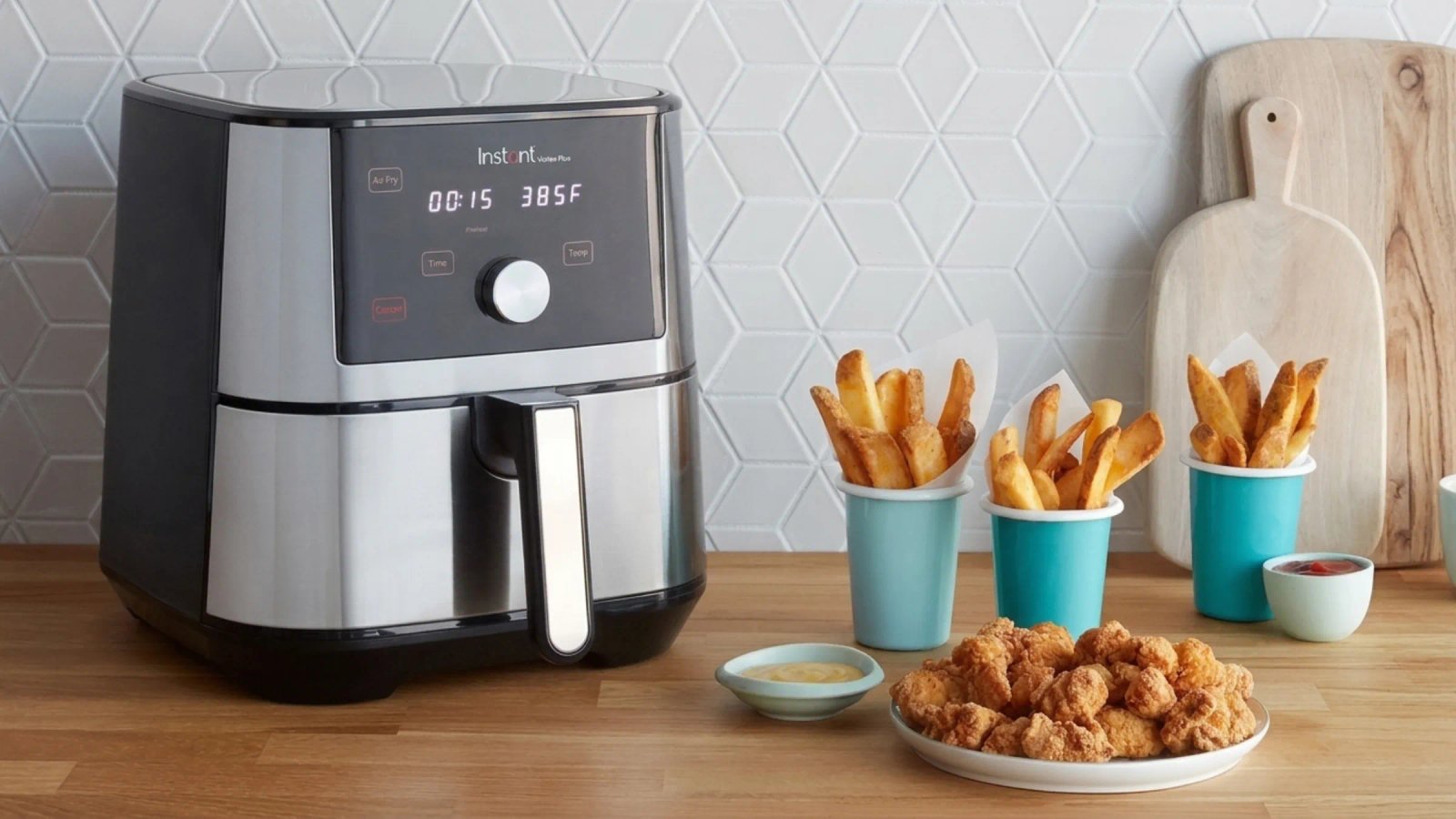
A 5-quart air fryer sounds like a lot of food. One widely sold model with that rating has a basket nine inches across — less usable cooking surface than a 10-inch frying pan.
That gap is the single biggest source of disappointment in the category, and it exists because the advertised figure measures the wrong thing. Quart ratings describe total basket volume, including all the empty air above the food. But an air fryer only works when food sits in a single layer, so the moving air can reach every surface. Stack it and you get soggy food with crisp patches.
So the number that actually determines how much you can cook is the basket’s floor area — a measurement almost nobody publishes.
Here’s how to read around that, plus the format decision that matters more than capacity, and what these appliances actually are.
The short version
Buy basket style, not oven style. Independent testing has been consistent on this: drawer-style baskets produce better, crisper results and cook faster, while oven-style models take up more counter space without fitting meaningfully more food.
Judge capacity by basket dimensions, not quarts. Look for the basket’s width and depth in the specifications or Q&A. Wide and shallow beats tall and narrow at the same advertised volume.
6 quarts in a basket model feeds about four people. Four quarts suits one or two, with batches for more.
And know what you’re buying: an air fryer is a small, fast convection oven. If you already have a good convection oven, the case for a second appliance is weaker than the marketing suggests.
What an air fryer actually is
Consumer Reports describes it plainly: it’s essentially a countertop convection oven. Hot air circulates rapidly around food suspended in a perforated basket.
The design difference from a conventional convection oven is placement. A regular convection oven has its heating element at the bottom, away from the fan. An air fryer puts the element directly behind the fan, so air is heated and immediately driven across the food at speed.
That, plus the small cavity, is where the performance comes from. A small chamber reaches temperature in a couple of minutes where a full-size oven takes fifteen, and the concentrated airflow crisps surfaces faster.
Two implications worth taking seriously:
It is not a fryer, and it is not oil-free. Air fryer recipes typically call for food tossed with a small amount of oil rather than submerged. It’s a low-oil cooking method — a genuine improvement over deep frying — not a no-oil one.
And if you already own a convection oven or a convection toaster oven, you own something that works on the same principle. The air fryer will still be faster to preheat and easier to clean, but it’s a convenience upgrade rather than a new capability.
The capacity problem, properly
Advertised capacity is basket volume. Usable capacity is basket floor area. These diverge considerably.
Why single-layer matters: circulating air has to reach every surface of every piece. Food piled two deep shields the pieces underneath, which steam rather than crisp. Every manufacturer’s instructions say not to overfill the basket, and every honest review says the same thing. So the real limit is how much food you can lay out in one layer — a function of area, not volume.
What this means in practice:
A wide, shallow basket outperforms a tall, narrow one of the same advertised quarts, because it offers more floor area.
A “10-quart” dual-basket model is not one 10-quart chamber. It’s two roughly five-quart chambers. Useful for cooking two things at once, not for cooking one large batch.
“XL” describes the basket class, not the footprint. An XL basket fryer still takes real counter space.
How to find the number that matters: basket dimensions sometimes appear in the full specification list, often in the customer Q&A, and occasionally in review photos with something for scale. If you can find width and depth, you can picture the actual cooking surface. If you can only find quarts, assume it’s smaller than it sounds.
Rough sizing by household, basket style:
Capacity | Realistically feeds |
2 quarts | One person, single portions |
4 quarts | One to two people; batches for more |
6 quarts | About four people |
8–10 quarts | Four-plus, or two-basket cooking |
Basket versus oven style
This is the decision that matters most, and the testing evidence points firmly one way.
America’s Test Kitchen found that regardless of size or capacity, the best results came from drawer-style baskets. Their assessment of oven-style models was blunt: all of the ones tested were difficult to use and produced lacklustre results, with bigger footprints that couldn’t actually fit much more food.
Independent appliance testing has found the same pattern. Oven-style models struggle to produce genuinely crisp food, while basket-style models cook faster and crisp better — even when the oven-style unit has more cooking surface area on paper. Side-by-side cooking of wings, fries and Brussels sprouts shows a visible difference in both speed and crispness.
Basket style | Oven style | |
Crisping | Better | Noticeably weaker |
Speed | Faster | Slower |
Preheat | ~2 minutes | ~10 minutes |
Layers | One | Two to three racks |
Counter footprint | Smaller | Substantially larger |
Cleaning | Easy — basket lifts out | More awkward |
Other functions | Limited | Toast, bake, broil, dehydrate |
To put the footprint difference in concrete terms: a typical 5.8-quart basket fryer occupies roughly 170 square inches of counter. A 26-quart oven model takes around 275 square inches, and a 30-quart around 375 — more than double.
When oven style still makes sense
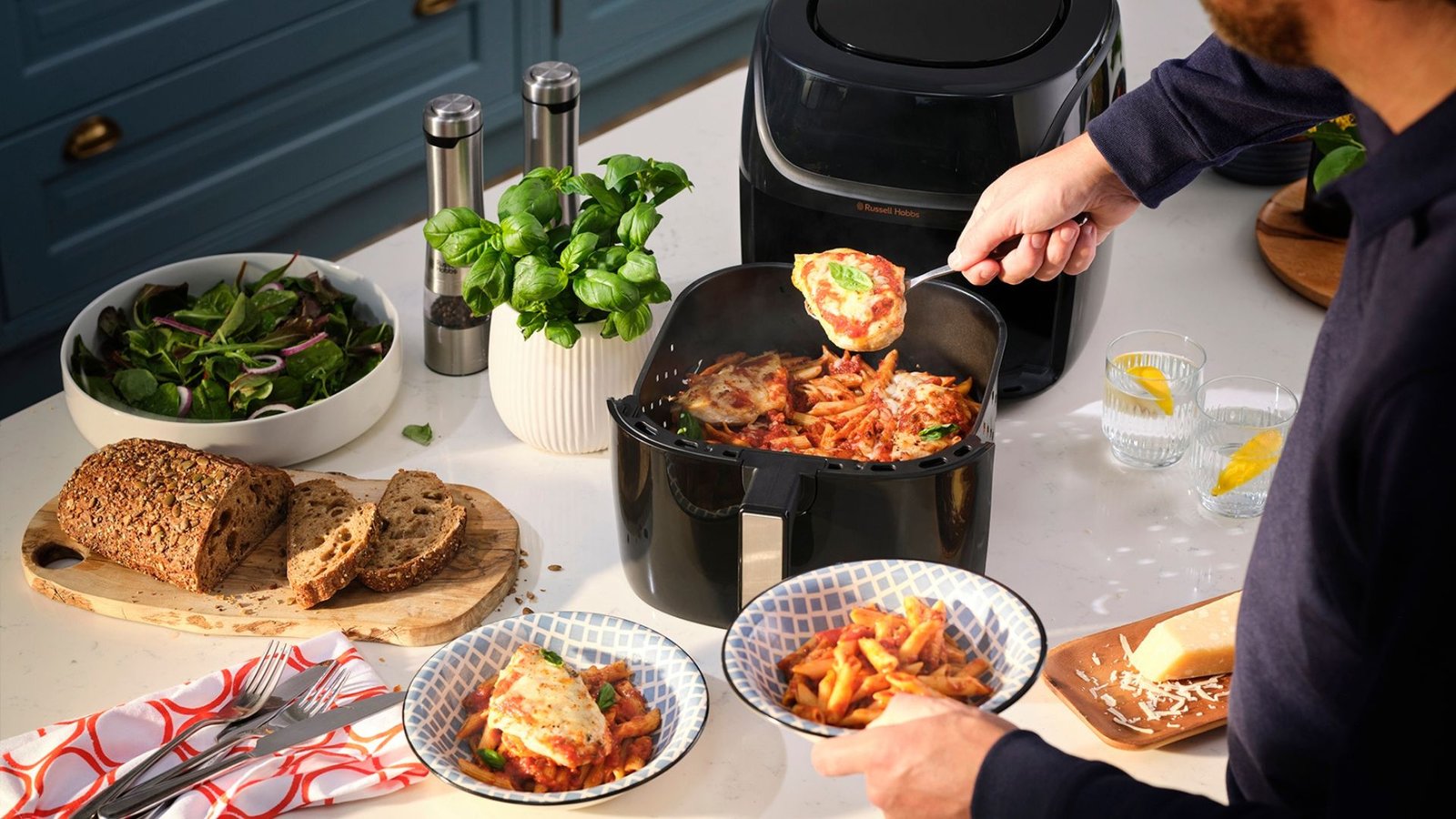
There’s one honest case for it: if it replaces appliances you already have. An air fryer oven can serve as your toaster, your small bake oven and your air fryer in one unit. If it lets you remove a toaster and a toaster oven from the counter, the footprint comparison looks very different.
If it’s going to sit alongside everything you already own, buy a basket.
What to check before buying
Basket dimensions, as covered above. The most important and least published figure.
Preheat time. Two minutes versus ten changes whether you use the thing on a weeknight. Basket models win here by a wide margin.
Dishwasher-safe basket and crisper plate. The crisper plate — the perforated insert — is the fiddliest part to clean by hand, and baked-on residue in the perforations is genuinely unpleasant. Check both parts are dishwasher-safe, not just the basket.
Nonstick coating. Air fryer baskets are nonstick, and that coating wears. Avoid metal utensils, don’t use aerosol cooking sprays — the propellant residue degrades nonstick coatings — and expect the basket to be the component that eventually needs replacing. Check whether replacement baskets are available.
Clearance requirements. These appliances exhaust hot air, and the manual will specify clearance at the back and sides. Measure your counter and the space under your cabinets — many air fryers are too tall to sit under a standard wall cabinet with their lid open or with required overhead clearance.
Noise. Most run at roughly microwave volume. Not loud, but not silent, and they run for the whole cook rather than a couple of minutes.
Temperature range. Look for something that goes down to around 120°F if you want dehydrating, and up to 400°F or more for proper crisping.
Window or no window. A viewing window is a convenience, not a guarantee of even cooking. Dense or overlapping food still needs shaking partway through regardless.
What it does well and badly
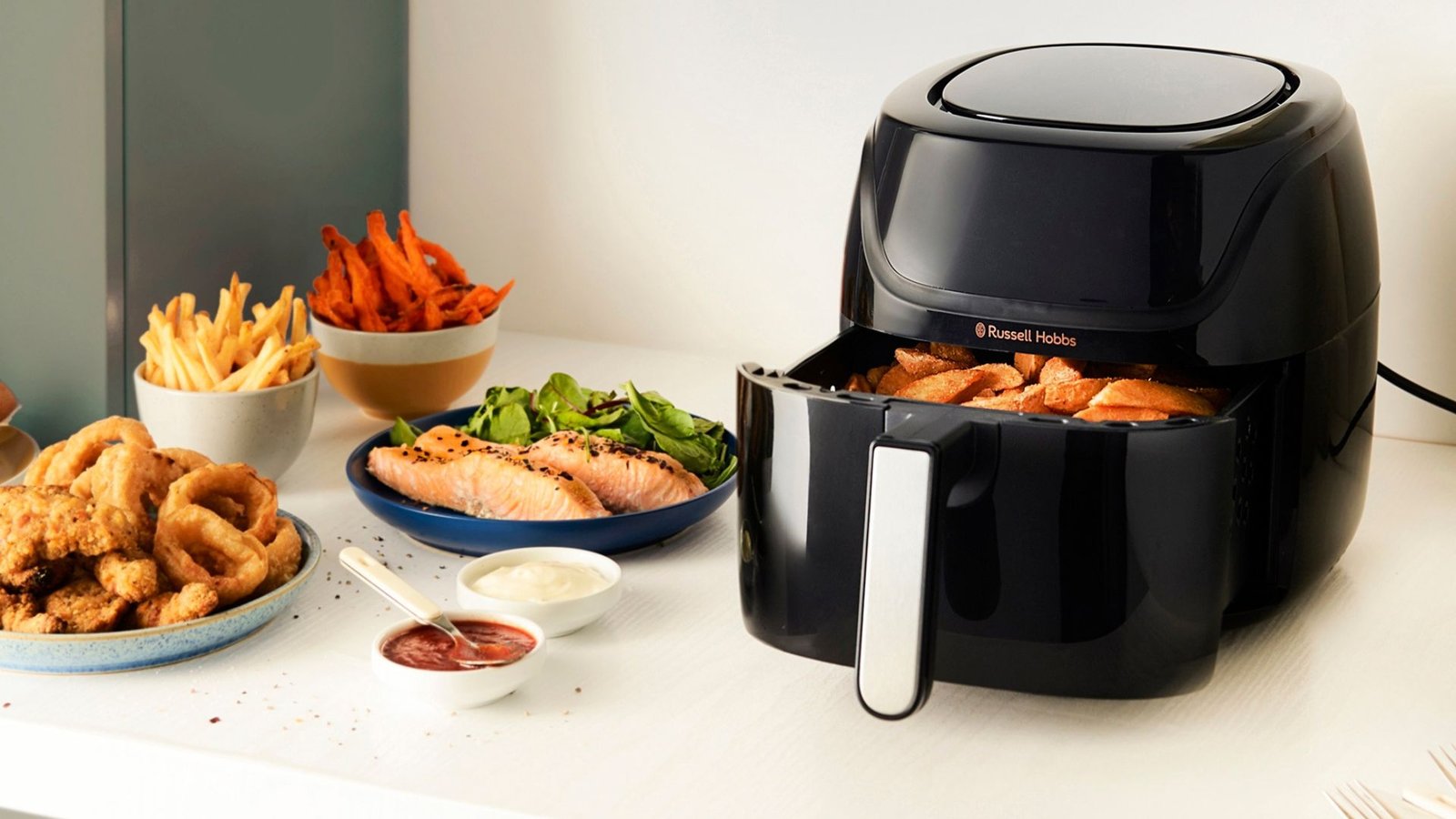
Does well: frozen foods of all kinds, chips and fries, wings, breaded items, roasted vegetables, reheating leftover pizza and fried food to something close to fresh, bacon, salmon fillets, small roast chicken pieces.
Does badly: anything wet or battered — wet batter drips through the basket and makes a mess. Large roasts that don’t fit in a single layer. Anything that needs to be left alone for an hour, where a normal oven is easier. Leafy greens and light items, which the fan blows around.
Reheating is the underrated use case. An air fryer restores crispness to leftovers in a way a microwave cannot, and for many households that becomes the main reason it stays on the counter.
Mistakes worth avoiding
Buying on the quart number. It measures volume including empty space. Floor area determines how much you can actually cook.
Overfilling the basket. The single most common cause of disappointing results. Food must sit in one layer. Cook two batches rather than one crowded one.
Buying oven style for better results. Testing consistently shows the opposite — bigger footprint, weaker crisping, slower cooking.
Assuming a dual-basket model gives you one large chamber. It gives you two small ones.
Using aerosol cooking spray. The propellants degrade nonstick coatings. Use a brush or a pump-style oil bottle.
Not measuring overhead clearance. Counter width isn’t enough — check the height under your cabinets and the exhaust clearance the manual requires.
Expecting deep-fried results. It’s a fast convection oven. Food comes out crisp and good; it does not come out identical to deep-fried.
Buying one if you already own a convection oven and rarely cook small batches. You may already have most of the capability.
Frequently asked questions
What size air fryer do I need?
In a basket model, roughly 4 quarts for one or two people and 6 quarts for about four. But check basket dimensions rather than relying on the quart figure — a 5-quart basket can be only nine inches across.
Is a basket or oven-style air fryer better?
Basket, for air frying specifically. Independent testing consistently finds drawer-style baskets crisp better and cook faster, while oven-style models take more counter space without fitting much more food. Oven style makes sense only if it replaces a toaster oven you already own.
Is an air fryer just a convection oven?
Essentially, yes — a small, fast one with the heating element placed directly behind the fan. The small cavity and concentrated airflow are what make it faster and crisper than a full-size oven.
Do air fryers use no oil?
No. Most recipes call for food tossed in a small amount of oil. It’s a low-oil method rather than an oil-free one.
Can I stack food in the basket?
No, and this is the main reason people get poor results. Air has to reach every surface. Cook in batches instead.
Why is my food not crisping?
Usually overcrowding. Also check you’re not skipping the shake partway through, and that you’ve used a little oil.
Are air fryer baskets dishwasher safe?
Many are, but check that the crisper plate is too — it’s the harder part to clean by hand.
The recommendation
Buy a basket-style air fryer, around 6 quarts for a household of three or four, with a dishwasher-safe basket and crisper plate.
Before ordering, find the basket’s width and depth rather than trusting the quart rating, and measure both your counter space and the clearance under your cabinets.
Then use it in single layers and accept that two batches beats one crowded one. Most people who conclude their air fryer doesn’t work well are overfilling it — and the appliance was sized by a number that encouraged them to.

Leave a comment