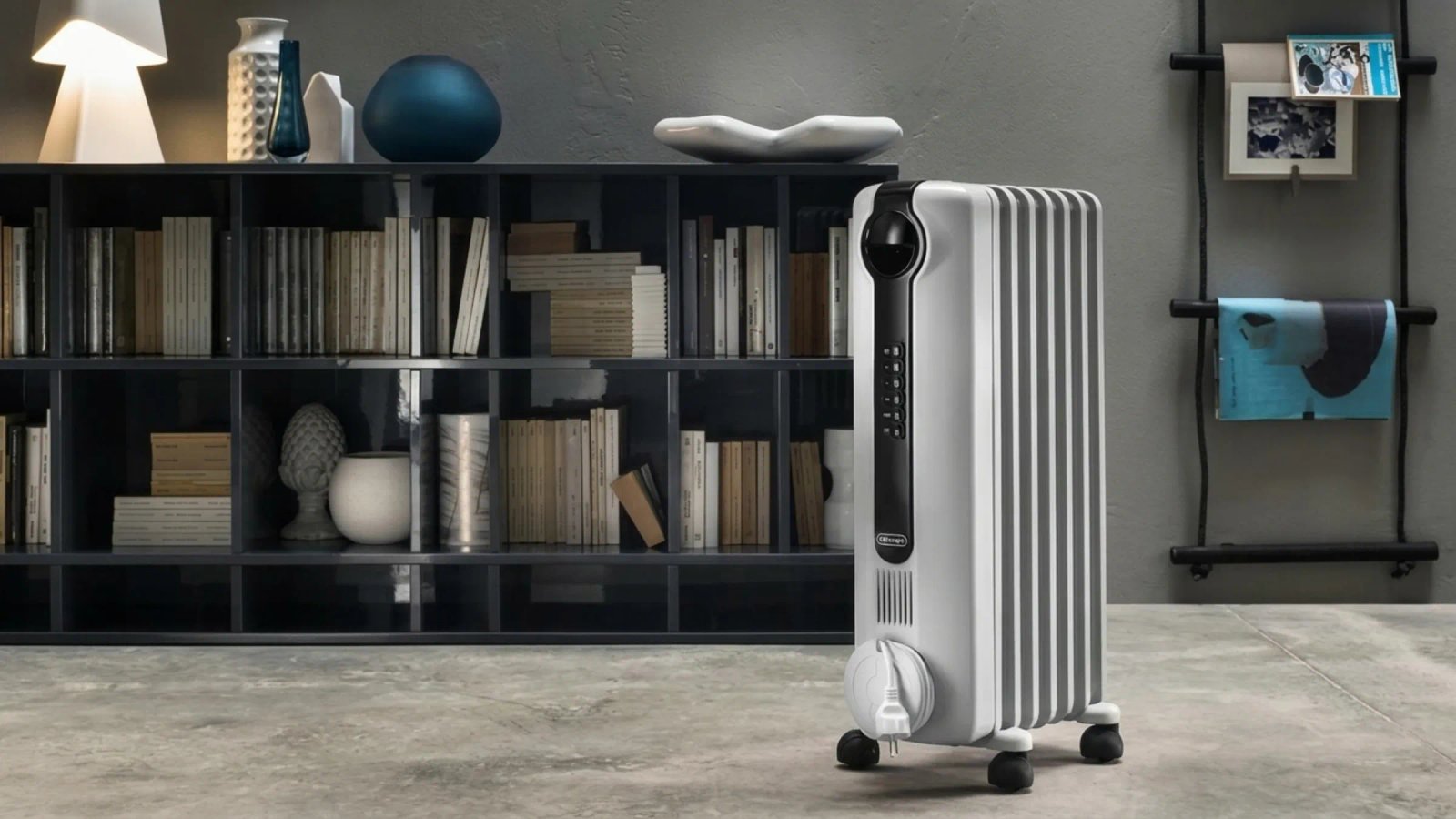
Space heaters are sold almost entirely on efficiency. Infrared models claim to use 30–40% less energy than standard heaters. Premium brands promise revolutionary heating technology. Listings compete on how much you’ll save.
Essentially all of it is false, and the physics is not complicated.
Every electric resistance heater converts close to 100% of the electricity it draws into heat. The US Department of Energy states this plainly: electric resistance heating is 100% energy efficient in the sense that all the incoming electric energy is converted to heat. There is nowhere else for the energy to go.
So a 1500-watt infrared heater, a 1500-watt ceramic heater and a 1500-watt oil-filled radiator all produce the same amount of heat — around 5,120 BTU per hour — and all cost exactly the same to run per hour. A $300 heater and a $30 heater at the same wattage are producing identical heat.
What genuinely differs is how that heat is delivered, and that does matter. Here’s what actually separates the types, and where the real savings come from.
The short version
All 1500W heaters produce the same heat at the same cost. Choose by delivery method, not by efficiency claims:
Ceramic/fan — fastest to warm a room, noisy, cools quickly
Oil-filled — slow to warm, silent, holds heat, safest surface
Infrared — heats you rather than the air, best for spot heating and draughty spaces
Real savings come from heating one room instead of the house and from a thermostat that actually cycles off — not from the heater’s technology.
And never plug one into an extension cord or power strip. That’s the most important sentence in this guide.
Why 1500 watts is on nearly every box
Walk down the aisle and almost every heater says 1500W. That’s not coincidence or convention — it’s the ceiling imposed by a standard household outlet.
A 1500-watt heater on a 120-volt circuit draws 12.5 amps, which sits just under the safe continuous load for a standard 15-amp circuit. Go higher and you’re tripping breakers or overheating wiring.
This has an important implication: no portable electric heater plugged into a normal outlet can produce meaningfully more heat than any other. They’re all capped at the same place. A more expensive heater is not a more powerful one.
What it costs to run
The formula is simple and worth doing before you buy:
(watts ÷ 1000) × hours of use × your electricity rate per kWh
A 1500W heater running for 5 hours is 7.5 kWh. At an assumed rate of $0.17/kWh, that’s about $1.28 for the evening, or roughly 26 cents an hour. At $0.12/kWh it’s about 18 cents an hour.
Run one continuously and it becomes a significant line on the bill — around $38 a month for 5 hours a night. This is the same for every type, which is the whole point of the section above.
Plug in your own electricity rate rather than the assumed one; US rates vary widely by state.
The three types, honestly compared
Ceramic / fan-forced | Oil-filled radiator | Infrared / radiant | |
Time to feel warm | 1–2 minutes | 20–30 minutes | Immediate, if you’re in front of it |
Noise | Fan noise | Silent | Usually quiet, some have fans |
Heats | The air | The air, slowly and evenly | Objects and people directly |
After switch-off | Cools quickly | Keeps radiating for a long time | Stops immediately |
Surface temperature | Hot | Warm | Can be very hot |
Weight | Light, portable | Heavy | Moderate |
Best for | Quick warm-up, bathrooms, small offices | Bedrooms, sustained all-day warmth | Spot heating, draughty rooms, garages |
Ceramic and fan-forced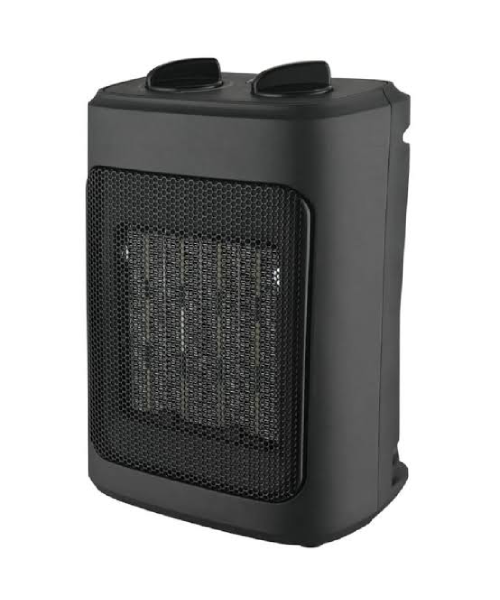
A heating element with a fan blowing air across it. You feel heat within a minute or two, and the fan circulates it around the room.
The costs are noise and persistence. The fan is audible — fine in a home office, less fine in a bedroom — and the moment you switch it off, the heat stops. There’s almost no thermal mass, so the room cools quickly.
Buy it if: you want a room warm fast and you’ll be in it for a couple of hours — a bathroom in the morning, a home office at the start of the day.
Skip it if: the noise will bother you, or you want sustained warmth overnight.
Oil-filled radiators 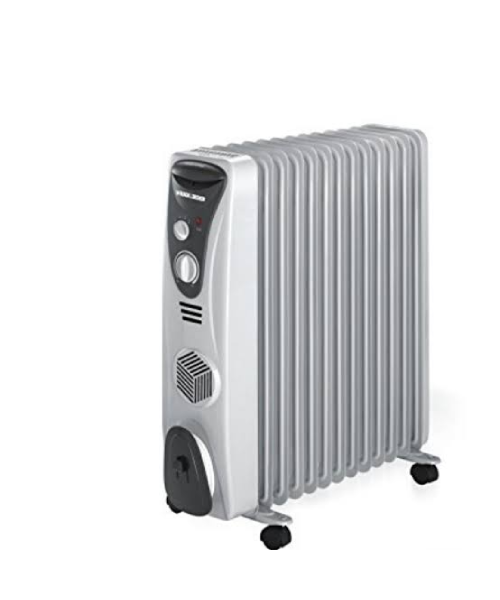
An element heats oil sealed inside the unit, and the oil heats the metal fins, which warm the surrounding air by convection.
The appeal is in the user reports rather than the spec sheet: silent operation with no fan, gentle even heat, and the radiator continues giving off warmth long after the thermostat cuts out. People who’ve used one for several winters consistently describe the same pattern — 20 to 30 minutes to warm up, then the room stays warm for a long time.
The lower surface temperature is also the safest of the three around children and pets, though it still needs clearance.
One myth to clear up: the residual heat after switch-off does not save you money. That heat was paid for earlier, when the element was drawing power to warm the oil. Energy in equals energy out. What the thermal mass gives you is smoother, quieter, more even heat — a comfort benefit, not a cost one.
Buy it if: it’s going in a bedroom, or you want steady background warmth for hours rather than a quick blast.
Skip it if: you want heat immediately, or you’ll be moving it between rooms — these are heavy.
Infrared and radiant 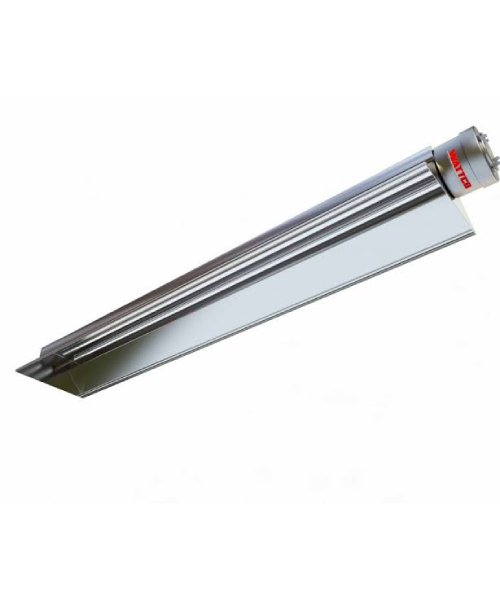
Infrared heaters emit radiant energy that warms objects and people directly, the way sunlight feels warm on a cold day. The air in between stays roughly the same temperature.
This makes them genuinely useful in a specific situation: spaces where heating the air is futile. A garage, a workshop, a draughty conservatory, a large open room where you only occupy one corner. Pointed at a person, an infrared heater makes them comfortable without any attempt to warm the volume around them.
Where they’re oversold is as general room heaters. The claim that infrared uses 30–40% less energy than standard heaters appears all over the category and contradicts the physics directly — a 1500W infrared heater draws 1500 watts and produces 5,120 BTU, the same as anything else. What’s true is that infrared can be perceptually more efficient for spot heating, because you feel warm without the room being warm. That’s a real benefit, described dishonestly.
Buy it if: you need targeted warmth in a space that’s hard or pointless to heat properly.
Skip it if: you want the whole room comfortable. Step out of the beam and you’re cold again.
Where savings actually come from
If all heaters cost the same per hour, how does anyone save money with one? Three ways, none of them about the heater’s technology.
Zone heating. This is the real mechanism. Turning the central thermostat down several degrees and heating only the room you’re occupying costs less than heating the whole house. A space heater used in addition to normal heating costs you money. Used instead of raising the thermostat, it saves.
A thermostat that works. A heater running continuously costs full price all evening. One with an accurate thermostat reaches temperature, shuts off, and cycles. This single feature changes the running cost substantially and is worth paying for — it’s one of the few places extra money buys a real result.
A timer. Heating a bedroom for an hour before bed and letting it switch off is far cheaper than running it all night, and more comfortable.
Everything else — the technology, the brand, the claimed efficiency — is noise.
Safety: the part that matters most
Space heaters are among the leading causes of home heating fires, and most of those are avoidable.
Plug it directly into a wall outlet. Never an extension cord, never a power strip. This is the single most important rule. A 12.5-amp continuous draw through a cord or strip not rated for it is a genuine fire risk, and the manufacturer’s manual will say the same thing. If there’s no outlet where you want the heater, move the heater.
Keep three feet of clearance from furniture, curtains, bedding and anything else that burns.
Insist on tip-over and overheat protection. A tip-over switch cuts power if the unit falls; overheat protection cuts out if the internals get too hot. Both are standard on reputable models and absent on some cheap ones.
Check for UL or ETL certification. Both are recognised testing marks against the same safety standards. A heater with neither has not been independently tested.
Don’t run fan-forced heaters unattended or overnight. Oil-filled radiators with a working thermostat are the type most people consider acceptable to leave running, due to the lower surface temperature and absence of an exposed element — but check the manual, and don’t leave any heater running in an empty house.
Place it on a hard, level floor, not on carpet, and not on furniture.
Mistakes worth avoiding
Paying extra for “efficiency.” Every 1500W heater produces identical heat at identical cost. The premium buys you a different delivery method, better build, or a better thermostat — not more heat per watt.
Using it on top of full central heating. That’s additive cost with no saving. Turn the thermostat down first.
Using an extension cord. Covered above, and worth repeating.
Buying a fan heater for a bedroom. The noise and the lack of residual heat both work against you. Oil-filled is the bedroom type.
Buying infrared for general room heating. It warms what it points at. Outside the beam, nothing.
Ignoring the thermostat quality. A heater without a working thermostat runs flat out continuously, which is both expensive and uncomfortable.
Assuming oil-filled is cheaper to run. It isn’t. The residual heat was paid for in advance.
Frequently asked questions
Which type of space heater is most energy efficient?
None of them, relative to each other. All electric resistance heaters convert nearly 100% of electricity to heat, per the Department of Energy. A 1500W heater costs the same to run whatever technology it uses.
Why are almost all space heaters 1500 watts?
Because that’s the practical ceiling for a standard 120V household circuit. It’s why no portable heater is meaningfully more powerful than another.
How much does a space heater cost to run?
(Watts ÷ 1000) × hours × your rate per kWh. A 1500W heater is roughly 18–26 cents an hour depending on your electricity rate.
Is an oil-filled heater cheaper because it stays warm after switching off?
No. That heat was paid for while the element was running. It makes the warmth smoother and quieter, not cheaper.
Can I leave a space heater on overnight?
Fan-forced heaters shouldn’t be left unattended. Oil-filled radiators with working thermostats and tip-over protection are the type most people consider acceptable — check the manual, and never with an extension cord.
Can I use an extension cord with a space heater?
No. Plug directly into a wall outlet. This is a leading cause of heater-related fires.
Do space heaters actually save money?
Only if you lower your central heating and heat one room instead. Used alongside full central heating, they only add cost.
The recommendation
Buy by room and by use, not by efficiency claim.
For a bedroom, buy an oil-filled radiator with a thermostat and a timer. Silent, gentle, and it holds warmth after it cycles off.
For a bathroom or home office where you want heat fast and will be there a couple of hours, buy a ceramic fan heater. Cheap, quick, and the noise matters less in those rooms.
For a garage, workshop or draughty open space, buy infrared and point it at yourself.
In all three cases, prioritise an accurate thermostat and a timer over everything else on the spec sheet, check for tip-over protection and a UL or ETL mark, and plug it straight into the wall.
Then turn your central heating down. That’s where the saving is — not in the box.



Leave a comment