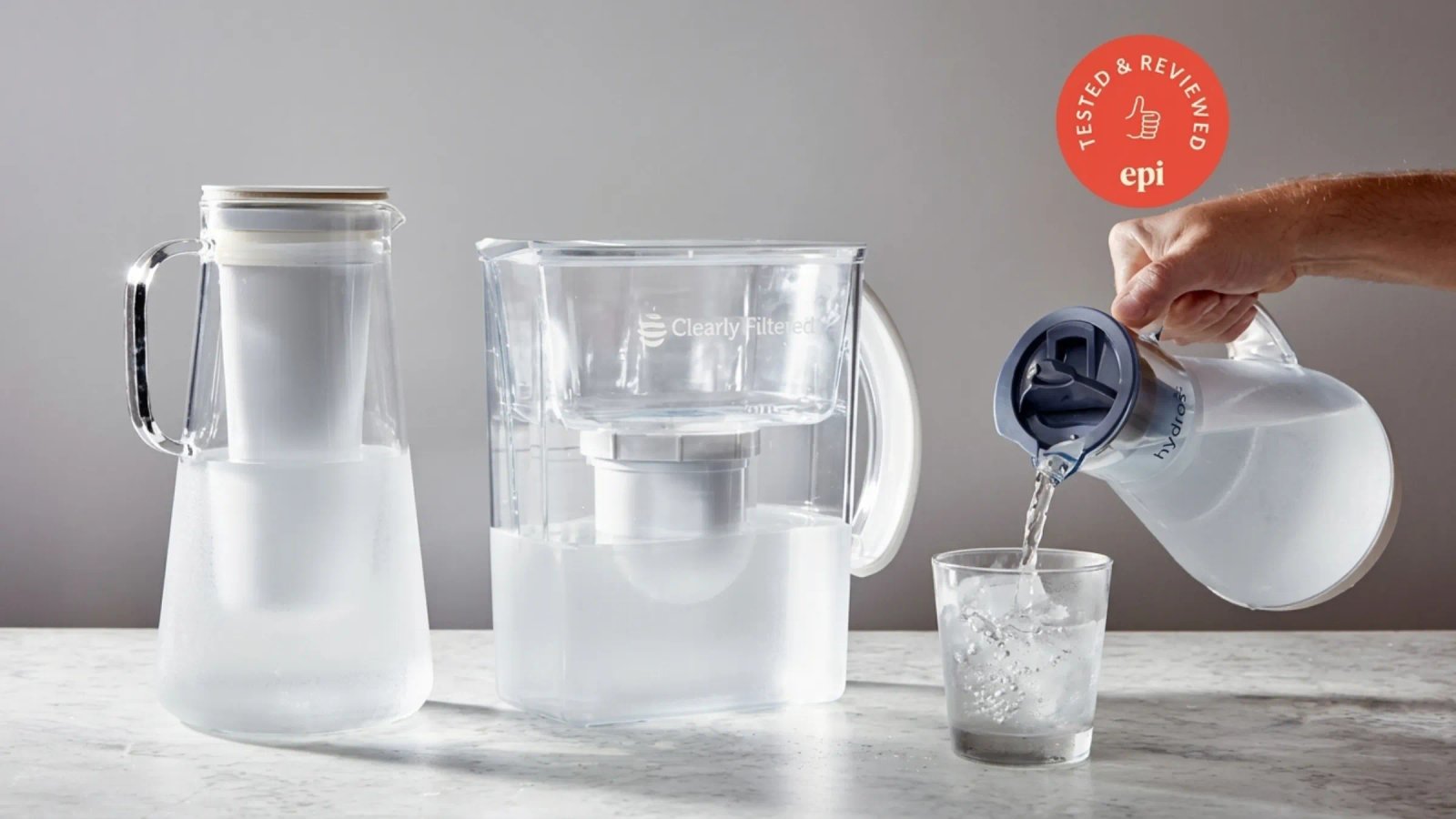
Water filter marketing runs on contaminant counts. Removes 99% of lead. Targets 365+ contaminants. Reduces PFAS.
None of those claims mean anything on their own, because a manufacturer can test for whatever it likes, in whatever conditions it likes, and report the result.
What means something is third-party certification against a specific NSF/ANSI standard. That tells you an independent body verified a defined set of contaminants were reduced by a defined amount, under a defined protocol, over the filter’s claimed lifespan.
There are four standards that matter, one that’s routinely cited to look impressive while meaning nothing about filtration, and a difference between “certified to” and “tested to” that most buyers miss.
Here’s how to read it, and three pitchers compared.
The short version
Find out what’s in your water first. US utilities publish an annual water quality report; filtering for contaminants you don’t have is wasted money.
Then match certifications to your actual problem. NSF 42 for taste, 53 for lead and heavy metals, 401 for pharmaceuticals and emerging contaminants, P473 for PFAS.
PUR Plus 11-Cup (~$30) — certified to 42, 53 and 401 for everything it claims, at the lowest running cost of the certified options.
Clearly Filtered (~$75–90) — the broadest contaminant coverage available in a pitcher, at roughly three times the cost per gallon.
ZeroWater / Culligan with ZeroWater (~$28–40) — the one with independent certification for Total PFAS reduction, and the shortest filter life.
The standards, decoded
Standard | Covers | Matters if |
NSF/ANSI 42 | Aesthetic effects — chlorine, taste, odour | Your water tastes of chlorine |
NSF/ANSI 53 | Health effects — lead, mercury, cysts, VOCs | Old plumbing, lead service lines |
NSF/ANSI 401 | Emerging contaminants — pharmaceuticals, herbicides, BPA | You’re concerned about trace compounds |
NSF/ANSI P473 | PFOA and PFOS specifically | You’re in a PFAS-affected area |
NSF/ANSI P231 | Microbiological — bacteria, parasites | Well water, or travel |
NSF/ANSI 372 | Lead-free materials — not filtration | Nothing about what the filter removes |
That last row is the one to watch. NSF/ANSI 372 certifies that the product’s own materials don’t leach lead. It is a materials standard, not a performance standard, and it says nothing about what the filter takes out of your water.
A listing advertising “NSF 42 and 372 certified” is telling you it handles chlorine taste and that the plastic is lead-free. It is not telling you it removes lead from your water.
“Certified to” versus “tested to”
This distinction is worth more than any contaminant count.
Certified means an accredited third party — NSF International, the Water Quality Association (WQA), or IAPMO — has verified performance and continues to audit it. The certification is listed in a public database you can search.
“Tested to NSF standards,” “meets NSF/ANSI 53,” “independently lab tested” means the manufacturer commissioned testing. It may be rigorous. It isn’t the same thing, and the wording is chosen deliberately.
This matters in practice. PUR Plus, for example, carries certification to 42, 53 and 401 covering everything it claims. Clearly Filtered’s marketing leans heavily on “tested to” language across a broader set of standards. Both may perform well; only one has ongoing third-party verification across the board.
What to do: look up the exact product in the NSF, WQA or IAPMO certification database before buying. It takes two minutes and it’s the only way to confirm a claim.
The TDS meter is not a purity test
ZeroWater includes a TDS meter and markets its filters on achieving a reading of zero. The number is real and widely misunderstood.
TDS means total dissolved solids — everything dissolved in the water, measured as conductivity. That includes calcium and magnesium, which are harmless and in fact why some people prefer mineral water.
TDS does not detect PFAS. It does not detect bacteria. It does not detect most organic contaminants. A reading of zero tells you dissolved solids have been removed. It does not tell you the water is safe, and a reading of 150 doesn’t tell you it’s unsafe.
Removing all dissolved minerals also produces water many people find flat or slightly sour.
Treat TDS as a filter-life indicator, which is genuinely useful — a rising reading tells you the resin is exhausted — rather than as a safety measurement.
Start with your actual water
This is the step nearly everyone skips, and it determines everything else.
In the US, your water utility is required to publish an annual Consumer Confidence Report listing what’s been detected and at what levels. It’s usually on their website or available on request. The EPA also maintains tools for looking up local systems.
If you’re on a well, you need to test — utilities don’t cover you. Lab test kits are widely available, and a basic panel covers bacteria, nitrates, hardness, pH and metals.
If you live in an older building, lead from pipes and solder is a plumbing problem rather than a supply problem, and won’t show in the utility report. That’s a case for NSF 53 certification regardless of what the report says.
Once you know what you’ve got, buy for that. Filtering PFAS you don’t have, at three times the cost per gallon, is money spent on reassurance rather than water.
Cost per gallon beats pitcher price
The pitcher is a one-off. Filters are forever, and the running costs diverge sharply.
Filter life | Filter price | Approx. cost/gallon | |
Brita Elite / Longlast+ | 120 gal (~6 months) | ~$16 | ~$0.13 |
PUR Plus | 40 gal (~2 months) | ~$10–12 | ~$0.25–0.30 |
Clearly Filtered | 100 gal (~4 months) | ~$50 | ~$0.35 |
ZeroWater | 25–100 gal | ~$15 | ~$0.30–0.80 |
ZeroWater’s range is the thing to note. Its ion-exchange resin exhausts in proportion to how much it removes, so in hard water it can wear out three to five times faster than in soft water. People in hard-water areas routinely find it the most expensive option to run despite the cheapest pitcher.
Work out your household’s gallons per year, multiply by cost per gallon, and compare that against the pitcher price. Over three years the running cost usually dominates.
The three picks
PUR Plus 11-Cup | Clearly Filtered | ZeroWater / Culligan | |
Price | ~$30 | ~$75–90 | ~$28–40 |
Capacity | 11 cups | 10 cups (80 oz) | 10 cups |
Filter life | 40 gal (~2 mo) | 100 gal (~4 mo) | 25–100 gal |
Certification | NSF/WQA 42, 53, 401 | Tested to 42, 53, 401, 473 | IAPMO, NSF/ANSI 53 |
PFAS | Partial | Targeted | Total PFAS 99.7% certified |
Fluoride | No | Yes | Partial |
Cost/gallon | ~$0.25–0.30 | ~$0.35 | ~$0.30–0.80 |
PUR Plus 11-Cup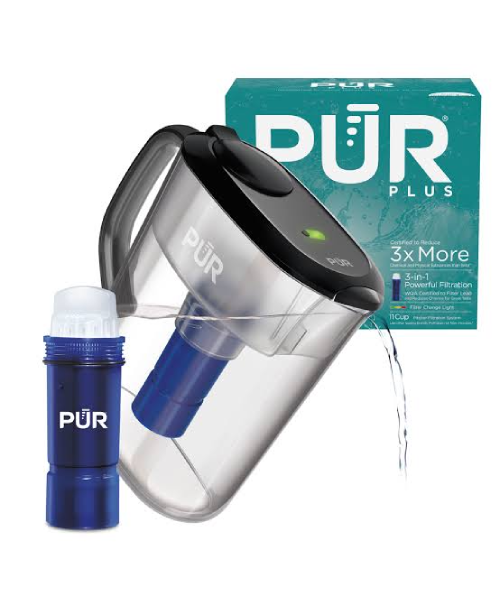
Around $30, and the pick for most households.
Its strength is that it’s certified rather than self-tested, to NSF/ANSI 42, 53 and 401, covering everything it claims. That means chlorine taste and odour, lead and heavy metals, and emerging contaminants including pharmaceuticals — the three categories that cover the overwhelming majority of real household concerns.
The 11-cup capacity is the largest of the three, and the running cost is low.
The drawbacks: the 40-gallon filter life is the shortest here, meaning replacement every couple of months — more frequent handling even if the per-gallon cost stays reasonable. It doesn’t remove fluoride, and PFAS coverage is partial rather than dedicated.
Buy it if: your concerns are taste, lead and general contaminants, and you want verified certification at a low price.
Skip it if: you’re specifically targeting PFAS or fluoride.
Clearly Filtered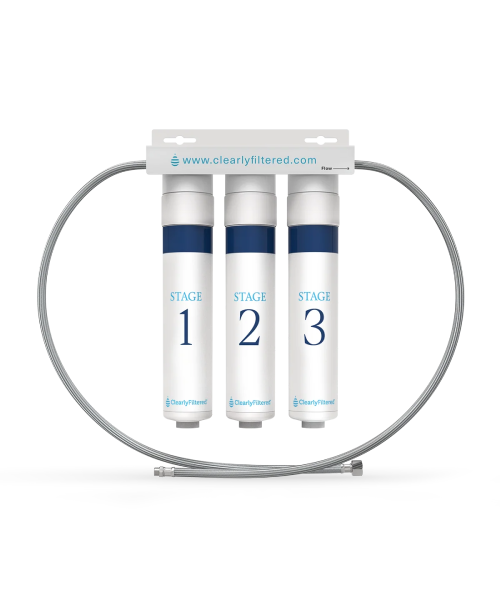
Around $75–90, with replacement filters around $50.
It targets the widest range of contaminants in the pitcher category — the marketing figure is 365-plus, and the categories include fluoride, PFAS, lead, arsenic and microplastics. For anyone with multiple concerns, or who simply wants the most comprehensive option without installing anything, it’s the answer.
The 100-gallon filter life is reasonable, and the construction uses BPA-free Tritan.
The drawbacks are real. It’s the most expensive to run at roughly $0.35 per gallon. The flow rate is slow — noticeably so, and it’s the most common owner complaint. And much of its claimed coverage is described as tested to NSF standards rather than certified across the board, so check the specific certifications in the relevant database rather than taking the breadth of the list at face value.
Buy it if: you want maximum contaminant coverage including fluoride, and you’ll accept slow filtering and higher running costs.
Skip it if: cost per gallon matters, or your concerns are narrow enough that a certified basic filter covers them.
ZeroWater / Culligan with ZeroWater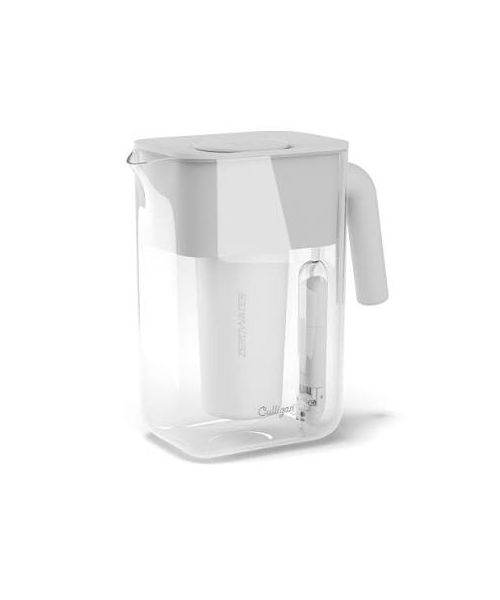
Around $28 to $40.
The distinguishing feature is independent certification for Total PFAS: Culligan with ZeroWater Technology is IAPMO-certified under NSF/ANSI 53 to reduce Total PFAS by 99.7%, covering PFOA, PFOS, PFHxS, PFNA, PFHpA, PFBS and PFDA. If PFAS is your specific reason for filtering, that’s the clearest certification evidence in the pitcher category.
The five-stage ion-exchange filter also removes lead, mercury and some fluoride, and brings TDS to near zero. A TDS meter is included.
The drawbacks: filter life is the real issue. The resin exhausts in proportion to what it removes, so in hard water it can need replacing every few weeks, making it the most expensive option to run. Many people find the resulting water flat-tasting. And the TDS marketing encourages a misreading of what the number means.
Buy it if: PFAS is your documented concern, or you’re in a soft-water area and want near-zero TDS.
Skip it if: you have hard water. The running cost will surprise you.
When a pitcher isn’t enough
Pitchers filter drinking water in small batches. They don’t help with the water you shower in, cook with at volume, or run through an ice maker.
Under-sink filters handle higher volumes with longer-lasting cartridges and better flow, at the cost of installation.
Reverse osmosis removes the widest range of contaminants of any domestic option, including those pitchers struggle with — but it wastes water, removes beneficial minerals, and needs plumbing.
Whole-house systems treat everything entering the property, which is the answer for sediment, hardness and chlorine at the point of entry rather than the point of use.
If your water report shows a serious problem, a pitcher is the wrong tool. Pitchers are for improving acceptable water, not fixing unsafe water.
Mistakes worth avoiding
Buying on contaminant counts. “365+ contaminants” is a marketing figure. Certification against a named standard is the substance.
Mistaking NSF 372 for a filtration certification. It covers lead-free materials, not what the filter removes.
Confusing “tested to” with “certified.” One is a manufacturer’s claim; the other is audited third-party verification.
Treating TDS as a safety reading. It measures dissolved solids including harmless minerals, and misses PFAS and bacteria entirely.
Not reading your water report. You may be paying to remove things you don’t have.
Ignoring cost per gallon. The pitcher is cheap; the filters aren’t, and they’re the ongoing cost.
Running filters past their rated life. An exhausted filter can release accumulated contaminants back into the water. Track gallons or set a reminder.
Frequently asked questions
What do the NSF numbers mean?
42 covers chlorine taste and odour; 53 covers health contaminants like lead; 401 covers emerging contaminants like pharmaceuticals; P473 covers PFOA and PFOS. 372 covers lead-free materials and says nothing about filtration.
Which pitcher is certified for PFAS?
Culligan with ZeroWater Technology carries IAPMO certification under NSF/ANSI 53 for Total PFAS reduction of 99.7%. Brita’s standard filter is not PFAS-certified; its Longlast+ carries some PFAS-related certification.
Does a TDS reading of zero mean the water is pure?
No. TDS measures dissolved solids including harmless minerals, and doesn’t detect PFAS, bacteria or many organic contaminants.
How do I find out what’s in my water?
US utilities publish an annual Consumer Confidence Report. On a well, you need to lab test. Lead from household plumbing won’t appear in a utility report.
Which pitcher is cheapest to run?
Brita’s long-life filters are generally the lowest cost per gallon. ZeroWater is often the most expensive in hard-water areas despite a low upfront price.
Do water filters remove fluoride?
Most don’t. Clearly Filtered is among the few pitchers targeting it; ZeroWater reduces it partially.
When should I upgrade from a pitcher?
If your water report shows a significant problem, or if you want filtered water at volume for cooking and ice. Under-sink or reverse osmosis are the next steps.
The recommendation
Read your water quality report first. It costs nothing and it decides everything else.
If your concerns are taste, lead and general contaminants — which covers most households — buy the PUR Plus 11-Cup. It’s certified rather than self-tested, it covers the three standards that matter most, and it’s cheap to buy and run.
If you want maximum coverage including fluoride and you’ll tolerate slow filtering and higher costs, buy Clearly Filtered.
If PFAS is your documented concern, buy Culligan with ZeroWater Technology for the certification — unless you’re in a hard-water area, where the filter life will make it expensive.
And look the product up in the NSF, WQA or IAPMO database before you buy. The database is the only place the claim on the box becomes a fact.
Leave a comment