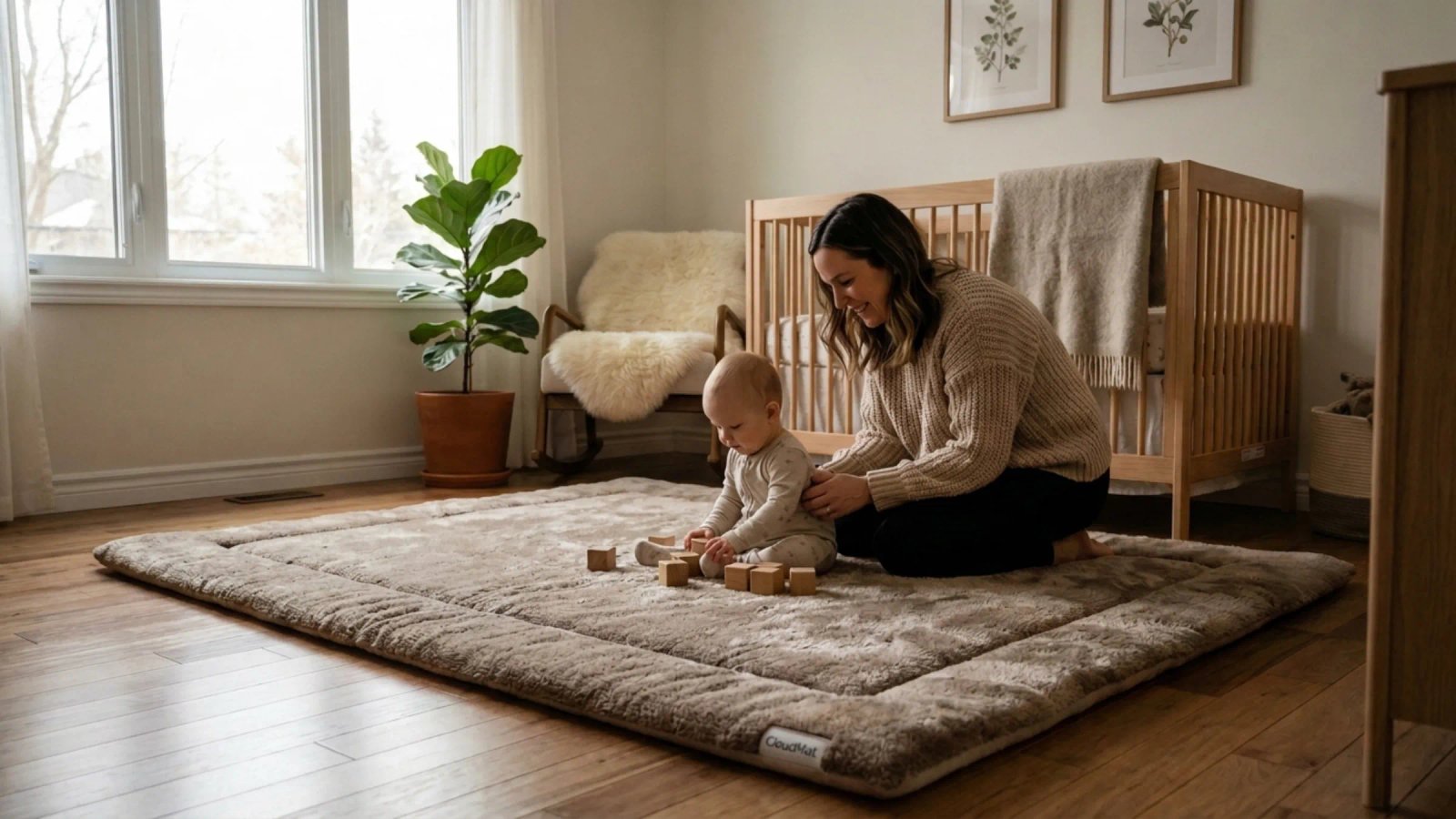
There’s one question that decides whether a washable rug is a good purchase, and most people don’t ask it until the rug has arrived: will it actually fit in your washing machine?
The answer is less obvious than it sounds, because the washer capacity a rug needs depends not only on its dimensions but on its construction. A flatwoven runner fits a 2.2-cubic-foot machine. A tufted runner of the same size needs 3.8. Same footprint, nearly double the machine.
Get this wrong and you’ve bought a rug that has to go to a laundromat every time the dog is sick on it, which defeats the entire purpose.
Here’s how the category actually works, what the two-piece system gets right, and what to check before ordering.
The short version
Check your washer’s cubic-foot capacity before you choose a rug, and match it to the specific size and pile type you want. Tufted and plush piles need substantially bigger machines than flatwoven ones. Some large sizes require a commercial machine regardless of what you own.
The two-piece system — a thin washable cover on a grippy pad — genuinely solves the shifting-rug problem and makes restyling cheap, but reassembly after washing is the common complaint, and the standard pad is thin enough that you’ll feel the floor through it.
If the assembly step bothers you, note that all-in-one washable rugs now exist alongside the two-piece ones, and they’re a different product with different trade-offs.
How the two-piece system works
The dominant design — Ruggable’s patented approach, and the one most of the category imitates — splits the rug into two parts.
A non-slip pad goes on the floor and stays there. It’s made of a rubber-like material and functions as one large sheet of velcro.
A lightweight printed cover lays on top and grips the pad. The cover is the part that goes in the washing machine; the pad stays down.
This solves a real problem. Traditional area rugs shift, bunch and ride up, particularly on hard floors, and the usual fix is a separate rug pad that may or may not work. Here the grip is engineered into the system, and reviewers consistently report that the rug stays flat and doesn’t move — including people who were sceptical of the two-piece concept going in.
It also makes restyling genuinely cheap. If you already own the pad, you buy only a new cover, which is a substantial saving over replacing a whole rug. For a renter or anyone who changes a room often, that’s a real advantage no traditional rug offers.
The washer question, properly
This is the specification to check first, before colour, size or price.
Capacity requirements scale with both size and pile construction, and the pile variable catches people out. Approximate published minimums:
Rug | Flatwoven / chenille | Tufted |
Runner (2.5' × 7') | ~1.6–2.2 cu ft | ~3.8 cu ft |
3' × 5' | ~2.2 cu ft | ~3.8 cu ft |
5' × 7' | ~3.8 cu ft | ~3.1 cu ft |
6' × 9' | ~3.8 cu ft | ~4.2 cu ft |
8' × 10' | ~3.8 cu ft | ~4.5 cu ft |
9' × 12' and above | Larger / commercial | Commercial |
Two warnings about that table. First, these figures come from published guidance that the manufacturer updates, and they vary by specific product line — plush and performance-weave constructions differ again. Check the exact rug you want against current guidance before ordering. Second, some large sizes are explicitly recommended for commercial machines, which means a laundromat trip rather than a home wash.
Now check your own machine. It’s on the model label or in the manual. A typical US home washer runs somewhere between 3.5 and 4.5 cubic feet; many are at the lower end of that. Several reviewers with roughly 4-cubic-foot machines found a 6×9 tufted rug didn’t fit, or fitted only by cramming it in — which is both bad for the machine and bad for the wash.
The practical rule: if you’re near the boundary, go down a pile type rather than up a machine. A flatwoven rug in a size you can comfortably wash beats a tufted one you can technically force in.
Where the system falls short
Reassembly is the real complaint. Getting a washed cover aligned back onto the pad takes time, and the larger the rug the worse it gets. One reviewer reported spending close to half an hour on large sizes, and most sources describe anything above about 6×9 as a two-person job. The cover grips strongly, which is exactly what makes the system work on the floor and exactly what makes it awkward to position.
This complaint was significant enough that in September 2025 Ruggable introduced an All-in-One line that removes the assembly step entirely. Both constructions are now sold alongside each other, and accessories are not universally interchangeable between them — so if you buy into one system, you’re buying into it.
The standard pad is thin. It measures around an eighth of an inch, and the standard flatwoven cover is only a couple of millimetres on top of that. The result is a rug you see rather than feel. If you want something plush underfoot, you need the cushioned pad, which is roughly three times thicker, and that pushes both the price and the washer requirement up.
You can’t mix brands. The pad and cover are designed as a matched system. A cover from one brand won’t grip another brand’s pad reliably, which limits your options once you’ve committed.
Drying takes a while. The covers are machine dryable on low, but they’re large and hold water. Expect more than one cycle for bigger sizes.
It isn’t a rug in the traditional sense. A flatwoven washable cover is a printed textile, not a woven pile construction. It looks good — pattern quality is consistently praised, and colours hold up across washes — but it doesn’t have the depth, texture or feel of a wool rug, and it isn’t trying to.
Who these are actually for
Buy a washable rug if: you have pets, young children, or a dining area where food lands on the floor. This is the entire point of the category, and in those situations the ability to wash a rug rather than scrub it or replace it is genuinely transformative.
Buy one if you change rooms often and want cheap restyling, or if you rent and don’t want to invest in a rug you might not use in the next place.
Don’t buy one if the rug is going in a formal room where it’ll never be dirtied. You’re paying for washability you won’t use, and a traditional rug at that price will look and feel better.
Don’t buy one if your washer can’t handle the size you need and you won’t realistically trek to a laundromat. Be honest about this — it’s the single most common source of regret.
The options
Flatwoven + standard pad | Tufted + cushioned pad | All-in-One | |
Feel underfoot | Thin, you feel the floor | Noticeably softer | Varies by product |
Washer demand | Lowest | Highest | Check per product |
Reassembly | Required | Required, harder | None |
Restyle cheaply | Yes — buy cover only | Yes | No |
Best for | Kitchens, entryways, high-traffic | Living rooms, bedrooms | People who hate assembly |
Flatwoven with a standard pad
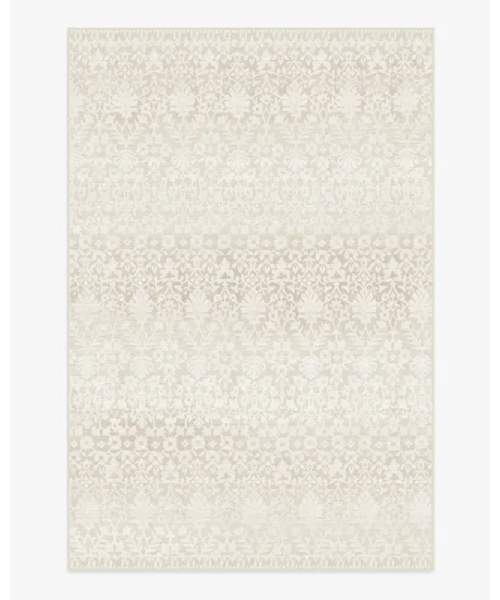 Thin, low-profile, and the easiest to wash because it packs down small. It fits under doors that a thicker rug would catch on, which matters in kitchens and entryways.
The trade-off is that it feels like a mat rather than a rug. On a hard floor you’ll feel the floor.
Buy it if: the rug is going somewhere that gets dirty often — kitchen, hallway, under a high chair — and you want the easiest possible wash cycle.
Skip it if: you want something comfortable to stand or sit on.
 — the comfortable one
Pile on top, a thicker pad underneath. This is closest to what most people picture when they think “area rug,” and it’s the version that feels good underfoot.
The costs are real: it needs a substantially larger washer for the same footprint, it’s heavier to handle wet, and reassembly is more awkward.
Buy it if: it’s going in a living room or bedroom where comfort matters, and your washer has the capacity for the size you want.
Skip it if: your machine is under about 4.2 cubic feet and you want 6×9 or larger.
All-in-One — if the assembly puts you off
A single-piece washable rug, introduced in response to exactly the complaint described above. No pad to align, no cover to wrestle back into place.
What you give up is the cheap-restyling advantage — there’s no cover to swap independently — and the systems aren’t cross-compatible, so this is a fork in the road rather than an upgrade.
Buy it if: you’d realistically be put off washing the rug by the reassembly step. A rug you don’t wash is just a rug.
Skip it if: you value being able to change the look later for the price of a cover.
Washing it properly
Vacuum first. Especially with pets. Loose hair that goes into the machine wet becomes much harder to deal with, and it ends up in your drum.
Cold water, liquid detergent, normal cycle. Hot water risks the backing and the print.
Tumble dry on low, and expect it to need longer than you think. Don’t high-heat it to speed things up.
Don’t wash the pad. On two-piece systems only the cover is washable. Wipe the pad down and let it dry fully before putting the cover back on.
Check the spin speed if your machine lets you. Lower spin speeds are gentler on the rug and reduce creasing, which makes reassembly easier.
Mistakes worth avoiding
Ordering before checking your washer’s capacity. The most common and most expensive error in this category.
Assuming size alone determines washability. Pile type changes the requirement substantially — a tufted runner can need almost double the machine of a flatwoven one of identical dimensions.
Buying the standard pad and expecting cushioning. It’s an eighth of an inch. If you want plush, pay for the cushioned pad and factor it into the washer calculation.
Buying a large size without reading about assembly. Above 6×9, plan for it to be a two-person, half-hour job.
Expecting it to replace a wool rug. It’s a different product solving a different problem.
Mixing pads and covers between brands or systems. They’re engineered as matched pairs and won’t grip reliably otherwise.
Frequently asked questions
What size washer do I need for a washable rug?
It depends on both size and pile. Flatwoven runners fit machines from around 1.6–2.2 cubic feet; tufted 8×10 rugs need around 4.5. Some large sizes require a commercial machine. Check the specific product’s current guidance.
Can you wash the rug pad too?
No, on two-piece systems. Only the cover is machine washable. Wipe the pad down instead.
Are washable rugs comfortable to walk on?
With a standard pad, not especially — it’s about an eighth of an inch thick. A cushioned pad is roughly three times thicker and makes a real difference.
Do the colours fade in the wash?
Reviewers generally report colours holding up well across repeated washes. Wash cold and dry low to keep it that way.
Is the two-piece system annoying?
Reassembly is the most common complaint, and it gets harder with size. All-in-One versions exist specifically to avoid it.
Do they work with underfloor heating?
The pads are generally designed to be compatible, but confirm for the specific product before buying.
The recommendation
Check your washer’s cubic-foot capacity first, then choose the rug — not the other way round.
For kitchens, entryways and anywhere that gets dirty frequently, buy flatwoven with a standard pad. It’s the easiest to wash, which means you’ll actually wash it.
For living rooms and bedrooms, buy tufted with a cushioned pad if your machine can handle the size. If it can’t, drop a size rather than a pile type — a 5×7 you can wash at home beats a 6×9 you have to take out.
And if the thought of wrestling a wet cover back onto a pad every month would stop you doing it, buy an All-in-One instead. The washability only counts if it’s convenient enough that you use it.
Prices in this category move constantly and there are frequent promotions — have your writer confirm current figures, and re-check the washer capacity table against the manufacturer’s live guidance, since those numbers get updated.
Continue


Leave a comment