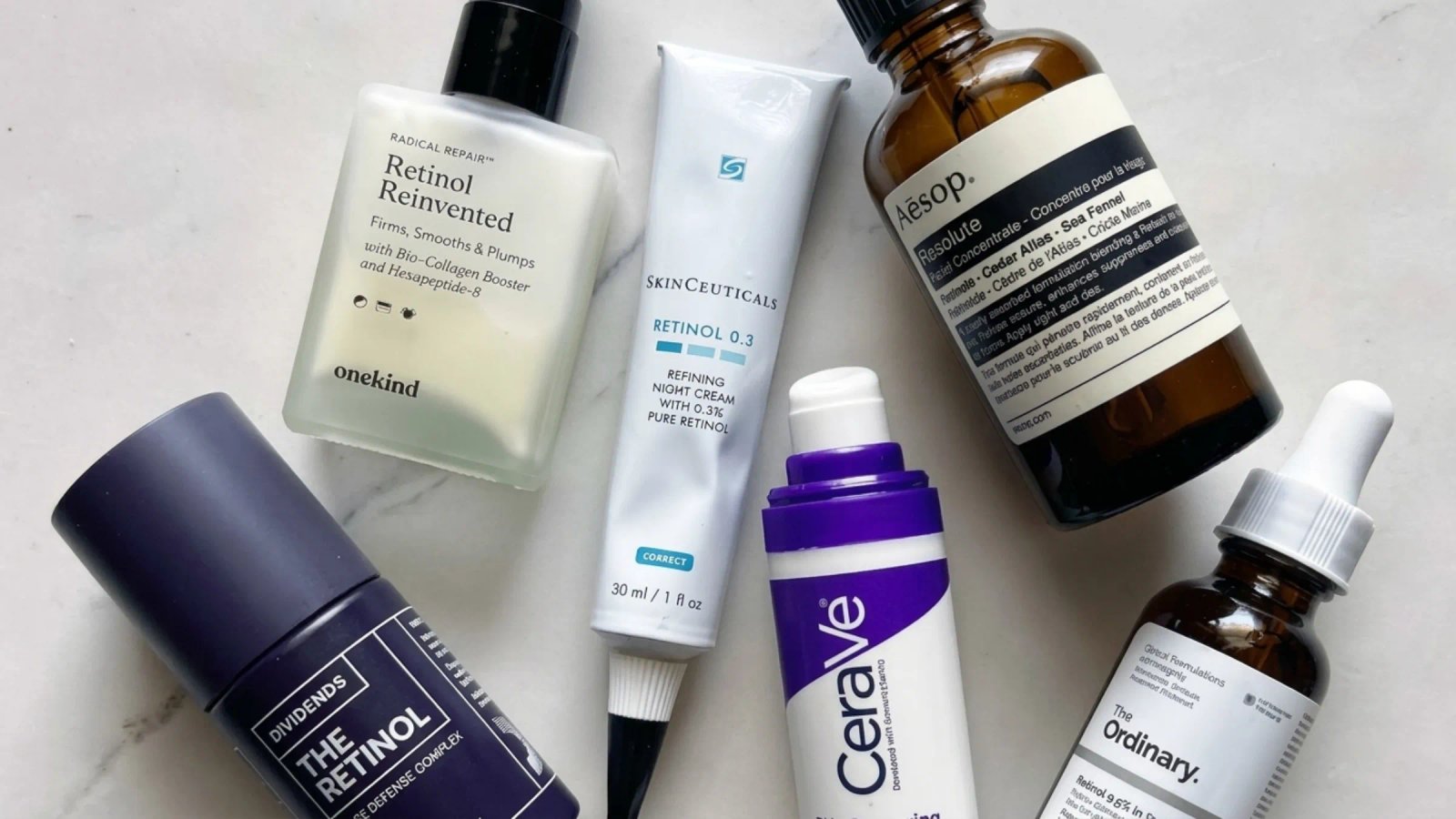
A 0.025% tretinoin cream is considerably stronger than a 1% retinol serum.
That looks like a mistake and isn’t. As one dermatologist puts it, these ingredients are very much not apples to apples — and the percentage on the bottle only means something relative to other products using the same molecule.
The reason is conversion. Your skin can only use one form of vitamin A: retinoic acid. Everything else has to be converted into it, and each conversion step loses potency. Retinol needs two steps. Retinaldehyde needs one. Tretinoin is retinoic acid already and needs none.
So comparing a 1% retinol against a 0.1% retinal against a 0.025% tretinoin on their numbers tells you nothing. What matters is which rung of the ladder you’re on, and whether the formulation protects the molecule well enough to deliver it.
The short version
Pick your rung, then your percentage. Percentages only compare within the same molecule.
The INKEY List Starter Retinol Serum (~$15) — encapsulated, slow-release, genuinely designed for beginners.
Medik8 Crystal Retinal 3 — the step up. Encapsulated retinaldehyde at an introductory strength, widely recommended as the “start without suffering” option.
Differin (0.1% adapalene) (~$15) — available without prescription in the US and the right choice if your concern is acne rather than ageing.
And treat the “10× more effective” retinal claims with caution. The evidence is thinner than the marketing.
The retinoid ladder
Every one of these is a retinoid. They differ in how many conversion steps your skin needs to make them usable.
Rung | Molecule | Conversions needed | Availability |
1 | Retinyl esters (e.g. retinyl palmitate) | 3 | OTC |
2 | Retinol | 2 | OTC |
3 | Retinaldehyde (retinal) | 1 | OTC |
4 | Adapalene | 0 (binds directly) | OTC in US, Rx in UK |
5 | Tretinoin (retinoic acid) | 0 | Prescription |
6 | Tazarotene | 0 | Prescription |
Retinyl esters are the weakest and show up in a lot of “with retinol” moisturisers. They’re gentle to the point of being barely active.
Retinol is the workhorse of the over-the-counter category and by some distance the best-researched cosmetic retinoid.
Retinaldehyde sits one step closer to the active form. In theory that makes it more efficient; see the caveat section below.
Adapalene is a synthetic retinoid that binds directly to retinoic acid receptors, skipping conversion entirely. It’s more effective for acne than retinol at any strength, and because it’s synthetic it tends to be less irritating than its potency suggests.
Tretinoin and tazarotene are prescription-only and are the reference standard.
How the strengths actually compare
This is the part that’s almost never spelled out, and it’s what makes shopping coherent. These are approximate equivalences drawn from clinical practice rather than exact conversions:
0.05% retinal may offer benefits comparable to 0.5–1% retinol
0.1% adapalene is roughly comparable in effect to the highest retinol strengths (0.5–1%)
0.3% adapalene is stronger than any over-the-counter retinol
0.1% tretinoin is roughly 20× more potent than the highest OTC retinol, and around 10× stronger than the highest-strength retinal
For retinol specifically, the strength bands are:
Low strength: below 0.3%
Mid: 0.3–0.5%
High: at or near 1%
The practical consequence: if you’re moving from one retinoid to another, don’t match percentages. Someone stepping from 1% retinol to 0.1% retinal is going up in strength, not down, despite the smaller number.
Encapsulation is a formulation spec, not marketing
Retinoids are unstable. They degrade on exposure to light, air and heat, and the more active the molecule, the faster it degrades.
Encapsulation wraps the molecule in a carrier that protects it until it’s in the skin, then releases it gradually. Two things follow:
Stability. Cosmetic chemists are blunt about this with retinaldehyde specifically: there aren’t enough antioxidants or airtight packaging in the world to save a non-encapsulated retinal from rapid degradation. If a retinal product doesn’t say it’s encapsulated, assume you’re buying something that won’t last the bottle.
Tolerance. Slow release means a lower peak concentration at any moment, which substantially reduces irritation at the same nominal strength. This is how products deliver meaningful actives to beginners without the two weeks of peeling that put people off retinoids permanently.
One nuance worth knowing: encapsulated retinol is a mature technology, so performance is fairly consistent between products at the same percentage. Encapsulated retinaldehyde is newer, and performance varies more between brands even at identical concentrations — so with retinal, the specific product matters more than the number.
About the retinal hype
Retinal is the fashionable rung right now, and you’ll see claims like “11× faster than retinol” and “tretinoin strength without tretinoin irritation.”
Treat these carefully. The theory is sound — fewer conversion steps should mean more efficiency. But independent cosmetic chemists reviewing the evidence point out that it’s early, that the percentage ranges for retinal aren’t well established yet, and that in at least one study retinal at 0.05% and 0.1% performed on par with retinol at the same percentages rather than ten times better.
The reasonable position: retinal is promising and retinol is better understood. If you’re choosing between a well-formulated encapsulated retinol and a retinal from a brand with no published testing, the retinol is the safer bet.
Look for products with actual clinical studies behind them. In this category, that’s a genuine differentiator.
The three picks
INKEY List Starter Retinol | Medik8 Crystal Retinal 3 | Differin (Adapalene 0.1%) | |
Price | ~$15 | Mid-range | ~$15 |
Molecule | Retinol complex + 0.01% retinal | Retinaldehyde | Adapalene |
Encapsulated | Yes, slow release | Yes | N/A — synthetic, stable |
Rung | 2 | 3 | 4 |
Best for | Complete beginners | Stepping up, anti-ageing | Acne |
Availability | OTC | OTC | OTC in US |
The INKEY List Starter Retinol Serum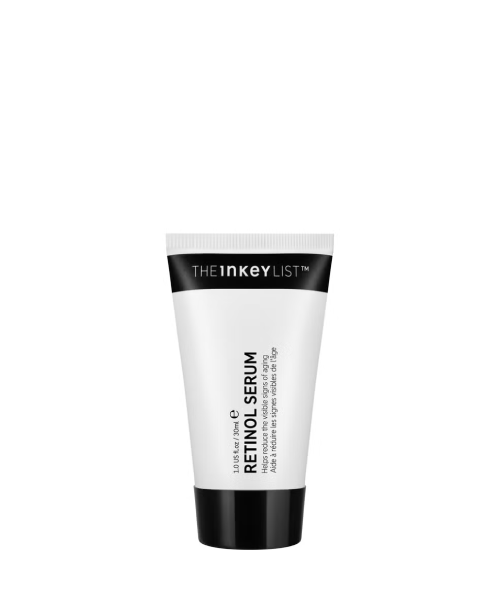
Around $15, and deliberately positioned at the cosmetic end of the ladder.
It uses an encapsulated slow-release dual-retinoid complex — 1% Granactive Retinoid Pro+ plus 0.01% retinal. The encapsulation is the point: it delivers a retinoid effect with the gradual release that makes the first few weeks tolerable, which is when most people abandon retinoids.
At this price, it’s also low-risk. If retinoids don’t suit you, you’ve spent $15 finding out rather than $70.
The drawbacks: it is genuinely gentle, which means results are slow and modest. Experienced retinoid users will find it underpowered. And the dual-complex formulation makes it hard to compare against a straightforward retinol percentage.
Buy it if: you’ve never used a retinoid, you have sensitive skin, or you’ve tried one before and reacted badly.
Skip it if: you already tolerate retinol at 0.5% or above.
Medik8 Crystal Retinal 3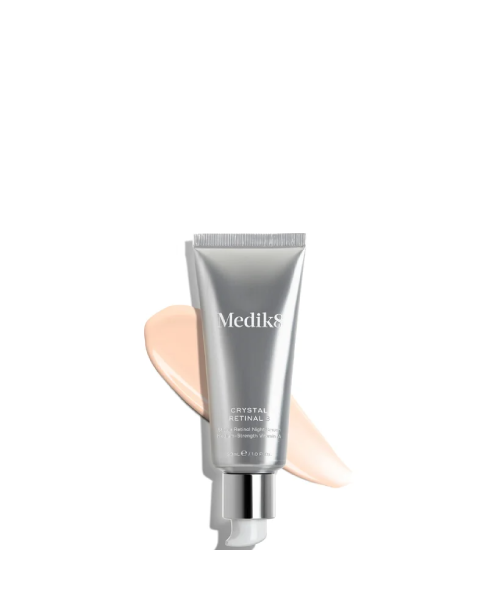
The entry point in Medik8’s retinal range and consistently the best-selling retinaldehyde product in pharmacy.
Encapsulated retinaldehyde at an introductory concentration. This is the product most often recommended to people who want to move beyond basic retinol without the retinisation period that puts them off. The encapsulation does real work here — as noted above, unencapsulated retinal is a stability problem.
It sits in a numbered range, so there’s a clear upgrade path: start at 3, move up as your skin adapts, over months rather than weeks.
The drawbacks: it’s substantially more expensive than the INKEY List option. Retinal’s evidence base is thinner than retinol’s. And the numbered naming obscures the actual percentage, which makes cross-brand comparison harder.
Buy it if: you tolerate low-strength retinol and want to progress, or you want a clear ladder to climb.
Skip it if: you’ve never used a retinoid — start lower — or you want the most evidence-backed molecule, which is still retinol.
Differin (Adapalene 0.1%)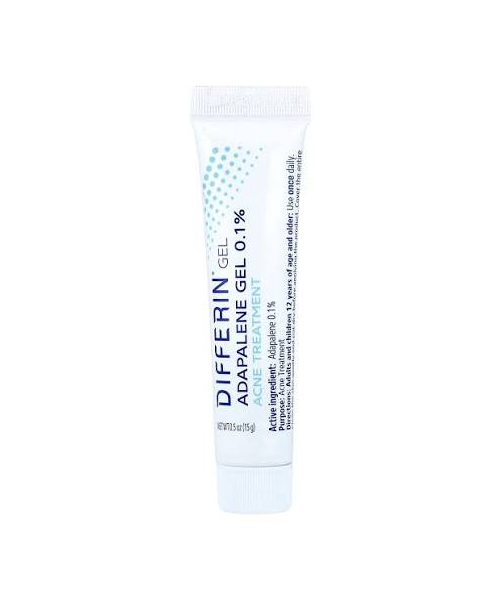
Around $15, available without prescription in the US, and genuinely different from the other two.
Adapalene binds directly to retinoic acid receptors, skipping conversion. That puts it functionally above every over-the-counter retinol, and 0.1% adapalene is roughly comparable in effect to the strongest retinol concentrations available.
Crucially, because it’s a synthetic retinoid, it tends to be less irritating than its potency would suggest — a genuinely favourable combination. And it was specifically developed for acne, where it outperforms retinol at any strength.
The drawbacks: it’s optimised for acne rather than anti-ageing, so if your concern is fine lines and texture rather than breakouts, retinol or retinal is a better fit. It still causes an initial purging period. And it’s prescription-only in the UK and some other markets.
Buy it if: your main concern is acne and you’re in a market where it’s available OTC.
Skip it if: you’re treating ageing rather than breakouts.
Two others worth knowing: The Ordinary Retinal 0.2% Emulsion is the brand’s most potent retinoid — stronger than its Retinol 1% in Squalane — and correspondingly more sensitising; it’s a value option for experienced users. Paula’s Choice Clinical PRO Retinaldehyde at around $68 uses calcium-encapsulated retinaldehyde and is a well-formulated premium option.
How to actually start
Night only. Retinoids degrade in UV and increase photosensitivity.
Start at twice a week, on completely dry skin, and build to every other night over four to six weeks, then nightly if comfortable. Going straight to nightly is the single most common reason people conclude retinoids don’t suit them.
A pea-sized amount for the whole face. More does not work faster.
Expect retinisation. Dryness, flaking and some redness in the first two to six weeks is normal and settles. Persistent burning or significant irritation is not — reduce frequency.
The sandwich method helps: moisturiser, then retinoid, then moisturiser. It reduces irritation meaningfully with only a small reduction in efficacy.
Sunscreen every morning is non-negotiable. Retinoids increase sun sensitivity, and sun damage undoes what you’re using them for.
Give it 8 to 12 weeks before judging results, and longer for fine lines.
Do not use retinoids in pregnancy or while breastfeeding. This applies to the whole class including over-the-counter products — speak to your doctor about alternatives such as azelaic acid.
Mistakes worth avoiding
Comparing percentages across different retinoids. 0.025% tretinoin beats 1% retinol. The number only means something within one molecule.
Buying non-encapsulated retinal. It degrades rapidly regardless of packaging.
Starting nightly. Two nights a week, then build. Most retinoid failures are pacing failures.
Using it with other strong actives at first. Give it its own night. Add exfoliating acids later if at all.
Applying to damp skin. It increases penetration and irritation. Wait until your face is fully dry.
Skipping sunscreen. Retinoids increase photosensitivity, and UV undoes the benefit.
Giving up at week three. That’s usually peak retinisation and the point just before it settles.
Believing the “10× stronger” retinal claims. The evidence is early and the comparisons are more modest than the marketing.
Frequently asked questions
Is 1% retinol stronger than 0.025% tretinoin?
No. Tretinoin is retinoic acid and needs no conversion, so even very low percentages are substantially stronger than the highest over-the-counter retinol.
Is retinal better than retinol?
It’s one conversion step closer to the active form, which should make it more efficient. But the evidence is early, and one study found retinal performing on par with retinol at the same percentage. Retinol is the better-understood ingredient.
What strength retinol should I start with?
Below 0.3%, or an encapsulated starter formulation. Build up over months.
What does encapsulated mean?
The molecule is wrapped in a carrier that protects it from degradation and releases it gradually, which improves stability and substantially reduces irritation.
Is adapalene stronger than retinol?
Yes. 0.1% adapalene is roughly comparable to the strongest OTC retinol, and 0.3% is stronger than any of them.
How long until I see results?
Eight to twelve weeks for texture and tone; longer for fine lines. Consistency matters more than strength.
Can I use retinoids while pregnant?
No. Retinoids are contraindicated in pregnancy and breastfeeding, including over-the-counter ones. Speak to your doctor about alternatives.
Why is my skin peeling?
Retinisation — normal in the first two to six weeks. Reduce frequency, use the sandwich method, and it settles.
The recommendation
If you’ve never used a retinoid, start with The INKEY List Starter Retinol Serum at around $15. Encapsulated, slow-release, cheap enough to find out whether retinoids suit you without committing.
If you already tolerate low-strength retinol and want to progress, move to Medik8 Crystal Retinal 3 and climb the numbered range over months, not weeks.
If your concern is acne rather than ageing, buy Differin (0.1% adapalene) — it outperforms retinol for breakouts at a comparable price and is available without prescription in the US.
Then go slowly, wear sunscreen, and judge it at twelve weeks. The percentage on the bottle matters far less than whether you’re still using it in three months.
Leave a comment