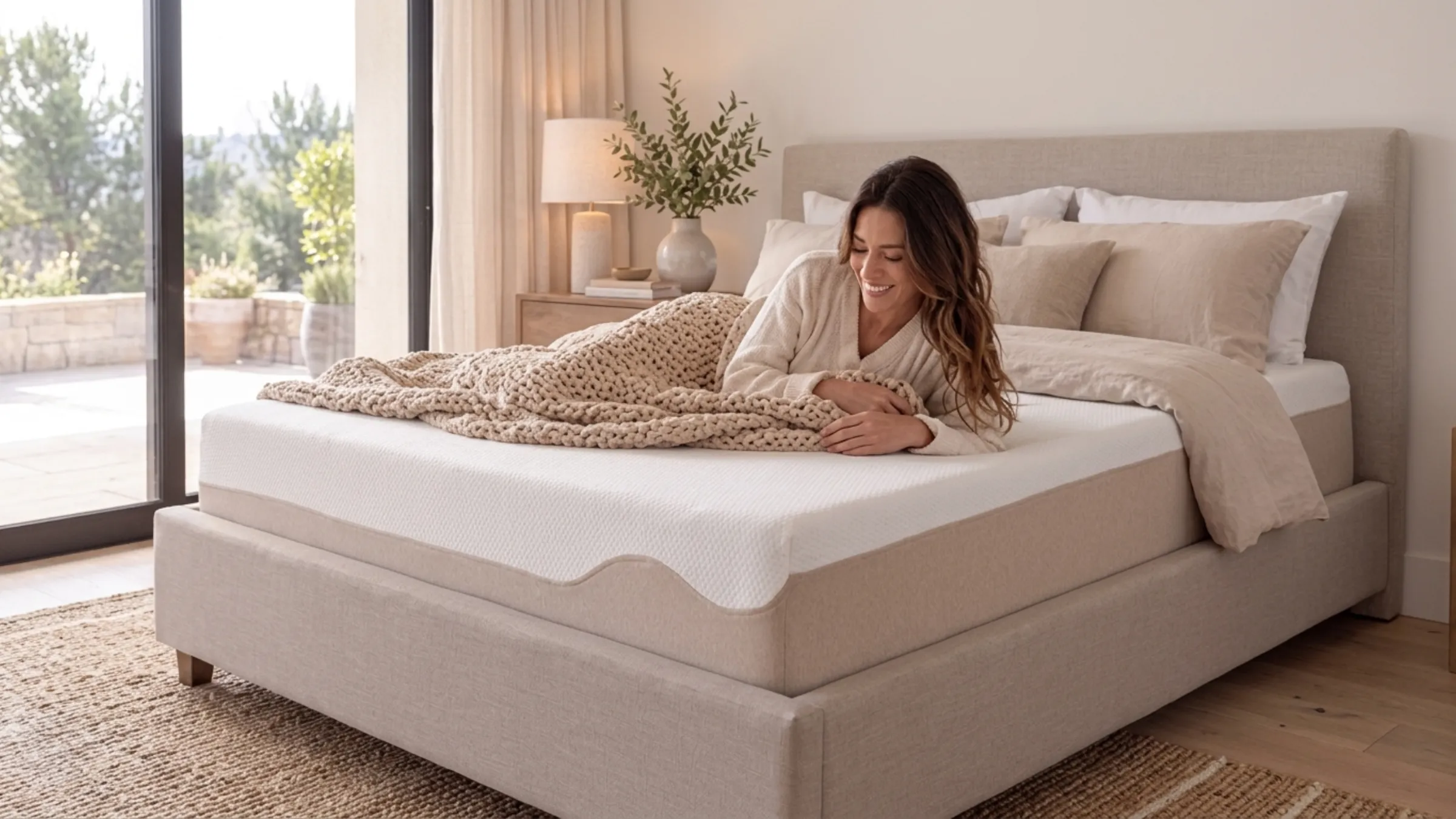
Most mattress topper purchases fail for one of two reasons. Either the buyer was trying to fix something a topper can’t fix, or they bought on thickness and softness and ignored the two numbers that actually predict how it performs.
The first one is worth settling immediately: a topper cannot fix a sagging mattress. If your bed dips in the middle, foam laid over the top will sink into the dip and follow its shape — in the case of cheap low-density foam, it will amplify it. You can’t build on a hole. If that’s your problem, the topper is the wrong purchase and you need a new mattress.
Everything below assumes your mattress still has structural support and the problem is the surface: too firm, too soft at the hips, too hot, or just worn in a way that’s uncomfortable rather than collapsed.
The short version
Two specifications predict quality better than brand or price. Density (for memory foam, in lb/ft³) tells you how long it will last. ILD tells you how firm it is. They are different measurements and get conflated constantly.
For memory foam, 3 lb/ft³ is the floor and 4–5 lb/ft³ is where it starts lasting. For firmness, err firmer than you think — you can add a soft layer on top of a firm topper, but you cannot add support to a soft one.
Latex outperforms memory foam on durability and temperature; memory foam beats it on deep pressure relief. Pick by which of those you need.
Density and ILD are not the same thing
This is the central confusion in the category, and getting it straight makes the rest of the decision easy.
Density is how much foam material occupies a cubic foot, measured in pounds. It predicts durability, not feel. More material means more cell walls to absorb each compression, which means it takes longer to break down. A dense foam can be soft or firm.
ILD — Indentation Load Deflection — is the measured force needed to compress the foam by a set amount. It predicts firmness. A low-ILD foam feels soft, a high-ILD foam feels firm, regardless of density.
Listings describe toppers as “medium-firm” or “plush,” which are marketing words with no definition. ILD is a measurement. As one specialist puts it: when comparing two similar-looking toppers, the one that publishes its ILD is usually the more honest product.
Density: what to look for in memory foam
Density | What to expect |
Under 3 lb/ft³ | Compresses quickly, loses shape within 1–2 years |
3 lb/ft³ | Acceptable minimum |
4 lb/ft³ (≈64 kg/m³) | Good everyday quality |
5 lb/ft³ and above | High density, typically 3–5 years of consistent feel |
Below 3 lb/ft³ is where most of the cheap toppers on marketplaces sit, and it’s why they flatten so fast. A listing that advertises thickness prominently and doesn’t mention density has made a choice about which number flatters it.
Latex is rated differently — ILD plus the manufacturing process and certification tell you more than a density figure, and quality natural latex is more durable than memory foam at any density.
ILD: what the numbers feel like
ILD | Feel | Typical use |
10–14 | Very soft | Deep contouring, very light sleepers |
14–19 | Soft | Side sleepers, pressure relief at shoulders and hips |
24–28 | Medium | General purpose, light adjustment |
28–36 | Medium-firm to firm | Back and stomach sleepers, adding support |
35–44 | Extra firm | Firm Dunlop latex, maximum support |
The rule worth remembering: if you’re unsure, choose firmer. A firm topper can be softened by adding a thin quilted pad or mattress protector on top. A soft topper cannot be made supportive by anything you put on it.
Thickness, and why thinner can feel firmer
Thickness is the specification everyone checks and it’s the least informative of the three, but it does matter in a way that catches people out.
2 inches is the minimum to change how a bed feels. Below that you’re adding a pad, not a topper.
3 inches is where you get a significant change in feel. This is the right choice if the mattress is noticeably too firm.
4 inches and above is a lot of foam. It can feel enveloping and make getting in and out of bed harder, and it may not fit under fitted sheets without deep pockets.
The counterintuitive part: at the same ILD, a thinner topper feels firmer than a thicker one. There’s less material to compress before you reach the mattress beneath. So a 2-inch 28-ILD topper and a 3-inch 28-ILD topper do not feel the same — the thicker one feels softer in use.
Thickness also interacts with sheets. Check your fitted sheet’s pocket depth before buying 3 or 4 inches, or budget for new ones.
The materials
Memory foam | Natural latex | Gel-infused foam | Wool | |
Pressure relief | Best | Good | Good | Moderate |
Temperature | Runs warm | Cool | Better than standard foam | Regulating |
Response | Slow, sinking | Springy, immediate | Slow | Immediate |
Durability | 2–5 yrs by density | 5–12 yrs | 2–5 yrs | Long |
Weight | Moderate | Heavy | Moderate | Light |
Price | Lower | Highest | Moderate | Moderate |
Memory foam
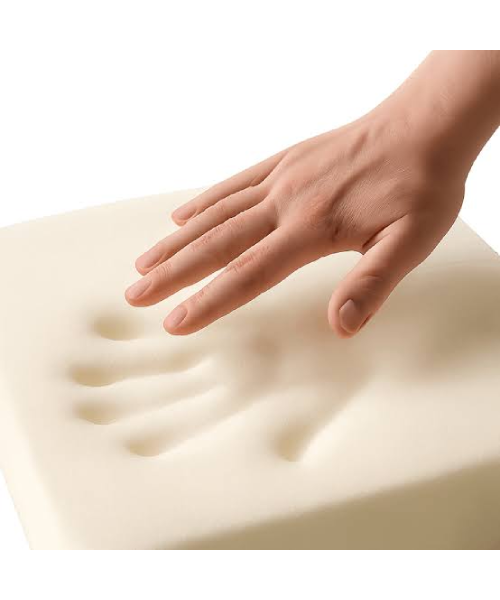
Memory foam responds to heat and weight, which is why it contours so closely around shoulders and hips. For anyone with pressure-point pain, nothing else matches it for sheer relief.
The trade-offs are temperature and response. Memory foam absorbs and holds body heat, which makes it the wrong choice if you sleep hot. And it responds slowly, so changing position means waiting for the foam to release — some people find this restful and others find it like sleeping in wet sand.
Buy it if: you have hip or shoulder pressure pain and you don’t sleep hot. Minimum 4 lb/ft³ density if you want it to last.
Skip it if: you sleep hot, or you move around a lot at night.
Natural latex
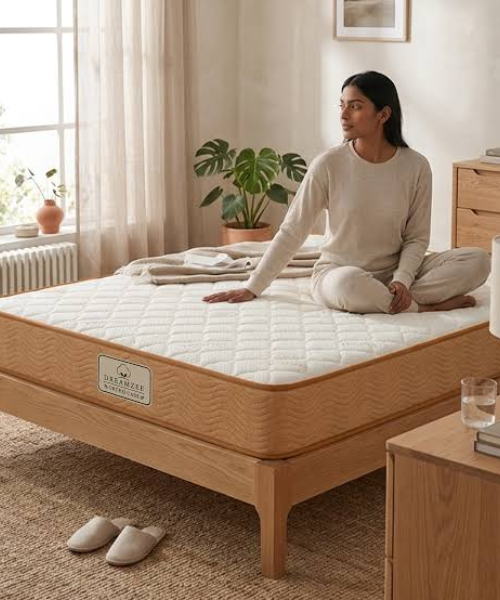
Latex is open-celled, which makes it meaningfully cooler than memory foam, and it’s springy rather than sinking — it pushes back immediately instead of slowly releasing.
It’s also the most durable option here by a clear margin. Quality natural latex toppers hold their feel for years where memory foam softens within two to five.
Dunlop vs Talalay is the main sub-choice. Dunlop is denser and firmer, better for support. Talalay is lighter and more uniform, better for a soft, consistent feel. Both are natural latex; they differ in how they’re made.
Avoid synthetic latex. It’s petroleum-based, off-gasses more, and doesn’t have the durability that makes natural latex worth the price. Look for a natural latex claim, and GOLS certification if you want organic — though natural and organic latex feel and perform identically at the same ILD, with the difference being certification and cost.
Buy it if: you sleep hot, you want it to last, or you need firm support rather than deep contouring.
Skip it if: budget is the main constraint, or you specifically want that sinking memory-foam feel.
Gel-infused memory foam
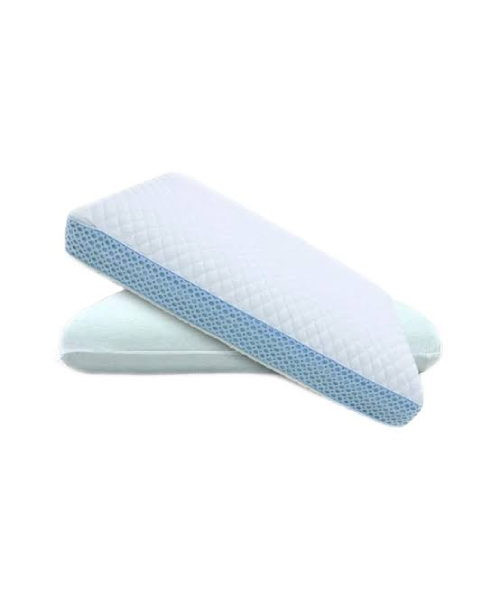
Memory foam with gel beads or a gel layer intended to improve heat dissipation. It does help, though it doesn’t make memory foam sleep as cool as latex.
Buy it if: you want memory foam’s pressure relief but run slightly warm.
Skip it if: you sleep genuinely hot — go latex instead.
Wool and budget options
Wool regulates temperature well and adds a modest amount of cushioning. It’s not a structural change to how the bed feels, so it won’t fix a too-firm mattress, but it’s good for temperature management and it’s breathable.
Egg crate foam is cheap convoluted polyfoam. It softens a surface slightly and compresses quickly. Reasonable for a guest room where the bed is used ten nights a year; a false economy anywhere else.
Matching the topper to the problem
Mattress too firm, pressure at hips and shoulders: memory foam, soft to medium ILD, 4 lb/ft³ minimum, 3 inches.
Mattress too firm but you sleep hot: natural latex, soft, 14–19 ILD, 2–3 inches.
Mattress too soft, you sink too far: firm natural latex, 28–36 ILD, 2 inches. Thinner is better here because you want support, not cushioning. Be realistic though — if the mattress is genuinely collapsed rather than just soft, see the next point.
Mattress sagging or dipped: none of the above. A topper follows the contour of what’s underneath. Replace the mattress.
Mattress fine, you just sleep hot: wool or latex. Not memory foam.
Guest room, used occasionally: budget memory foam or egg crate, accepting a short lifespan.
Certifications worth checking
CertiPUR-US for polyurethane and memory foam — covers emissions, content and durability testing. Widely available and worth insisting on, since foam you sleep on for years is foam you breathe.
OEKO-TEX for textiles and covers.
GOLS for organic latex, GOTS for organic cotton covers.
A foam topper with no certification at all, sold cheaply, is worth being cautious about — particularly if off-gassing bothers you.
Mistakes worth avoiding
Buying a topper to fix a sagging mattress. It won’t work, and the thicker and softer the topper, the worse it tracks the dip.
Confusing density with firmness. Density is durability. ILD is firmness. A 5 lb/ft³ foam can be soft.
Buying on thickness alone. Four inches of 2 lb/ft³ foam is worse than two inches of 5 lb/ft³.
Choosing too soft. You can add a soft layer over a firm topper. You cannot add support to a soft one.
Ignoring your fitted sheets. Three or four inches of extra depth needs deep-pocket sheets.
Expecting memory foam to sleep cool. Gel infusion helps at the margins. If you sleep hot, buy latex.
Not airing it out. New foam off-gasses. Unwrap it and leave it in a ventilated room for a day or two before putting sheets on.
Frequently asked questions
Can a mattress topper fix a sagging mattress?
No. Foam laid over a dip will follow the dip, and low-density foam will make it worse. Sagging is a structural failure and needs a new mattress.
What density memory foam topper should I buy?
3 lb/ft³ is the minimum worth considering; 4–5 lb/ft³ is where durability starts. Below 3 lb/ft³, expect it to flatten within a year or two.
What’s the difference between density and ILD?
Density measures material per cubic foot and predicts how long the foam lasts. ILD measures firmness. They’re independent of each other.
Is latex better than memory foam?
Latex is cooler and considerably more durable. Memory foam gives deeper pressure relief. Choose by whether your priority is comfort at pressure points or longevity and temperature.
How thick should a mattress topper be?
Two inches to change the feel slightly, three inches for a significant change. Four inches is a lot and affects sheet fit and getting in and out of bed.
Does a thicker topper feel softer?
At the same ILD, yes — there’s more material to compress before you reach the mattress. So thickness and firmness interact.
How long do mattress toppers last?
Low-density memory foam: two to three years. High-density memory foam: three to five. Quality natural latex: considerably longer.
The recommendation
First, check whether your mattress is sagging or just uncomfortable. If it’s sagging, stop — buy a mattress, not a topper.
If the surface is simply too firm, buy memory foam at 4 lb/ft³ or higher, 3 inches, in a soft to medium ILD — unless you sleep hot, in which case buy natural latex at 14–19 ILD instead.
If the mattress is too soft, buy firm latex at 28–36 ILD in a 2-inch thickness. Thinner and firmer is what adds support.
And whatever you choose, buy from a listing that publishes density and ILD. A seller who states those numbers is telling you something; a seller who only tells you it’s three inches and plush is telling you something too.

Leave a comment