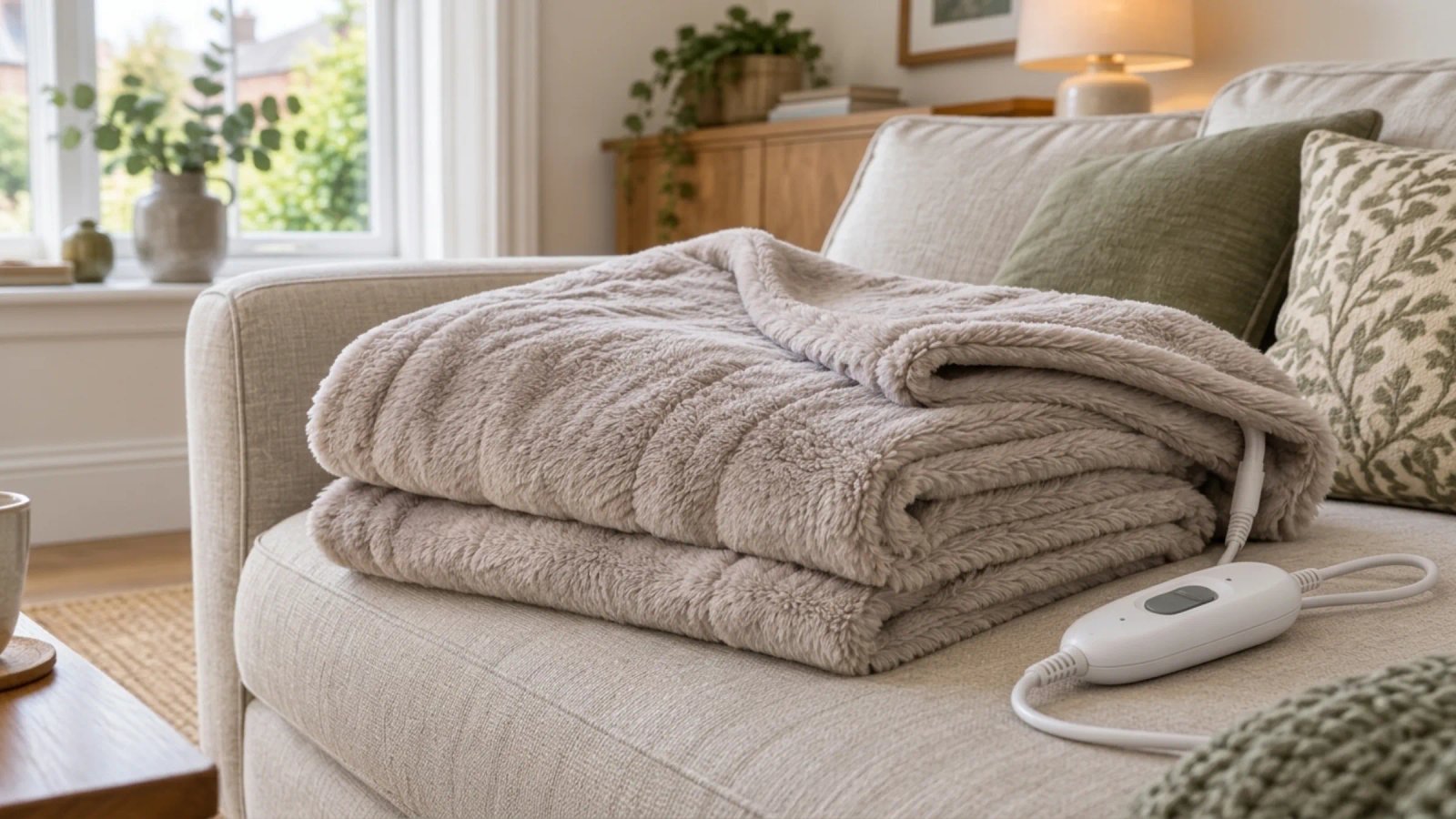
Heated Throw Blankets: The Four Specs That Actually Matter
Heated throws are one of the easiest winter purchases to get wrong, because almost every listing describes the same product in the same words. Soft. Plush. Machine washable. Multiple heat settings. Auto shut-off. Read ten product pages and you’ll come away knowing less than when you started.
The things that genuinely separate a good heated throw from a frustrating one are rarely in the headline bullets. How long before it shuts itself off. Whether the controller comes off for washing. Whether it carries a safety certification mark. And what temperature it actually reaches — a number that is, remarkably, almost never published.
This guide covers all four, works through what one of these costs to run, and then applies the criteria to three throws at three price points. It’s based on manufacturer specifications and retailer documentation rather than hands-on testing.
The short version
The Pure Enrichment PureRelief Plush is the pick for most people at around $70 — it’s the only throw here that publishes its actual temperature range, and it carries a five-year warranty, which is unusual in this category. The Sunbeam Nordic Premium is the established-brand option with a longer four-hour shut-off and UL certification. And there’s a large sub-$35 segment on Walmart and Amazon that is genuinely usable if you know which three things to check — covered below.
Auto shut-off is a usability spec, not just a safety one
Every heated throw turns itself off after a set period. That’s a safety requirement and a good thing. But the duration varies far more than people expect, and it affects daily use more than any other single specification.
Two hours sounds generous until you’re watching a film. The Pure Enrichment throw shuts off after 120 minutes. The L.L.Bean heated throw is also two hours. Plenty of budget models run to three or four, and some go as high as ten.
In practice, a two-hour timer means getting up, finding the controller, and restarting it partway through an evening. That’s a minor annoyance if the throw lives on the sofa and a real one if you fall asleep under it. A four-hour shut-off covers almost any evening without intervention.
Longer isn’t automatically better, though. A ten-hour timer on a blanket you use in bed is doing very little as a safety feature. If you want something that stays on all night, that’s a decision to make deliberately rather than by accident, and it’s worth favouring a model with overheat protection as well as a timer.
What to do: decide whether this is a sofa throw or a bed blanket. For the sofa, three to four hours is the sweet spot. For bed, prioritise overheat protection over timer length.
Check for a certification mark
This is the one specification that is genuinely non-negotiable, and it is also the easiest to verify.
Look for UL or ETL on the listing. Both indicate the product has been tested to recognised North American safety standards for electrical household goods. Sunbeam’s Nordic Premium throw lists UL certification. Many of the budget throws list ETL, which is equally valid — ETL is a testing mark from Intertek against the same standards, not a lesser alternative.
What should concern you is a listing that mentions neither. Heated throws contain live wiring that you sit on, fold, wash and sleep under. A listing proudly advertising nine heat levels and overheat protection while saying nothing at all about certification has chosen which facts to lead with.
If the product page doesn’t say, check the manufacturer’s own site before buying. If neither says, buy something else. This is not an area to save ten dollars on.
The controller has to come off
“Machine washable” appears on virtually every heated throw sold. It means something slightly different on each one.
The wiring inside the blanket is generally fine getting wet — it’s sealed. The controller is not. On a well-designed throw, the controller detaches at a connector near the hem, you wash the blanket alone, and you reconnect it afterwards. Pure Enrichment specifies a detachable LED controller. Sunbeam’s throws are listed as machine washable and dryer safe.
Where it goes wrong is with models where the controller is awkward to remove, or where the manufacturer permits washing but not tumble drying, or specifies cold water and gentle cycle only. None of that is unreasonable, but it is worth knowing before you buy a blanket you expect to wash regularly — and if you have pets or children, you will wash it regularly.
A few more things worth knowing about washing heated throws generally: don’t dry clean them, don’t wring them out, and don’t use them again until they’re completely dry. The solvents and the twisting are both bad for the internal wiring.
What to check: does the listing say the controller detaches? Does it say dryer safe, or only machine washable? Those two phrases are not interchangeable.
Nobody tells you how hot it gets — except one brand
Here’s the odd gap in this entire product category. Listings advertise four heat levels, or six, or nine. None of them tell you what those levels correspond to in degrees.
Pure Enrichment is the exception. It publishes a range of 90°F to 105°F across its four settings on the PureRelief Plush. That’s a useful benchmark to carry into any other purchase, because it tells you roughly what this category delivers: meaningfully above body temperature at the top end, mildly warm at the bottom.
It also puts the “heat levels” arms race in perspective. A throw advertising nine or ten settings isn’t getting hotter than one with four — it’s dividing roughly the same range into more increments. The ceiling is bounded by the same safety considerations for everyone. More settings gives you finer control, which is a genuine if modest benefit, but it is not more heat.
Treat a high settings count as a nice-to-have rather than a reason to choose one throw over another. Treat a published temperature range as a sign of a manufacturer willing to be specific.
What it costs to run
This is the main reason people buy heated throws, and the maths is simple enough to do yourself.
Heated throws typically draw somewhere between 50 and 120 watts depending on size and setting. The formula is:
(watts ÷ 1000) × hours used × your electricity rate per kWh = cost
So a 100-watt throw used for four hours in an evening consumes 0.4 kWh. At an assumed rate of $0.17 per kWh, that’s about seven cents an evening — roughly $2 a month if you use it every single night.
Compare that to the alternative. A portable space heater typically draws 1,500 watts. Four hours of that is 6 kWh, or around a dollar at the same rate — somewhere in the region of fifteen times the cost.
Two caveats. First, plug in your own electricity rate rather than the assumed one above; US rates vary enormously by state. Second, a heated throw and a space heater aren’t doing the same job. The throw warms one person. The heater warms a room. If you’re alone in the evening and the rest of the house is empty, the throw is the obvious win. If there are four of you, the comparison gets murkier.
The honest version of the energy-saving claim is this: a heated throw lets you drop the thermostat a degree or two and stay comfortable while sitting still. That’s a real saving. It is not a replacement for heating your home.
The three picks
Pure Enrichment PureRelief Plush | Sunbeam Nordic Premium | Budget segment | |
Price | Around $70 | Around $70–100 | $26–35 |
Size | 50" x 60" | 50" x 60" | Usually 50" x 60" |
Heat settings | 4 | 3–4 (listings vary) | 4–9 |
Temp range | 90–105°F published | Not published | Not published |
Auto shut-off | 2 hours | 4 hours | 2–10 hours |
Certification | Check listing | UL | Usually ETL |
Controller | Detachable LED | Detachable | Varies |
Care | Machine washable | Washable, dryer safe | Usually machine washable |
Warranty | 5 years | Standard | Minimal |
Pure Enrichment PureRelief Plush — the one to get
At around $70 this is the throw that gives you the most information about what you’re buying, which in a category this opaque counts for a lot.
The published 90–105°F range across four settings is the headline, but the five-year warranty is arguably more valuable. Heated throws fail at the wiring and the connector, usually after a couple of seasons, and most of this category offers a year at best. Five years changes the arithmetic on a $70 purchase considerably. The detachable LED controller makes washing straightforward, and it ships with a storage bag, which sounds like a trivial inclusion until you’ve tried to fold one of these neatly into a linen cupboard.
The drawback is the two-hour shut-off, which is the shortest of the three options here and the thing most likely to irritate you day to day. At 50" x 60" it’s a single-person throw — comfortable over one adult on a sofa, not enough for two.
Buy it if: you want the longest warranty and you’re buying for one person.
Skip it if: a two-hour timer will annoy you, or you need something large enough to share.
Sunbeam Nordic
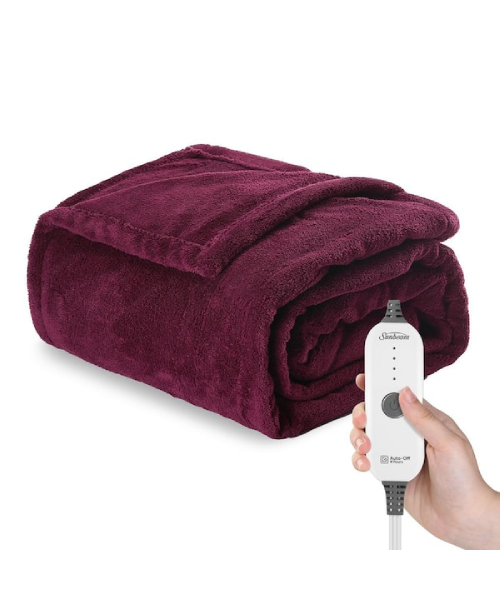
Sunbeam has been making heated bedding for decades, and the practical benefit of that is a supply of replacement controllers and a company likely to still exist when something goes wrong.
The four-hour auto shut-off is the most useful in this comparison — it covers a full evening without intervention. UL certification is explicitly listed. Machine washable and dryer safe, which is a slightly stronger claim than washable alone.
One flag: the Walmart listing for this model is internally inconsistent, with the title specifying four heat settings and the feature bullets saying three. That’s a listing error rather than a product flaw, but it illustrates why you should check the manufacturer’s own specifications rather than trusting retailer copy. Confirm the setting count before you buy if it matters to you.
Buy it if: you want the longer shut-off and a brand with a long-term parts supply.
Skip it if: you want a published temperature range or a long warranty.
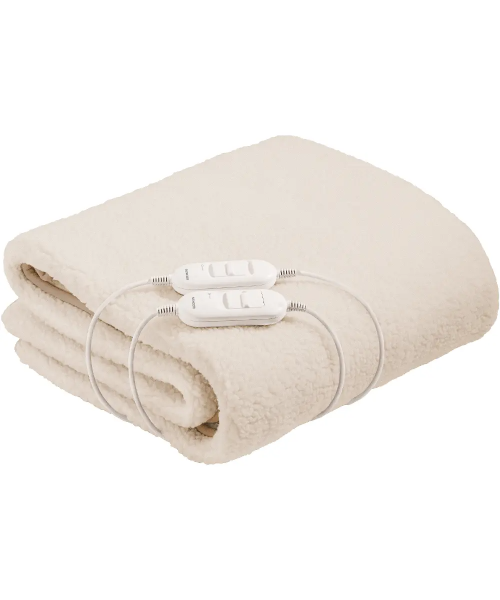
There’s a large market of heated throws from brands like JUSTLET, WISHEAD and GOTCOZY, mostly at 50" x 60", typically $26 to $35, usually listing ETL certification, four to nine heat levels, and timers running from two to ten hours.
These are not a trap. Many are perfectly good, and at a third of the price of the branded options, a two-season lifespan is defensible. But buy them on the three things you can actually verify rather than on the feature list:
Is ETL or UL stated explicitly? If not, move on.
Does the controller detach? The listing should say so plainly.
What’s the shut-off duration? Pick one in the three-to-four-hour range.
Ignore the heat level count, ignore the GSM figure unless you know what you’re comparing it to, and treat the review count with scepticism in a category where listings are frequently relaunched under new names.
Buy one if: you want a second throw for a spare room, you’re buying for a household with several people, or you’d rather replace cheaply than repair.
Skip it if: you want a warranty worth claiming on.
Who shouldn’t use a heated throw
This matters and most roundups skip it. Heated bedding is not suitable for everyone. Anyone with reduced sensation in the skin — including from diabetes-related nerve damage — may not feel a burn developing. The same caution applies to infants, to anyone unable to operate the controller themselves, and to pets, who will shred the wiring given the opportunity.
If any of that applies in your household, check the manufacturer’s safety sheet and speak to a doctor or pharmacist before buying. Don’t rely on a product listing to flag it for you.
Mistakes worth avoiding
Using it folded or tucked in. This is the most common misuse. Folding concentrates heat in one spot and is the leading cause of damage and scorching. Heated throws go over you, not under you, and not bunched up.
Using an extension cord. Most manufacturers explicitly advise against it. If your sofa is far from an outlet, that’s a furniture problem rather than a reason to improvise.
Buying throw size when you need blanket size. Most heated throws are 50" x 60", which covers one seated adult. If two people want to share, you need a full-size heated blanket, not a bigger throw.
Ignoring the controller length. A short cord between blanket and controller means the controller ends up somewhere awkward. Listings rarely state this; product photos sometimes show it.
Storing it with the controller attached and the cord wrapped tight. Wrapping the cable around the folded blanket stresses the connector, which is the part most likely to fail.
Frequently asked questions
Do heated throws use a lot of electricity?
No. Most draw 50–120 watts, which works out to a few cents per evening at typical US rates. A space heater draws around 1,500 watts, roughly fifteen times as much.
Can you wash a heated throw?
Most are machine washable, but check whether the controller detaches and whether the model is dryer safe or air-dry only. Never dry clean, never wring, and never use it until it’s completely dry.
How hot do heated throws actually get?
Where published, around 90–105°F across the settings range. Most manufacturers don’t publish this figure. More heat settings does not mean a higher maximum temperature.
Is UL or ETL better?
Neither. Both are recognised testing marks against the same North American safety standards. A listing with either is fine; a listing with neither is the problem.
How long do heated throws last?
Typically a few seasons, with the connector and wiring being the usual failure points. Warranty length is a reasonable proxy for manufacturer confidence — most offer a year, some offer five.
Throw or full blanket?
A throw at 50" x 60" suits one person on a sofa. For a bed, or for two people, buy a full-size heated blanket instead.
The recommendation
For a single person buying one heated throw, the Pure Enrichment PureRelief Plush is the sensible default. The published temperature range and the five-year warranty are both rare in this category and both indicate a manufacturer willing to stand behind the product.
Choose the Sunbeam Nordic Premium if the two-hour shut-off would bother you — four hours is a meaningfully better fit for evening use, and the brand’s longevity is worth something.
Buy from the budget segment if you need two or three throws rather than one, and apply the three-point check above rather than the feature list.
Leave a comment