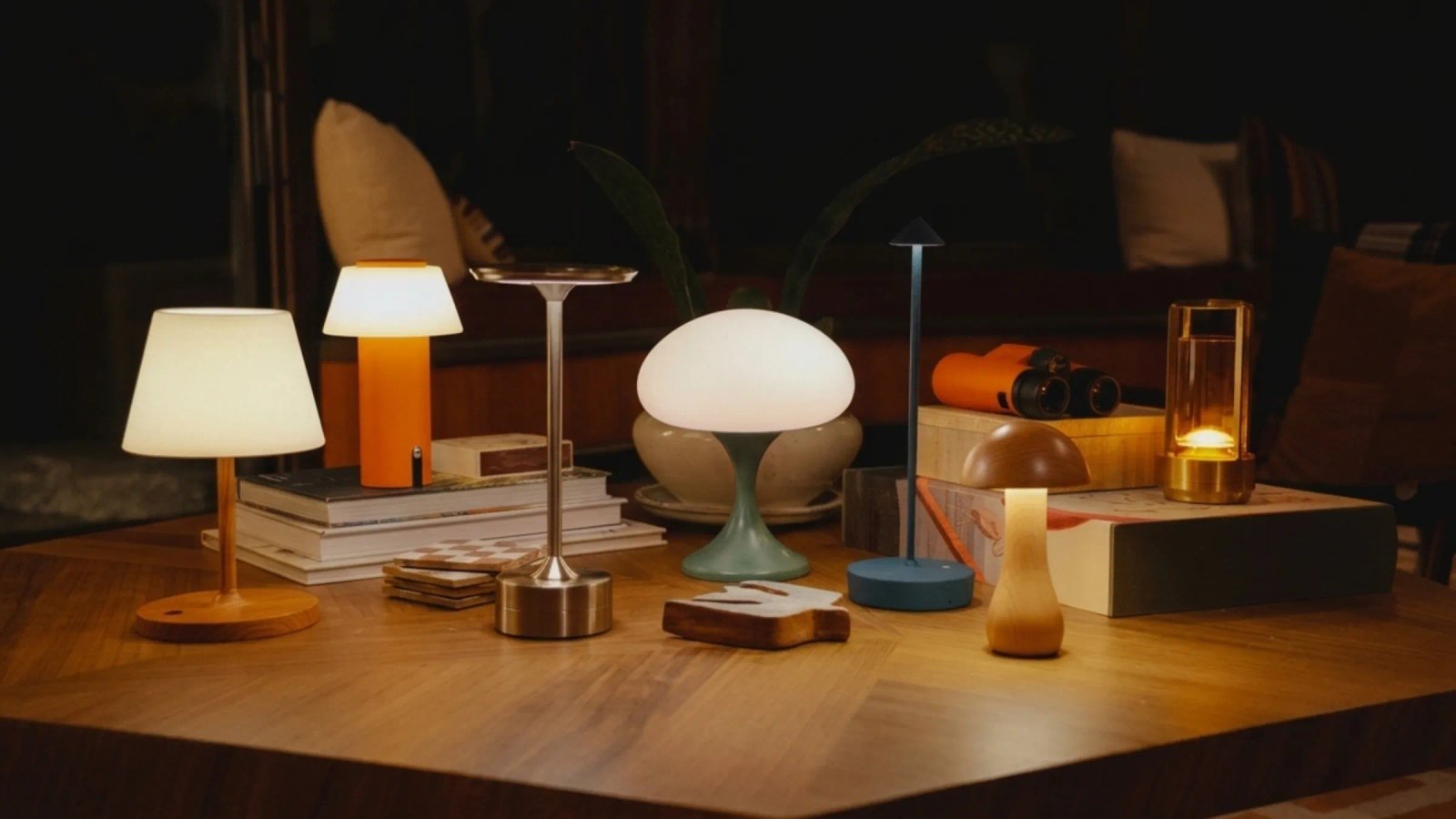
Cordless Table Lamps for Dining Tables: What Actually Works at Eye Level
The appeal is easy to understand. You’ve eaten somewhere with a small warm lamp on every table, the kind that throws a soft circle of light across the linen and makes the room feel considered rather than merely lit, and you’ve wanted that at home. Rechargeable lamps make it possible without an electrician, an extension lead taped to a table leg, or a candle that drips on your tablecloth.
What’s less obvious is that most lamps sold for this purpose don’t produce that effect at all. They produce a glowing object sitting on a table, which is a different thing. The gap between those two outcomes comes down to four specifications that product listings rarely emphasise: how tall the lamp is, how narrowly it throws light downward, how warm that light is, and how long the battery survives being charged every single day.
The short version
If you want the restaurant effect and you’re prepared to pay for it, the Zafferano Poldina Pro is the reference product — the narrowest downward beam here and the only one with a candlelight setting. If you want a design piece that happens to be cordless, the &Tradition Flowerpot VP9 is a 1968 icon with the best colour rendering of the three. If you want warm atmosphere rather than functional table light without spending $300, the Fatboy Edison the Petit is a soft all-over glow at a fraction of the price.
Those are three different jobs, not three grades of the same thing.
The height problem nobody mentions
Dining tables are typically around 30 inches tall. Put a 15-inch lamp on one and the top of the shade sits at roughly 45 inches from the floor. Now sit down at that table.
For most adults, seated eye level lands in that same general range. The lamp is no longer a low pool of light; it’s an object directly in your line of sight to whoever is sitting opposite. On a wide or long table it doesn’t matter much — the lamp sits off to one side of any given sightline. On a narrow two-person table, or a small round table where everyone faces the centre, a tall lamp genuinely gets in the way.
Before you buy, sit at your table and measure from the floor to your eye line. Compare that to the lamp’s height plus the 30-odd inches of table beneath it. If the shade is going to land within a few inches of your eye line and your table is narrow, go shorter.
This is also why restaurants get away with tall lamps that would be awkward at home. Restaurant tables are often wider, and the lamp usually sits toward the wall side or against a banquette rather than dead centre.
Beam angle decides what you actually get
This is the distinction that separates lamps which do the job from lamps which merely look the part.
A lamp with an opaque shade and a defined downward beam concentrates light onto the table surface. That’s the restaurant effect: a bright circle on the table, faces lit softly from below, the rest of the room falling away. The Poldina Pro publishes a 45-degree beam angle, which is why it reads the way it does.
A lamp whose entire body glows — shade and base both emitting light — does close to the opposite. It spreads light outward in all directions, lifting the ambient level slightly while putting very little onto the table itself. The Fatboy Edison the Petit works this way by design.
Neither approach is wrong. But if you buy an all-over glow expecting a defined pool of light, you’ll be disappointed, and no amount of dimming will fix it. Check whether the shade is opaque and whether a beam angle is published. If light escapes upward and sideways, you’re buying atmosphere, not table lighting.
Lumens: a six-fold spread
The three lamps here range from 43 lumens to 256. That’s a big spread for products that look similar in photographs.
Dinner doesn’t need much light — you’re not reading fine print. But you do want to see what’s on the plate, read a wine label, and make out the face opposite you. At around 43 lumens you’re getting presence and warmth rather than usable illumination: pleasant alongside other lighting, insufficient alone. At around 250 lumens you can actually light a place setting and still dim down when you want to.
The practical point is that a dimmable lamp with a higher maximum is more flexible. You can always turn a bright lamp down. You cannot turn a dim lamp up.
Colour temperature, and the case for 2200K
Most cordless lamps are fixed at 2700K warm white. That’s a reasonable default and looks fine at a table.
The Poldina Pro also offers 2200K — considerably warmer, closer to candlelight. For evening dining this is a real advantage rather than a marketing bullet. It flatters food and skin tones and reads as firelight rather than as a lamp.
Colour rendering index (CRI) is worth a glance too. It describes how accurately colours appear under the light. The Flowerpot VP9 publishes a CRI above 90, which is high; the Poldina Pro publishes 80, which is ordinary. On a table with food on it, higher CRI makes a visible difference to how appetising things look.
Battery life: cycles matter more than hours
Every listing advertises runtime per charge. Almost none mention charge cycles, and for a lamp you use nightly, cycles determine how long you own a working product.
Zafferano publishes that the Poldina Pro’s battery is rated for roughly 450 recharges. Charged every evening, that’s a little over a year before you should expect meaningful capacity loss — the lamp won’t stop working, but runtime will shrink. &Tradition publishes a replaceable battery for the VP9 and sells replacements directly.
The models that should worry you are the ones with a sealed, non-replaceable battery. When that cell degrades, the lamp is disposable. For a $40 lamp that may be acceptable. Above $100, a replaceable battery should be close to a requirement, and the absence of any published cycle rating is itself informative.
Charging method matters less but is still real. A contact base means setting the lamp down and nothing else — convenient daily, but it’s another object taking up space. A USB cable is more portable and easier to replace, but you have to plug in each time, and some models ship the cable without a wall adapter.
The IP rating trap
If you plan to carry the lamp out to a patio table, read the fine print, because this is where marketing copy is least reliable.
Zafferano rates the Poldina Pro at IP65, which is genuinely weather-resistant — but the metal leaf and galvanic finishes are recommended for indoor use only. Same model, same headline rating, and a restriction that only appears in the descriptive text. Buy the gold leaf version for the patio and you’ve bought the wrong finish.
The Flowerpot VP9 is IP44, which covers splashes rather than weather; it should come indoors at night. The Fatboy Edison the Petit is listed at IP21, a low rating covering dripping water only, despite some retailer copy calling it weatherproof. The polyethylene body is robust and UV-resistant, but IP21 does not mean leave it out in the rain.
The three lamps
Zafferano Poldina Pro | &Tradition Flowerpot VP9 | Fatboy Edison the Petit | |
Height | 14.96 in / 38 cm | 11.6 in / 29.5 cm | 10 in / 25 cm |
Max output | 234–256 lm | 104 lm | 43 lm |
Colour temp | 2200 / 2700 / 3000K | 2700K | 2700K |
CRI | 80 | Above 90 | Not published |
Dimming | Continuous | 3 levels | 3 levels |
Runtime | 12 hrs | 10 hrs | 24 / 15 / 6 hrs by level |
Charge time | 6–7 hrs | 8 hrs | About 3 hrs |
Charging | Contact base | Magnetic USB cable | USB cable |
IP rating | IP65 (leaf finishes indoor only) | IP44 | IP21 |
Battery | Replaceable, approx. 450 cycles | Replaceable | Not published |
Price | From $175 | From $315 | Around $100–160 |
Zafferano Poldina Pro — the one the category copied
Zafferano launched the Poldina in 2018 and effectively created this product category. In Italy the name has become near-synonymous with “rechargeable table lamp,” which is both a compliment and a warning about the number of imitations in circulation.
It earns the position. The 45-degree beam through an opaque polycarbonate diffuser produces the pool of light most buyers are actually chasing. Continuous touch dimming is more useful at a table than stepped levels, because the right brightness for a dinner party is rarely one of three presets. The three colour temperatures cover genuinely different moods. Twelve hours of runtime comfortably outlasts any dinner. The die-cast aluminium body is heavy enough to feel stable rather than tippy, which matters when people reach across a table.
The drawbacks are real. At nearly 15 inches it’s the tallest lamp here and the most likely to interfere with sightlines on a narrow table. CRI of 80 is unremarkable at this price. The contact base is convenient but it’s a second object to accommodate, and the lamp won’t charge without it. The price also jumps sharply for metallic and leaf finishes — which are the same finishes you can’t take outdoors.
Buy it if: you want the restaurant effect specifically and have a table wide enough to carry a taller lamp.
Skip it if: your dining table is narrow or small and round, or you mainly want a decorative glow.
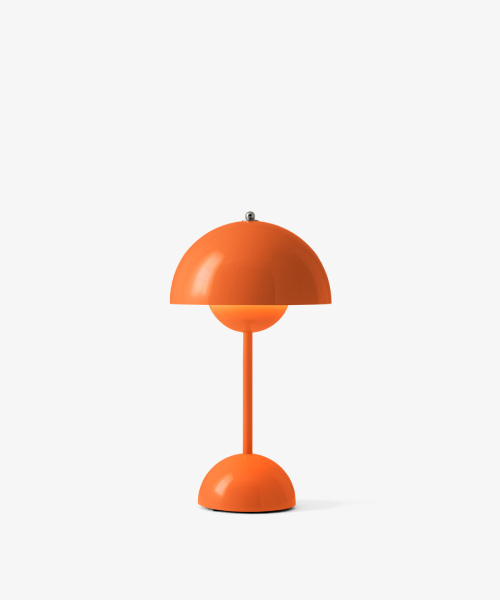
Verner Panton designed the Flowerpot in 1968 and it became a symbol of the era. The VP9 is that shape rebuilt in polycarbonate and steel with a rechargeable battery, slightly smaller than the mains-powered version.
What it does better than the Poldina is colour. A CRI above 90 is high for this category, and on a laid table it shows — colours look accurate rather than flattened. At 11.6 inches it’s noticeably shorter and less intrusive at eye level. The three-level dimmer bottoms out at 20%, which is genuinely soft. The battery is replaceable and &Tradition sells replacements.
Against it: 104 lumens is modest, and the stepped dimming gives you less fine control than the spec implies. Ten hours of runtime against eight hours of charging is the least convenient ratio here — this is a lamp you charge overnight, not one you top up between uses. At $315 for matte finishes, and more for brass or chrome, you’re paying substantially for design heritage. That’s a legitimate reason to buy, but worth being clear-eyed about.
Buy it if: the design matters to you independently of performance, or the shorter height solves a sightline problem.
Skip it if: you need brightness, want fast recharging, or the premium doesn’t buy you anything you care about.
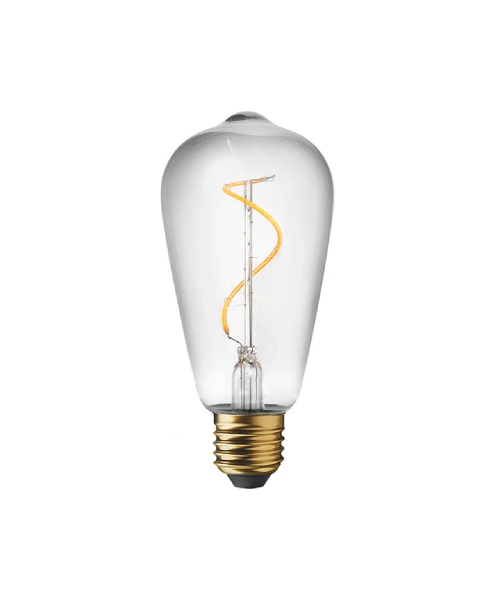
Designed by DeMakersVan for Fatboy, this is the odd one out, deliberately. Its polyethylene body lights up across its entire surface — shade and base together — so rather than throwing light down onto the table, it sits there as a warm luminous object.
That makes it the wrong choice if you want a pool of light, and the right choice if you want a few warm points of light along a long table, on a sideboard, or on a covered terrace. At its lowest setting it runs for a claimed 24 hours, far more than anything else here, and recharges in about three hours. At 10 inches it stays well below eye level. The plastic construction is light, robust and easy to wipe clean, which matters more at a dining table than it sounds.
The compromises are significant. At 43 lumens it isn’t a functional light source to eat by on its own. There’s no published CRI. The IP21 rating means it isn’t a genuine outdoor lamp despite how it’s sometimes described. And the adapter isn’t always included with the cable.
Buy it if: you want several warm glowing objects rather than one task light, or you’re buying in pairs for a longer table.
Skip it if: you’re expecting the restaurant pool-of-light effect. This lamp does not do that.
What about the cheap ones?
There’s a large market of sub-$50 cordless table lamps, mostly unbranded, widely available online. None are recommended here, for a specific reason rather than snobbery: their published specifications are frequently unverifiable. Battery capacities are quoted in milliamp-hours without runtime at a stated brightness, lumens often go unlisted, and cycle ratings are essentially never published.
That doesn’t make them bad — some are perfectly good. But if you’re shopping in that bracket, judge them on what you can confirm. Is the shade opaque, or does the whole body glow? Is a lumen figure published at all? Is there a stated colour temperature? Does the listing say whether the battery can be replaced? A listing that answers those four questions is more trustworthy than one quoting an impressive milliamp-hour number and nothing else.
Mistakes worth avoiding
Buying on looks alone from a product photo. These lamps are almost always photographed in near-darkness at full brightness, which flatters every model equally and tells you nothing about beam shape.
Ignoring the charging routine. A lamp you use nightly is a lamp you charge nightly. Decide now where the base or cable will live. If the answer is “I’ll figure it out,” the lamp will spend most of its life flat.
Buying one when you need two. On a table seating six or more, a single small lamp looks marooned. Two or three lower, cheaper lamps often read better than one expensive tall one.
Assuming an IP rating covers every finish. As above, it may not.
Over-indexing on runtime. Twelve hours versus ten hours is irrelevant for dinner. Charge cycles and charge time matter far more.
Frequently asked questions
How long do cordless table lamps last before the battery dies?
Runtime per charge is typically 6–12 hours at full brightness and longer when dimmed. Overall lifespan is better predicted by charge cycles — the Poldina Pro is rated for roughly 450. Charged daily, that’s a little over a year before noticeable capacity loss. Models with replaceable batteries can be refreshed; sealed ones cannot.
Are cordless table lamps bright enough to eat by?
The brighter models are. Around 250 lumens with a downward beam will comfortably light a place setting. Around 40–100 lumens gives atmosphere and presence but works best alongside other lighting.
Can I use one outdoors?
Only if the IP rating supports it, and only for the specific finish you’re buying. IP65 is weather-resistant, IP44 handles splashes but should come indoors, IP21 is effectively indoor-only.
Do cordless table lamps have replaceable batteries?
The better ones do. Zafferano and &Tradition both publish replaceable batteries and sell replacements. Many budget models don’t, which effectively makes them consumable.
What colour temperature is best for a dining table?
2700K warm white is a safe default. 2200K is warmer still and reads as candlelight, which suits evening dining particularly well. Avoid anything above 3000K at a table.
How tall should the lamp be?
Shorter than you’d assume. Measure your seated eye level and work backwards. On narrow or small round tables, aim for roughly 10–12 inches. Taller lamps suit wider tables or placement toward one edge.
The recommendation
For most people buying a cordless lamp specifically for a dining table, the Zafferano Poldina Pro is the one to get, provided your table is wide enough to carry its height. It’s the only lamp here that reliably produces the effect people are actually shopping for, the candlelight setting earns its place, and the replaceable battery with a published cycle rating is the kind of transparency worth paying for.
Choose the Flowerpot VP9 if the design matters to you independently of performance, or if its shorter height solves a sightline problem the Poldina would create.
Choose the Edison the Petit — ideally two of them — if you want warmth along the length of a table rather than a single pool of light. Just buy it knowing what it is.

Leave a comment