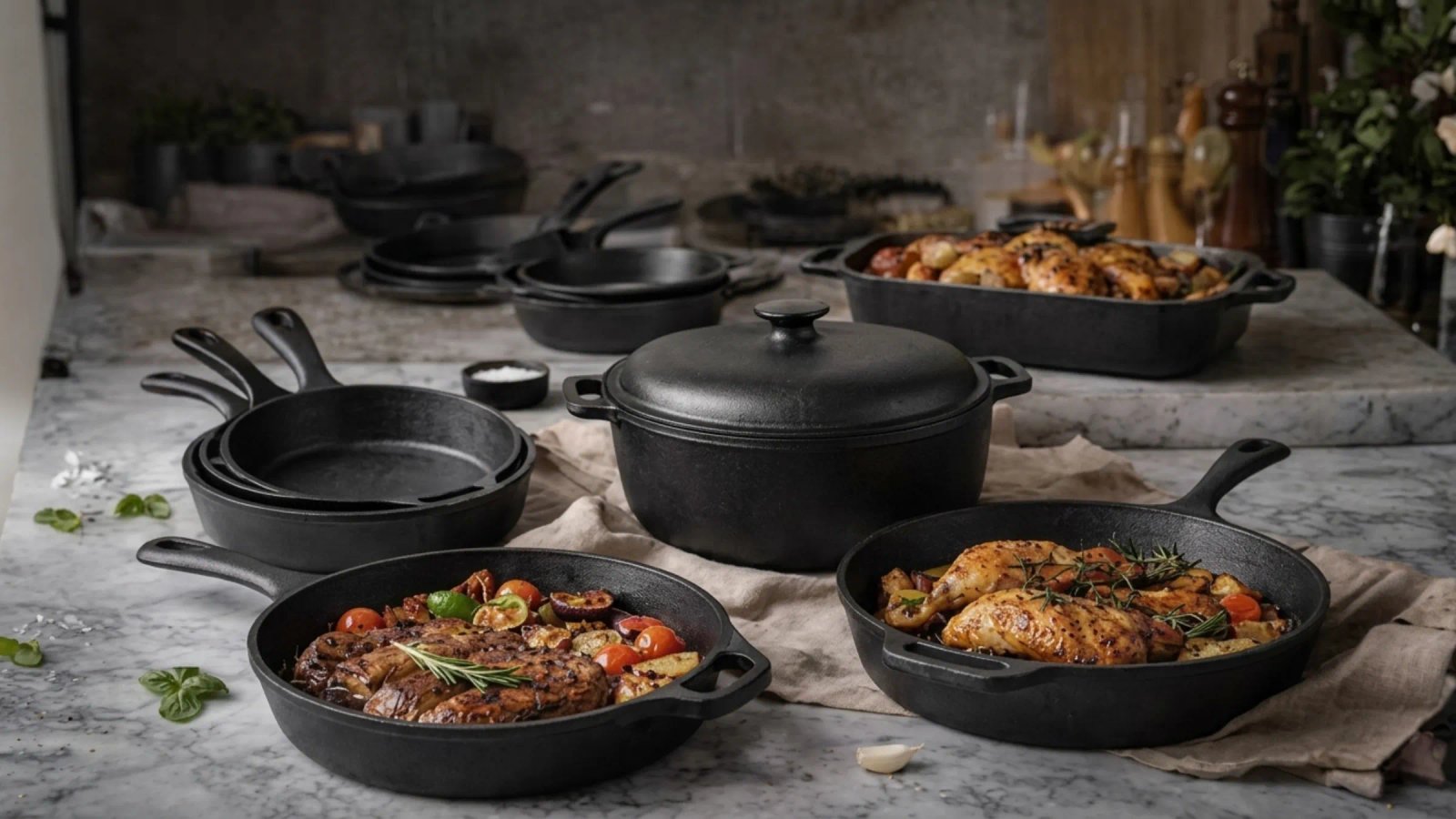
A Lodge enamelled Dutch oven costs around $90. A Le Creuset of similar size costs three to four times that. A Staub sits in the same premium bracket.
All three are enamelled cast iron. All three braise, stew, bake bread and hold heat. Independent comparisons repeatedly conclude that Lodge delivers something in the region of 80–90% of the performance for a fraction of the price.
So the honest question isn’t which one cooks better. It’s whether the remaining 10–20% — plus finish quality, weight, handle design, warranty and the fact that it looks like a Le Creuset — is worth two or three hundred dollars to you.
Here’s exactly what differs, so you can answer that for yourself.
The short version
Lodge Essential Enamel 6 qt (~$50–90) — the value answer. Does nearly everything the expensive ones do, with a metal knob and a light interior.
Le Creuset Signature 5.5 qt (~$270–420) — the refined one. Lightest for its capacity, widest handles, light interior, lifetime warranty. The plastic lid knob is its one real flaw.
Staub Round Cocotte (~$150–400 by size) — the heat-retention specialist. Thickest walls, spiked self-basting lid, metal knob, dark interior.
And buy 5 to 6 quarts. It’s the size that fits a chicken, a loaf of bread and a family stew, and bigger than that gets genuinely hard to lift.
Wall thickness: the spec that explains the behaviour
The most measurable difference between the premium brands is how thick the iron is.
Staub walls are around 4.2mm. Le Creuset’s are around 3.6mm.
That half-millimetre changes how the pot behaves:
Thicker (Staub) means more thermal mass. Slower to come up to temperature, but it holds that temperature harder once there. Better for long braises and anything where you’re adding cold ingredients and don’t want the pot to drop. Also heavier.
Thinner (Le Creuset) means faster response. It reaches temperature sooner and reacts more quickly when you turn the heat down — but it also cools faster and is marginally less stable.
Neither is better in the abstract. Thicker suits low-and-slow; thinner suits a pot you’re actively managing on the hob.
What it also means is weight, and weight matters more than people anticipate. A 7-quart enamelled Dutch oven can run over 16 lb empty. Full of stew and coming out of a hot oven at arm’s length, that’s a real consideration — particularly for anyone with wrist or shoulder issues.
The lid knob is a functional spec
This sounds trivial and isn’t.
Le Creuset’s standard knob is phenolic resin — a hard plastic. It caps the pot’s oven-safe temperature at around 500°F.
Staub and Lodge use metal knobs, which don’t impose that limit. Staub’s body is rated considerably higher — one commonly quoted figure is 900°F with the lid removed, though manufacturers state maxima differently and it’s worth checking the current spec sheet for the piece you’re buying.
Why it matters: no-knead bread. The standard method preheats the empty Dutch oven at 450–500°F, which sits right at or above the phenolic knob’s limit. Plenty of people bake bread in Le Creusets regardless, but you’re operating at the edge of the rating.
The fix is cheap: Le Creuset sells a stainless steel replacement knob, and it swaps out with a screwdriver. If you buy a Le Creuset and intend to bake bread, budget for it.
Second-hand tip worth knowing: older Le Creuset pieces came with the phenolic knob as standard, so check what’s on the lid before buying used.
Interior enamel colour
A genuine functional difference that looks cosmetic.
Light or cream interiors (Le Creuset, Lodge) let you see what’s happening. You can watch onions go from translucent to golden, and crucially you can see the fond — the browned residue on the base that becomes a pan sauce. For anyone who cooks by eye, this is a real advantage.
Dark matte interiors (Staub) hide all of that. What you get instead is a surface that doesn’t show staining, resists scratching better, and — Staub’s argument — develops a slight patina that improves searing over time.
Choose light if you make pan sauces, braise regularly, or want to monitor browning. Choose dark if you want a pot that still looks new in five years and you don’t mind cooking by feel.
Self-basting lids
Both premium brands texture the underside of the lid so condensation collects and drips back onto the food rather than running to the edges.
Le Creuset uses concentric rings. Staub uses raised spikes, which are more aggressive and distribute the drip more evenly across the surface.
Staub’s implementation is the better of the two, and it’s the main reason Staub is often recommended specifically for braising. The difference isn’t enormous, but it’s real over a three-hour braise.
Lodge’s lids are flatter inside and don’t self-baste in the same way.
Handles
Another spec that reads as trivial until you’re holding 15 lb of hot iron with oven mitts on.
Le Creuset’s handles are notably wider than most enamelled cast iron, which makes a genuine difference in grip security with thick mitts. This is one of the more consistently praised aspects of the brand and one of the least discussed.
Staub’s are smaller. Lodge’s are rounded and more elongated, with handle openings around three quarters of an inch — adequate but not generous.
If you have large hands or use bulky oven gloves, handle them in a shop before buying.
The three picks
Lodge Essential Enamel | Le Creuset Signature | Staub Round Cocotte | |
Price | ~$50–90 | ~$270–420 | ~$150–400 |
Size shown | 6 qt | 5.5 qt | 5.5–7 qt |
Wall thickness | Standard | ~3.6mm | ~4.2mm |
Interior | Light | Light sand | Matte black |
Lid knob | Stainless steel | Phenolic resin | Metal |
Lid | Flat | Concentric rings | Spikes |
Oven safe | 500°F | 500°F (knob-limited) | Higher, check spec |
Warranty | Limited | Lifetime | Lifetime |
Made in | China | France | France |
Lodge Essential Enamel 6 qt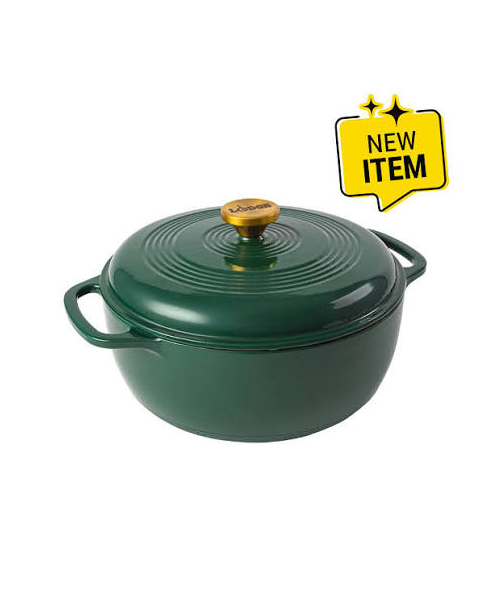
Around $50–90, and the one most people should buy.
It’s enamelled cast iron doing the same job: it browns, it braises, it holds heat, it goes in the oven to 500°F, it’s dishwasher safe and it’s PFOA and PFAS free. The knob is stainless steel, which means no temperature ceiling from the lid — an advantage over the standard Le Creuset for bread baking, at a fifth of the price.
The interior is light, so you can see browning and fond. Lodge offers a wide range of colours, more than Staub does.
The drawbacks: the enamel finish isn’t as refined as the French brands — slightly less even, occasionally with minor imperfections — and it’s more prone to chipping if knocked or dropped. The warranty is limited rather than lifetime. Handles are smaller than Le Creuset’s. And it’s heavier than a Le Creuset of comparable capacity.
Buy it if: you want a Dutch oven to cook with rather than to display, or you’re not sure you’ll use one enough to justify $400.
Skip it if: finish quality and warranty matter to you, or you want something that’ll be worth something in twenty years.
Le Creuset Signature 5.5 qt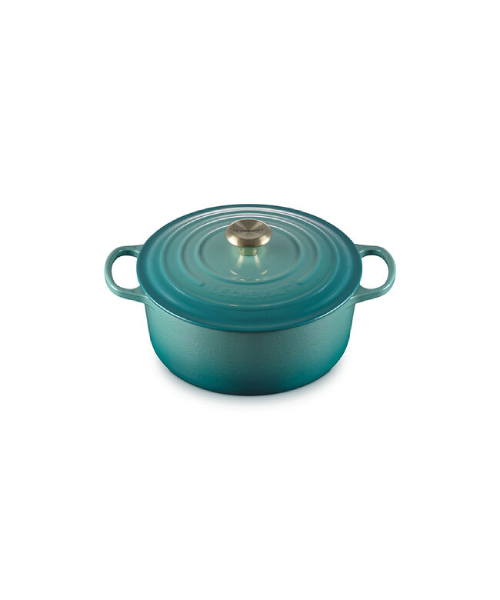
Around $270 to $420 depending on size, colour and retailer. Made in France in sand moulds unique to each piece.
What you’re paying for is execution. The enamel finish is the best in the category, the colours are deep and consistent, and it’s lighter than comparable enamelled cast iron thanks to the thinner walls — which, when you’re lifting a full pot out of an oven, you notice immediately. The handles are wider than anyone else’s, which compounds that advantage.
The light sand interior shows browning clearly, the concentric-ring lid self-bastes, and the lifetime warranty is genuinely honoured. Resale value is strong, which quietly reduces the real cost of ownership.
The drawbacks: the phenolic knob and its 500°F limit, which you’ll want to replace if you bake bread. Thinner walls mean slightly less heat retention than Staub. And a substantial part of the price is the brand and the colour, which is fine as long as you know that’s what you’re buying.
Buy it if: you’ll use it for decades, weight matters to you, and you want the nicest object.
Skip it if: you’re judging purely on cooking results. Lodge gets most of the way there.
Staub Round Cocotte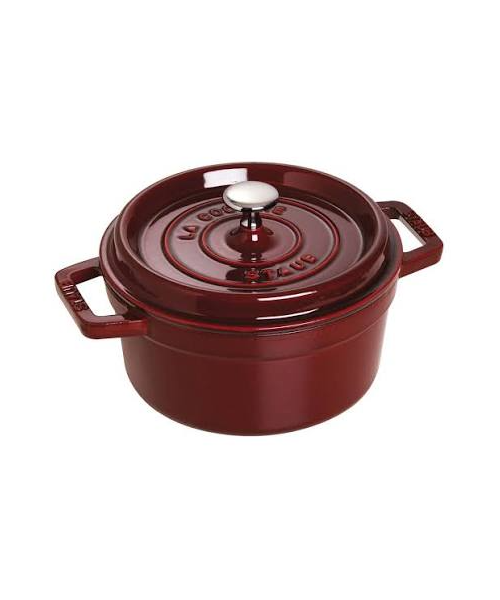
Roughly $150 to $400 depending on size and retailer; it discounts more often than Le Creuset.
The thickest walls here at around 4.2mm, which means the best heat retention of the three. The spiked self-basting lid is the most effective implementation of that feature. The metal knob imposes no temperature ceiling. And the matte black interior resists staining and scratching in a way light enamel doesn’t.
For long braises and anything where you want the pot to hold its temperature while you add cold ingredients, this is the best performer of the three.
The drawbacks: it’s the heaviest, with the 7-quart running past 16 lb empty. The dark interior hides browning and fond, which costs you something every time you make a pan sauce. Handles are smaller than Le Creuset’s. And the colour range is narrower.
Buy it if: you braise often, you want maximum heat retention, or you want a pot that still looks new after years of use.
Skip it if: weight is a concern, or you cook by watching the colour of your fond.
Sizing it
5 to 6 quarts is the right answer for most households. It fits a whole chicken, holds a standard loaf of no-knead bread, and makes enough stew for four with leftovers.
3.5 quarts suits one or two people and is much easier to handle, but won’t take a chicken.
7 quarts and up is for large families and batch cooking, and it’s heavy enough that it becomes a two-handed, both-arms operation when full.
One practical point: an oversized Dutch oven cooks small quantities badly. Liquid spreads thin and reduces too fast. Buying the biggest one you can afford is a common mistake.
Looking after it
Don’t preheat it empty on high heat on the hob. Enamel is glass; thermal shock cracks it. Add fat or liquid, and bring it up gradually.
No metal utensils. Wood, silicone or nylon. Enamel chips.
Don’t drop it or knock it against the sink. The most common cause of damage, and chips aren’t repairable.
Avoid thermal shock in the other direction — don’t put a hot pot into cold water.
For stains on light interiors, a soak with water and baking soda, or a dedicated enamel cleaner. Don’t use abrasive scourers.
Dishwasher safe, mostly, but hand washing preserves the exterior finish longer.
Mistakes worth avoiding
Buying the biggest size. Small quantities cook badly in a big pot, and you’ll find it too heavy to use casually.
Ignoring the lid knob rating if you plan to bake bread. Phenolic knobs cap you at 500°F.
Assuming the premium brands cook meaningfully better. They’re better made, lighter for their capacity and better finished. The cooking gap is small.
Preheating empty on high. Cracks enamel.
Using metal utensils. Chips enamel.
Buying dark interior if you make pan sauces. You won’t be able to see your fond.
Not checking the weight. Full pots of braise are heavy. Handle one before committing to 7 quarts.
Frequently asked questions
Is Le Creuset worth the money over Lodge?
On cooking results, barely — Lodge delivers most of the performance. You’re paying for finish, lighter weight, wider handles, a lifetime warranty and resale value. Whether those are worth it is a personal call.
What size Dutch oven should I buy?
5 to 6 quarts for most households. It takes a chicken, a loaf of bread and a family-sized stew.
Le Creuset or Staub?
Le Creuset for lighter weight, better handles and a light interior that shows browning. Staub for thicker walls, better heat retention, a more effective self-basting lid and a metal knob.
Can I bake bread in a Dutch oven?
Yes, and it’s one of the best uses. Check the lid knob rating — phenolic knobs cap at around 500°F. Metal knobs don’t, and Le Creuset sells a metal replacement.
Light or dark interior?
Light shows browning and fond, which helps with pan sauces. Dark hides staining and resists scratching.
Is enamelled cast iron dishwasher safe?
Generally yes, but hand washing preserves the exterior finish longer.
Does enamel chip easily?
It chips if dropped or knocked, on any brand. Chips aren’t repairable, though a chipped exterior is cosmetic.
The recommendation
Buy the Lodge Essential Enamel 6 qt unless you have a specific reason not to. It’s the honest value answer, it has a metal knob and a light interior, and the money you save is substantial.
Buy the Le Creuset Signature 5.5 qt if you’ll use it for decades and weight and handling matter — and budget $20 for the metal knob if you bake bread.
Buy a Staub Cocotte if you braise seriously and want the best heat retention and the best self-basting lid in the category.
Then buy 5 to 6 quarts rather than the biggest one, never preheat it empty, and keep metal away from the enamel. Any of these three will outlive most of your other cookware.

Leave a comment