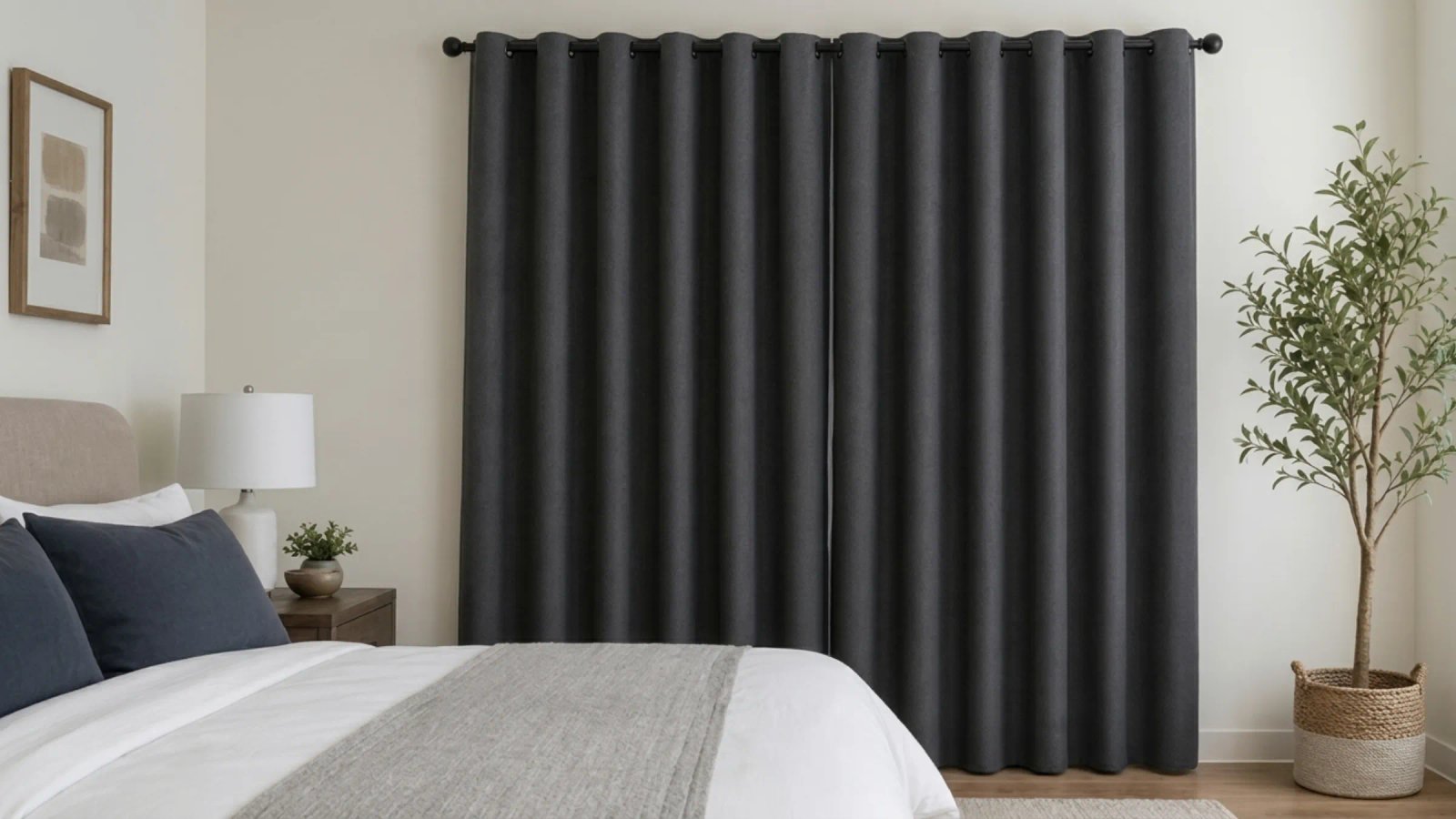
Blackout Curtains: Why Most Don’t Actually Black Out
You bought curtains labelled blackout. You hung them. The room is dimmer, but at 6am in June there’s a bright line running down each side of the window and a glow above the rod, and you’re awake again.
This is the most common outcome in the entire category, and the reason is almost never the fabric. It’s the four gaps around it — the sides, the top, the middle where the panels meet, and the bottom. A panel of genuinely light-proof fabric hung badly will leak more light than a mediocre panel hung well.
That reframes what you’re shopping for. The fabric is maybe a third of the problem. The hardware and the measurements are the rest, and almost no buying guide mentions them.
“Blackout” means nothing in particular
There’s no standard behind the word. Retailers define it differently, and you can see the inconsistency plainly by comparing them.
One major blinds retailer defines room darkening as blocking 95–99% of light, and reserves blackout for fabric that blocks 100%. Another defines room darkening as 70–85% and blackout as anything from 85% up. Those two definitions barely overlap. A product sold as “room darkening” by the first would qualify as “blackout” under the second.
So when a listing says 90% blackout, or 100% blackout, understand what that figure refers to: the fabric, measured on its own, not the window after installation. A fabric can block 100% of light and still leave your room visibly lit, because light doesn’t have to come through the fabric. It comes around it.
What to do: ignore the word on the packaging. Look for a stated percentage, treat it as a fabric specification only, and assume the installed result will be worse unless you fix the gaps.
Colour makes no difference, which surprises most people
A persistent belief is that dark curtains block more light than pale ones, and that you have to accept a dark grey or navy bedroom to get a dark bedroom.
You don’t. In a proper blackout panel, the light-blocking layer is a separate coated or woven layer sandwiched between the decorative outer fabric and the lining. The outside face is cosmetic. A white blackout panel and a charcoal one with the same core perform the same.
This matters practically, because it means you don’t have to compromise on how the room looks to get darkness. What you should check instead is construction: how many layers, and whether the blocking layer is a proper coated liner or just thicker fabric. Triple-weave or three-layer construction performs better than a single heavy weave, regardless of colour.
The four gaps, and what to do about each
This is the part that actually determines your result.
1. The sides
The biggest culprit. Light comes in at an angle through the gap between the edge of the panel and the wall, and because it enters at a low angle, it throws a bright stripe across the room.
The fix is a wraparound rod — also called a return rod or bay-window rod. Instead of ending in a straight finial, the rod bends back toward the wall at each end, carrying the curtain around the corner so the panel edge meets the wall rather than hanging in open air. This single piece of hardware does more for darkness than upgrading your fabric.
The second fix is width. Mount the rod wide — extending 8 to 12 inches past the window frame on each side. This also makes the window look larger, which is why interior designers recommend it anyway.
A counterintuitive detail: heavy blackout fabric is heavier than normal curtain fabric, and that weight pulls the panels inward and down, which can actually widen the side gap over time. Heavier doesn’t automatically mean darker.
2. The top
Light passes over the rod and down the back of the curtain. With rod-pocket or grommet-top panels, there’s an open channel above the fabric almost by design.
Fixes: mount the rod 6 to 8 inches above the frame so the leaked light hits wall rather than window, or add a cornice box or valance over the top, or — the cheap version — run a strip of adhesive-backed hook-and-loop tape along the top edge to seal the panel to the wall.
3. The middle
Two panels meeting in the centre leave a vertical seam. If they merely touch, they’ll separate.
Fix: buy panels wide enough to overlap by several inches in the centre, and use a centre support bracket that the curtain rings can pass over rather than one that blocks them. Total panel width should be roughly two to two and a half times your window width.
4. The bottom
Less important than the others because light from below is usually reflected rather than direct, but it still contributes.
Fix: go floor-length, or past the floor. A panel that breaks on the floor — an inch or two of fabric pooling — seals better than one hanging an inch above it.
Inside mount versus outside mount
If you’re choosing between hanging the curtains inside the window recess or on the wall outside it, outside mount wins for darkness, and it isn’t close.
Inside mount looks tidier and suits a deep recess, but the panel has to be narrower than the opening to fit, which builds a gap in on every side by design. Outside mount lets you extend past the frame in every direction, which is exactly what you need.
If you have blinds or shades already and want to add curtains, outside-mounted curtains over an inside-mounted shade is a good combination — the shade handles most of the light and the curtains cover the shade’s own side gaps.
A note on who’s telling you this
Much of the best writing about why blackout curtains fail comes from companies selling sealed-track blackout systems and portable suction-mounted blackout panels. They are correct about the physics — curtains genuinely cannot seal all four sides the way a track system can — but they also have a commercial interest in you concluding that curtains are hopeless.
They aren’t hopeless. A good panel on a wraparound rod, mounted high and wide, gets most people to a room dark enough to sleep through a summer sunrise. Whether you need to go further depends on how sensitive you are and what you’re solving for.
You probably need more than curtains if: you’re a shift worker sleeping during daylight, you’re darkening a nursery, or you’ve already tried a good installation and it isn’t enough. In those cases a sealed track system or a portable suction-seal panel is the honest answer, and it will cost considerably more.
Curtains are fine if: you want your bedroom dark enough for normal night sleeping, you’re reducing early-morning light, or you’re cutting glare and heat in a living room.
What to buy
Rather than naming a single best panel — fabric quality in this category varies more by batch than by brand — here’s what to check on any listing:
Check | What you want |
Construction | Triple-weave or three-layer with a distinct blocking liner |
Stated blocking | A percentage figure, not just the word “blackout” |
Panel width | Total width 2–2.5× your window width |
Length | Floor-length or longer, measured from rod to floor |
Header type | Grommet or pinch pleat over rod pocket for easier sliding and better stacking |
Weight | Heavier is not automatically better — see the side-gap issue above |
The widely available panel brands in this space — NICETOWN, Deconovo, Pony Dance and similar — sell triple-weave panels at reasonable prices and are generally adequate. The quality difference between these and premium panels is smaller than the difference a wraparound rod makes.
Budget your money accordingly. If you have $120 to spend on a window, $70 of panels plus a $50 wraparound rod will give you a darker room than $120 of panels on the straight rod you already own.
How to measure properly
Get this right before ordering, because returns on curtains are tedious.
Width: measure your window frame, add 8 to 12 inches on each side, and that’s your rod length. Then multiply the window width by 2 to 2.5 for total panel width, and divide by the number of panels.
Length: measure from where the rod will sit — 6 to 8 inches above the frame, not at the frame — down to the floor. Order that length or an inch longer.
Common mistake: measuring the window and buying panels that width. Curtains that exactly match the window are curtains that don’t close properly and have no fullness when drawn.
Other things worth knowing
Blackout fabric helps with heat. The same coated layer that blocks light reduces radiant heat transfer through the window, both in summer and winter. This is a genuine secondary benefit, though it’s often oversold — a curtain is not insulation, and most heat loss in a room with single glazing goes through the glass regardless.
Noise reduction is overstated. Heavy fabric absorbs a small amount of high-frequency sound within the room. It does very little against traffic noise coming through a window. If noise is your actual problem, the glazing is the issue, not the curtains.
Washing degrades the coating. Many blackout panels have a coated backing that doesn’t survive repeated hot washing. Check the care label, wash cold, and don’t tumble dry unless permitted.
Frequently asked questions
Do blackout curtains block 100% of light?
The fabric might. The window won’t, unless the installation seals all four edges. Most of the light you see is coming around the panel, not through it.
Do dark curtains block more light than light ones?
No. The blocking layer is internal and the outer colour is cosmetic. A white blackout panel performs the same as a black one with the same construction.
What’s the difference between room darkening and blackout?
There’s no standard. Retailers define the terms differently, and some definitions barely overlap. Look for a stated percentage instead of the label.
What’s the single biggest improvement I can make?
A wraparound rod, which carries the panel edge around to the wall and closes the side gap. It typically does more than buying better fabric.
Should I mount inside or outside the window recess?
Outside, if darkness is the goal. Inside mount builds a gap in on every side by necessity.
Do blackout curtains keep a room cooler?
Somewhat. The coated layer reduces radiant heat through the window. It’s a real but modest effect.
The recommendation
Buy a mid-priced triple-weave panel, sized at two to two and a half times your window width and long enough to reach the floor. Spend the money you save on a wraparound rod, and mount it 6 to 8 inches above the frame and 8 to 12 inches wider on each side. Overlap the panels in the middle.
That combination gets most bedrooms genuinely dark, and it costs less than the premium panels that most guides will point you at.
If you’ve done all that and it’s still not enough — which is a real outcome for shift workers and nurseries — the next step isn’t better curtains. It’s a sealed track system or a portable suction-mounted panel, and it’s worth knowing that before you buy a third set of curtains hoping the fabric is the problem.


Leave a comment