Most vitamin C serums fail for one of three reasons, and the percentage on the front of the bottle tells you about none of them.
The form might be wrong. “Vitamin C” covers pure L-ascorbic acid and a dozen derivatives with very different track records.
The pH might be wrong. L-ascorbic acid only penetrates skin below about pH 3.5. A 20% serum at neutral pH sits on the surface doing essentially nothing — and almost no brand publishes its pH.
The packaging might be wrong. L-ascorbic acid oxidises on contact with air and light. In a clear dropper bottle, a serum can be substantially degraded before you finish it.
Get those three right and the evidence behind vitamin C is genuinely good. Get any one wrong and you’ve bought an expensive bottle of nothing.
The short version
Look for L-ascorbic acid at 10–20%, at a stated pH below 3.5, with vitamin E and ferulic acid, in opaque or amber glass with an airless pump. That’s the whole specification.
SkinCeuticals C E Ferulic (~$180–240) — the benchmark formulation everything else is compared to.
Timeless 20% Vitamin C + E Ferulic (~$27) — effectively the same formula architecture at a tenth of the price.
CeraVe Vitamin C Serum (10% L-AA) — the gentle starting point, with ceramides for barrier support.
And it doesn’t replace sunscreen. It works alongside it, not instead of it.
The form: L-ascorbic acid versus derivatives
L-ascorbic acid (L-AA) is pure vitamin C. It has by far the deepest body of clinical research behind it, and it remains the form every comparison is measured against.
It’s also unstable, acidic, and capable of stinging — the three reasons the industry keeps developing alternatives.
Derivatives — magnesium ascorbyl phosphate, sodium ascorbyl phosphate, ascorbyl glucoside, tetrahexyldecyl ascorbate, ethyl ascorbic acid — are more stable, less acidic, and far gentler. They need to convert to ascorbic acid in the skin to work, and that conversion is incomplete, so they penetrate and perform substantially less effectively than L-AA at equivalent percentages.
Choose by skin, not by ideology:
L-ascorbic acid | Derivatives | |
Evidence | Strongest | Weaker |
Potency | Highest | Lower |
Stability | Poor | Good |
Irritation | Possible | Minimal |
pH required | Below 3.5 | Not critical |
Best for | Normal, oily, resilient skin | Sensitive skin, beginners |
If your skin tolerates it, L-AA is the better-supported choice. If you have sensitive or reactive skin, a derivative used consistently beats an L-AA serum you abandon after a week of stinging.
The three conditions L-AA needs
This is the part most product pages skip, and it comes from well-established dermatological research — the same work SkinCeuticals built its patent on.
1. Concentration between 10% and 20%
Below roughly 8%, you’re unlikely to see meaningful effect. Between 10% and 20% is the useful range.
Above 20% adds irritation without adding benefit. Absorption plateaus, so a 30% serum is buying you stinging rather than results. Treat very high percentages as a marketing move.
Start at 10% if you’re new to it, and move up if your skin is comfortable.
2. pH below 3.5
This is the condition nobody checks and the one that most often quietly ruins a product.
L-ascorbic acid is water-soluble and carries a charge at neutral pH, which stops it crossing the skin barrier. At pH below about 3.5 it becomes uncharged and can penetrate. The benchmark formulations sit around pH 2.5 to 3.0.
A 20% L-AA serum formulated at pH 5 will not work. The concentration is irrelevant if the vehicle is wrong.
The problem is that most brands don’t publish pH. Those that do — and SkinCeuticals and Timeless both state theirs — are telling you they’ve formulated deliberately. A brand advertising a big percentage and no pH has chosen which number flatters it.
One consequence worth knowing: a serum at pH 2.5–3.0 is genuinely acidic and will sting on broken or freshly exfoliated skin. That’s the formulation working as designed, not a fault — but it’s why sensitive skin often does better with derivatives.
3. Vitamin E and ferulic acid
These aren’t filler. Tocopherol (vitamin E) at around 1% and ferulic acid at around 0.5% do two things: they stabilise the L-ascorbic acid against oxidation, and they amplify its antioxidant effect.
SkinCeuticals cites up to eight times the antioxidant protection of untreated skin for the combination, which is the basis of the patent and the reason that specific trio keeps appearing on competitor labels.
If a serum has L-AA but neither stabiliser, it will oxidise faster and do less.
Packaging is a performance spec
L-ascorbic acid oxidises on exposure to air, light and heat. Oxidised vitamin C doesn’t just stop working — it becomes dehydroascorbic acid, which can be mildly irritating and can stain fabric.
You can see it happening. A fresh L-AA serum is clear to very pale straw. As it oxidises it goes yellow, then orange, then brown. Once it’s dark amber, throw it away. It isn’t doing anything.
What good packaging looks like:
Opaque or dark amber glass — blocks light
Airless pump — the mechanism rises as product is used, so air never enters
Small bottle sizes — you finish it before it degrades
What to avoid:
Clear bottles of any kind
Jars — maximum air exposure every single use
Standard dropper bottles — every use pulls a dropper full of air into the bottle
Drunk Elephant’s approach is worth noting as an alternative solution: two-part packaging you mix fresh when you open it, which keeps the L-AA potent across the bottle’s life.
Storage matters too. Cool, dark, away from the bathroom window. Some people refrigerate L-AA serums, which genuinely extends their life.
The three picks
CeraVe Vitamin C | Timeless 20% C+E Ferulic | SkinCeuticals C E Ferulic | |
Price | Drugstore | ~$27 | ~$180–240 |
Form | 10% L-AA | 20% L-AA | 15% L-AA |
Stabilisers | — | 1% E, 0.5% ferulic | 1% E, 0.5% ferulic |
pH | — | Below 3.5 | 2.5–3.0 |
Extras | 3 ceramides, hyaluronic acid | Hyaluronic acid | Patented formulation |
Packaging | Protective, airtight | Airless pump | Airless pump |
Best for | Sensitive skin, beginners | Value, experienced users | The benchmark, if budget allows |
CeraVe Vitamin C Serum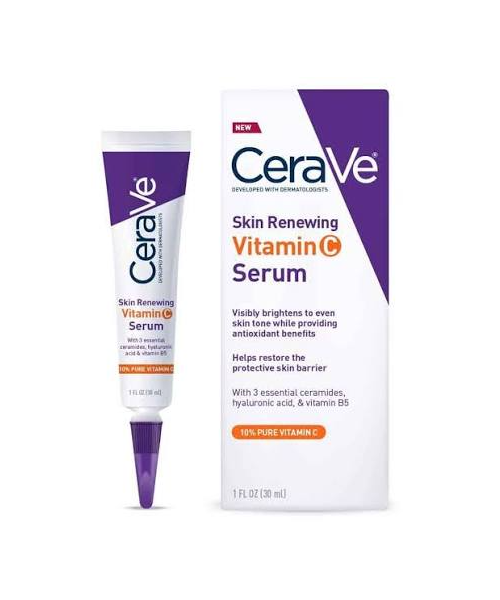
The drugstore option, and the right first vitamin C serum for most people.
It uses 10% pure L-ascorbic acid — the low end of the effective range, which is deliberate — combined with three essential ceramides and hyaluronic acid. The ceramides matter: L-AA is acidic and can compromise the skin barrier in people not used to it, and building barrier support into the same product is sensible formulation.
The packaging is protective and airtight, and the texture is a lightweight gel that absorbs quickly without residue.
The drawbacks: 10% is the lowest concentration here, so results are gentler and slower. The pH isn’t published. And it doesn’t include ferulic acid, so stabilisation relies on packaging rather than formulation chemistry.
Buy it if: you’ve never used vitamin C, your skin is sensitive or dry, or you want barrier support alongside the active.
Skip it if: you’ve used L-AA before and want more potency.
Timeless 20% Vitamin C + E Ferulic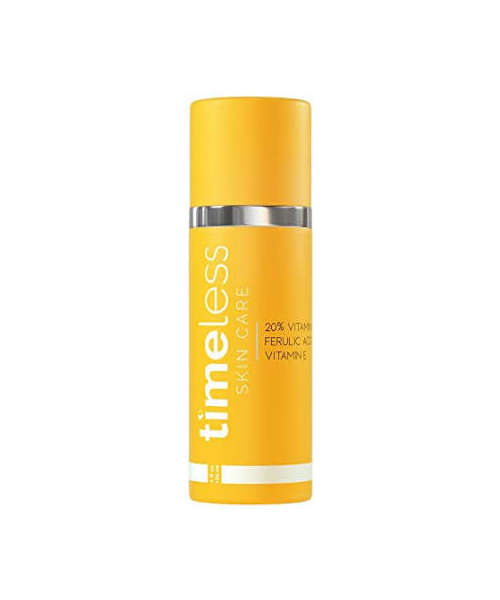
Around $27, and the serum that gets recommended more than any other by people who understand the formulation.
It delivers 20% L-ascorbic acid with 1% vitamin E and 0.5% ferulic acid — the same architecture as the benchmark, at a higher L-AA concentration, at a tenth of the price. Wirecutter has praised it specifically as an affordable alternative sharing many ingredients with the high-end option, and it’s a long-standing favourite in skincare communities.
It comes in an airless pump, uses the correct low pH range, and adds hyaluronic acid for hydration.
The drawbacks: 20% is too strong for beginners and sensitive skin. If you haven’t used L-AA before, start lower. The packaging is functional rather than elegant. And the formulation isn’t identical to the patented original — similar ingredients at similar levels isn’t the same as the same product, whatever the dupe claims suggest.
Buy it if: you’ve used vitamin C before, your skin tolerates actives, and you want the best value in the category.
Skip it if: you’re new to L-AA or your skin reacts easily.
SkinCeuticals C E Ferulic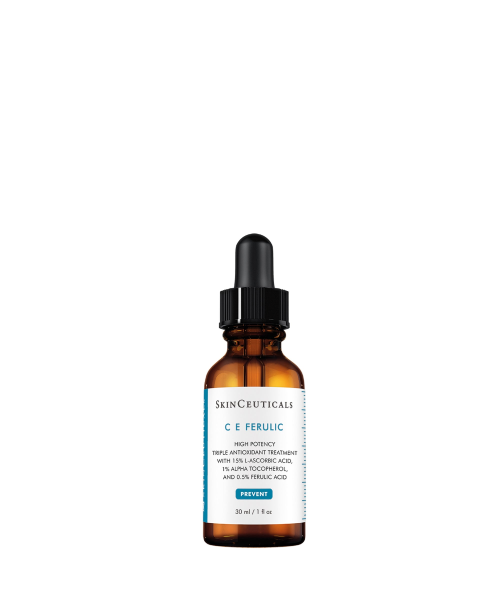
Around $180 to $240 for 30ml, and the serum every other one on the market is measured against.
15% L-ascorbic acid, 1% vitamin E, 0.5% ferulic acid, at pH 2.5 to 3.0. The formulation came out of Duke University research and is patented, and the brand cites up to eight times the antioxidant protection of untreated skin.
Everything about it is deliberate: the concentration sits in the proven range rather than chasing a bigger number, the pH is stated, the stabilisers are at researched levels, and the airless packaging protects it properly.
The drawbacks: the price is extraordinary for 30ml of a formula that can be closely approximated for $27. The acidic formulation requires tolerance. And it has a distinctive hot-dog-ish smell that some people find genuinely unpleasant — a known characteristic of ferulic acid at this concentration.
Buy it if: you want the specific patented formulation with the research behind it and the price isn’t decisive.
Skip it if: you’re judging on value. Timeless gets you most of the way there.
How to actually use it
Morning, on clean skin, before moisturiser and sunscreen. Vitamin C is an antioxidant that works against environmental damage during the day.
A few drops is enough — around four to five for the whole face. More doesn’t absorb.
On damp or dry skin, not wet. Very wet skin dilutes the formulation and can increase penetration enough to irritate.
Always follow with sunscreen. This is the important one: vitamin C supports your sun protection, it does not provide it. An antioxidant neutralises free radicals that get past your SPF; it doesn’t block UV. Using vitamin C instead of sunscreen is worse than using neither, because it creates false confidence.
Introduce it slowly. Every other day for a fortnight, then daily if comfortable.
Patch test first, especially at 20%.
Expect weeks, not days. Brightening and evenness build gradually over one to three months of consistent use.
On combining with other actives: the warnings about niacinamide and retinol are largely overstated for modern formulations, but if you’re getting irritation, the simplest fix is to separate them — vitamin C in the morning, retinol at night.
Mistakes worth avoiding
Buying on percentage alone. A 20% serum at the wrong pH does nothing. Concentration without pH is half a specification.
Buying L-AA in a clear bottle or a jar. It will oxidise before you finish it.
Using it past the colour change. Dark yellow or brown means oxidised. Replace it.
Starting at 20% as a beginner. You’ll irritate your skin and conclude vitamin C doesn’t suit you.
Using it instead of sunscreen. It supports SPF; it doesn’t replace it.
Expecting results in a week. Give it one to three months.
Storing it on a sunny windowsill or in a hot bathroom. Heat and light accelerate oxidation. Cool and dark, or the fridge.
Buying a large bottle. You won’t finish it before it degrades. Smaller is better with L-AA.
Frequently asked questions
What’s the best form of vitamin C?
L-ascorbic acid has the deepest research behind it. Derivatives are gentler and more stable but less effective — a reasonable choice for sensitive skin.
What concentration should I use?
Between 10% and 20%. Start at 10% if you’re new. Above 20% adds irritation without benefit.
Why does pH matter?
L-ascorbic acid only penetrates skin below about pH 3.5. Above that, the concentration is irrelevant because it can’t get in.
Why has my serum turned orange?
It’s oxidised. Oxidised vitamin C doesn’t work and can stain fabric. Replace it, and check your packaging — clear bottles and droppers accelerate this.
Morning or night?
Morning, under sunscreen. It’s an antioxidant that works against daytime environmental damage.
Does vitamin C replace sunscreen?
No. It supports sun protection by neutralising free radicals; it doesn’t block UV.
How long until I see results?
Typically one to three months of consistent use for brightening and tone evenness.
Can I use it with retinol or niacinamide?
Usually fine. If you get irritation, separate them — vitamin C in the morning, retinol at night.
The recommendation
If you’ve never used vitamin C, start with the CeraVe Vitamin C Serum at 10% L-ascorbic acid with ceramides. Gentle, well packaged, and it builds barrier support while you find out how your skin reacts.
If you’ve used it before and want the best value, buy Timeless 20% Vitamin C + E Ferulic at around $27. It’s the same formulation architecture as the benchmark at a fraction of the cost, and it’s the most recommended serum among people who read ingredient lists.
If you want the original patented formulation and the price doesn’t matter, buy SkinCeuticals C E Ferulic.
Whichever you choose, check the packaging before the percentage, apply it in the morning, follow it with sunscreen, and throw it out when it turns orange.
Leave a comment