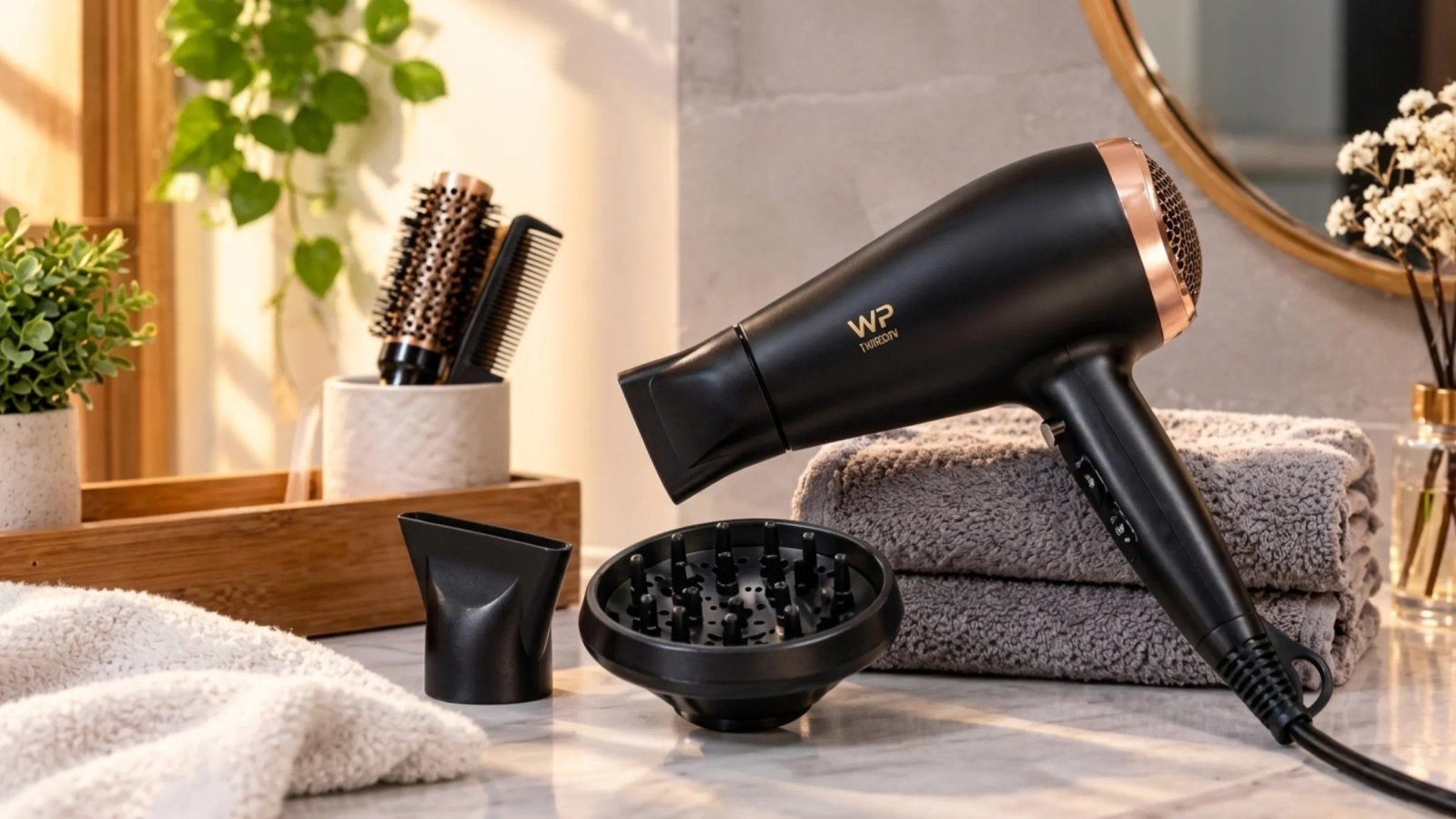
A Conair InfinitiPRO costs around $30 and advertises 1,875 watts. A Dyson Supersonic costs around $400 and runs at 1,600 watts.
On the number everyone checks, the $30 dryer wins — and it dries hair more slowly.
The reason is that wattage measures electrical consumption, not drying performance, and most of that consumption becomes heat. Heat does dry hair, inefficiently, and it’s also the thing that damages it — lifting the cuticle, stripping moisture and causing the frizz you’re then trying to style out.
What dries hair quickly and safely is air moving fast, not air being hot. That’s the entire premise of the expensive dryers, and it’s why they run at lower wattage while drying faster.
Here’s what actually differentiates one dryer from another, and three worth buying at three very different prices.
The short version
Conair InfinitiPRO 1875W (~$30–36) — the honest budget answer. Ionic, ceramic, two attachments, and it does the job if you’re not drying daily.
Shark FlexStyle (~$180–350) — the value pick at the premium end. Dryer and multi-styler in one, with auto-wrap curlers and genuine temperature regulation.
Dyson Supersonic (~$400) — fastest drying with the lowest heat, lightest in the hand, best attachments. Worth it only if you dry often.
And ignore “ionic,” “ceramic” and “tourmaline” as buying criteria. They’re on $25 dryers and $400 dryers alike.
Why wattage misleads
Wattage is the electricity the dryer draws. In a conventional dryer, the large majority of that goes into the heating element, with a comparatively modest motor pushing air across it.
So an 1,875-watt dryer is mostly an 1,875-watt heater with a fan attached.
The premium machines invert that ratio. They use small, very high-speed digital motors — which is why they’re compact enough to sit in the handle — to move a much greater volume of air at much higher velocity, with less heat behind it. The Dyson Supersonic runs at 1,600 watts and dries faster than higher-wattage conventional dryers because more of that energy is going into airflow.
What this means practically:
Comparing wattage between a conventional dryer and a digital-motor dryer is meaningless. They’re different architectures.
Comparing wattage between two conventional dryers is roughly fair. 1,875W is the standard ceiling for a US household dryer and most decent conventional models sit there.
Airflow velocity is the figure that would actually be useful, and almost nobody publishes it — which is itself informative about why wattage remains the headline number.
Heat control is the real premium feature
This is where the money goes, and it’s a genuine engineering difference rather than marketing.
Conventional dryers have heat settings — low, medium, high — which set a target the element then overshoots and undershoots. The hottest spots can get considerably hotter than the setting implies, and that’s where damage happens.
The premium dryers measure and correct continuously:
Dyson Supersonic uses a glass bead thermistor measuring temperature many times per second, sending data to a microprocessor that regulates the heating element to prevent extreme heat.
Shark SpeedStyle measures and regulates temperature 1,000 times per second and claims never to exceed 230°F.
Dyson Supersonic Nural adds scalp-protect mode, reducing to around 130°F as the dryer approaches the scalp, and learns your attachment preferences.
Why 230°F matters: hair damage from heat is cumulative and largely irreversible. The cuticle lifts, moisture escapes, and the result is the dryness and breakage people then treat with products. A dryer that caps its own temperature is addressing the cause.
Who this actually matters for: anyone drying daily, anyone with fine, coloured or already-damaged hair, and anyone who uses high heat because they’re in a hurry. If you air-dry most days and blow-dry occasionally, a conventional dryer on medium heat is fine.
Ionic, ceramic, tourmaline, infrared
These four terms appear on nearly every dryer sold, at every price. They’re real technologies and they’re not differentiators.
Ionic generators emit negative ions, which help break up water droplets and reduce static. The effect is real — less frizz, slightly faster drying. It’s on $25 dryers.
Ceramic coats the heating element so heat distributes more evenly instead of concentrating in hot spots. Also standard, also cheap.
Tourmaline is a mineral that emits negative ions when heated; in practice it’s an ionic implementation. Also standard.
Infrared heats from within the hair shaft rather than only the surface, in theory drying more gently. Appears on dryers from around $24.
The point: a Remington at under $30 combining ceramic, ionic and tourmaline has the same feature list as dryers costing ten times more. These terms tell you a dryer is not from 1995. They don’t tell you it’s good.
What differentiates is airflow, heat regulation, weight and attachments.
Weight is the spec nobody checks
You hold a hair dryer at head height for ten to twenty minutes, often with your arm raised. Weight is not a trivial consideration.
Dryer | Approximate weight |
Dyson Supersonic | 816 g (~1.8 lb) |
Shark SpeedStyle | ~767 g (1.69 lb) |
CHI 1875 Professional | ~1 lb |
Typical AC professional dryer | 1.5–2 lb |
Balance matters as much as mass. Dyson and Shark put the motor in the handle rather than the barrel, which shifts the weight into your palm instead of hanging off the end of your wrist. A 1.8 lb dryer balanced in the hand feels lighter than a 1.5 lb dryer that’s front-heavy.
If you have long or thick hair and you’re drying for twenty minutes, this is worth more than almost any other feature.
Attachments do the styling
The dryer provides air. The attachment decides what the air does.
Concentrator — narrows the airflow into a focused stream for smoothing and straightening with a brush. Essential for a blow-dry.
Diffuser — spreads airflow over a wide area at low velocity so it doesn’t disrupt curl pattern. Essential for curly hair, and the single most commonly missing attachment on cheap dryers.
Smoothing nozzle — gentler than a concentrator, for finishing.
Auto-wrap curlers (Coanda) — use airflow to wrap hair around a barrel without heat clamping. This is what the Shark FlexStyle and Dyson Airwrap do, and it’s a genuinely different capability rather than a dryer feature.
Check what’s in the box. Budget dryers often ship with a concentrator only. If you have curly hair and the dryer has no diffuser, it’s the wrong dryer regardless of its specs.
The three picks
Conair InfinitiPRO | Shark FlexStyle | Dyson Supersonic | |
Price | ~$30–36 | ~$180–350 | ~$400 |
Wattage | 1,875W AC | — | 1,600W digital |
Heat control | 3 settings | Regulated | Measured continuously |
Weight | ~1.5 lb | — | 816 g |
Attachments | Concentrator, diffuser | Curlers, paddle brush, oval brush, concentrator | 5 included |
Styling | Dryer only | Dryer + multi-styler | Dryer only |
Conair InfinitiPRO 1875W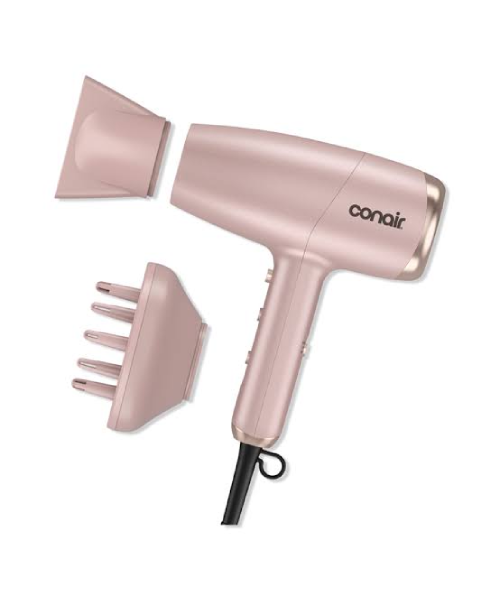
Around $30 to $36, and one of the best-selling dryers on the market with tens of thousands of reviews behind it.
It has a 1,875W AC motor, tourmaline ceramic coating, ionic conditioning, three heat and two speed settings, and — importantly — both a concentrator and a diffuser in the box. That last point puts it ahead of plenty of pricier dryers.
For anyone who blow-dries once or twice a week on a medium setting, this does the job perfectly well. The gap to a premium dryer is real but it’s a gap in speed, weight and heat precision — not a gap between working and not working.
The drawbacks: it’s heavier and less balanced than the premium options, it’s louder, heat control is a setting rather than a regulated temperature, and AC motors in this price bracket are not built for daily professional use.
Buy it if: you dry occasionally, you’re on a budget, or you want a second dryer for travel or a guest room.
Skip it if: you dry daily, have fine or damaged hair, or you have long thick hair where the weight and drying time will tell.
Shark FlexStyle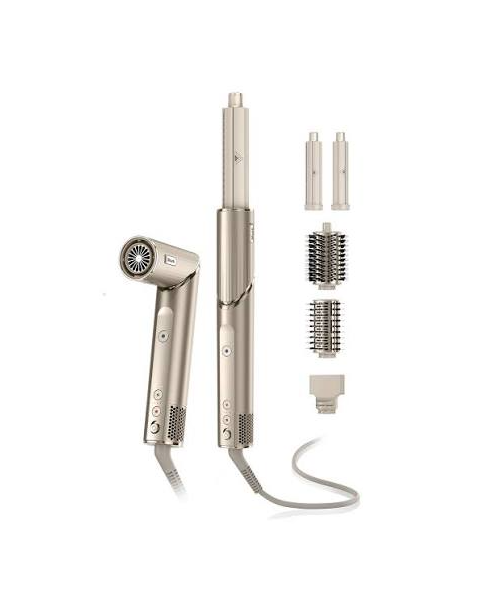
Roughly $180 to $350 depending on configuration and retailer, with refurbished units appearing lower still.
This is the one that makes the most sense for most people considering spending real money. It’s a dryer and multi-styler in one — the barrel rotates so it works as a conventional dryer with a concentrator, or converts to auto-wrap Coanda curlers, a paddle brush or an oval brush. For anyone who currently owns a dryer and a curling iron and a round brush, it replaces three things.
Temperature is actively regulated rather than set, and Shark’s SpeedStyle sibling caps at 230°F with regulation a thousand times a second. The IQ system detects which attachment is fitted and adjusts heat and airflow automatically.
The drawbacks: it’s a compromise at both jobs — not quite as fast a dryer as the Dyson, not quite as refined a styler as the Airwrap. The rotating mechanism is another part that can fail. And pricing varies enormously by bundle, so comparing offers takes attention.
Buy it if: you style as well as dry, and you want one tool instead of three.
Skip it if: you only ever blow-dry straight — you’re paying for styling capability you won’t use.
Dyson Supersoni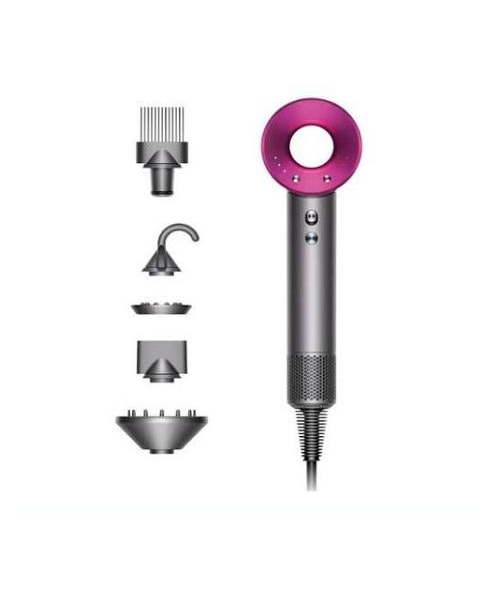
Around $400 at list, with the newer Nural version occasionally seen lower.
It’s the fastest dryer here and the one that applies the least heat doing it, which is the combination that matters if you dry often. At 816 g with the motor in the handle, it’s also the best balanced — the difference over twenty minutes of drying long hair is substantial.
Five attachments are included, covering concentrating, diffusing and smoothing, and they attach magnetically and rotate while hot. The Nural version adds scalp-protect mode, dropping to around 130°F near the scalp, and learns your attachment preferences.
The drawbacks: the price, obviously. As one reviewer puts it plainly, it’s a significant investment if you dry your hair once a week or less. It’s also not as ergonomic in the hand as some competitors despite the weight advantage, and attachments are expensive to replace.
Buy it if: you dry daily, you have fine, coloured or damaged hair, or you have a lot of hair and drying time is a real cost in your day.
Skip it if: you blow-dry occasionally. The value case doesn’t survive contact with low usage.
Mistakes worth avoiding
Buying on wattage. It measures electricity drawn, most of which becomes heat. Airflow dries hair.
Paying extra for ionic or ceramic. They’re on $25 dryers. They’re not a premium feature.
Using the highest heat setting by default. It’s the setting that damages hair, and on most dryers it’s not meaningfully faster than medium with good airflow.
Buying a dryer with no diffuser if you have curly hair. The diffuser is not optional for curls.
Drying soaking-wet hair. Towel-dry or let it air-dry to damp first. The first few minutes of drying dripping hair is the most heat exposure for the least result.
Holding it too close. A few inches away, moving constantly. Static positioning concentrates heat in one spot.
Skipping heat protectant if you use high heat regularly.
Never cleaning the filter. A clogged rear filter restricts airflow, which makes the dryer run hotter and slower. Both Dyson and Shark filters need regular cleaning; so do cheap dryers, and nobody does it.
Frequently asked questions
Does higher wattage mean a better hair dryer?
No. Wattage measures electricity consumed, most of which becomes heat. The Dyson Supersonic is 1,600W and dries faster than many 1,875W dryers because it moves far more air.
Is ionic technology worth paying for?
It’s worth having and it’s not worth paying extra for — it’s on dryers costing under $30.
Is a Dyson worth $400?
If you dry daily, or you have fine, coloured or damaged hair, the speed and heat control are a real benefit. If you dry once a week, the value case is weak.
What temperature damages hair?
Damage is cumulative with heat exposure. The premium dryers regulate temperature actively — Shark’s SpeedStyle caps at 230°F — rather than relying on a setting.
Do I need a diffuser?
If you have curly or wavy hair, yes. It spreads airflow so it doesn’t disrupt the curl pattern.
How do I dry hair with less damage?
Towel-dry to damp first, use medium heat rather than high, keep the dryer moving a few inches away, finish with a cool shot, and use heat protectant.
Why has my dryer got slower?
Usually a blocked rear filter. Clean it — restricted airflow makes any dryer run hotter and slower.
The recommendation
If you blow-dry once or twice a week, buy the Conair InfinitiPRO at around $30. It includes a diffuser, it has the same ionic and ceramic features as dryers costing ten times more, and spending more buys you speed you don’t need.
If you style as well as dry, buy the Shark FlexStyle. Replacing a dryer, a curling iron and a round brush with one tool is a genuine saving, and the temperature regulation is real.
If you dry daily, or your hair is fine, coloured or damaged, buy the Dyson Supersonic. Fastest drying with the least heat is worth the money when you’re doing it 300 times a year.
Whichever you buy, dry to damp first, use medium rather than high, and clean the filter. Those three habits do more for your hair than the difference between any two dryers on this list.

Leave a comment