Most flat iron shopping gets stuck on one question: ceramic or titanium?
It’s the wrong question to start with. The specification that determines both how well a straightener works and how much damage it does is how consistently it holds its temperature — and that barely gets mentioned.
Here’s why it matters. A cheap iron advertising 450°F doesn’t sit at 450°F. The plates heat, overshoot, cool, and reheat, so the actual temperature at any moment swings well above and below the number. The cool phases mean the hair doesn’t straighten in one pass, so you go over the same section two or three times. The hot phases mean those passes happen at temperatures higher than you chose.
Repeated passes are the damage mechanism. An iron that straightens a section in one pass at 365°F is gentler than one that needs three passes at 400°F — even though the second has a lower-sounding setting on the dial.
That’s what you’re paying for at the top of this category, and it’s why plate material is a secondary question.
The short version
Pick your temperature by hair type first, then buy an iron that holds it.
Remington Shine Therapy (~$30) — the budget answer. Ceramic, LCD display, genuinely good for the money.
ghd Platinum+ Styler (~$279–319) — the one for fine, coloured or damaged hair. Multiple heat sensors holding a single optimal temperature.
BaBylissPRO Nano Titanium (~$100–210) — the one for thick, coarse or curly hair that resists straightening.
And never use 450°F on fine hair, whatever the iron is capable of.
Set the temperature to your hair, not the maximum
This is the single biggest avoidable mistake, and most irons encourage it by advertising their maximum.
Hair type | Temperature |
Fine, damaged, bleached or coloured | 250–300°F (120–150°C) |
Normal, medium | 300–380°F (150–190°C) |
Thick, coarse, curly | 380–450°F (190–230°C) |
Fine hair at 450°F will be damaged, and it will be damaged quickly and visibly. Fine hair also straightens at low temperatures, so the high setting buys you nothing.
Thick, coarse hair genuinely needs high heat, and using an iron that can’t reach it means repeated passes, which is worse.
If you’re unsure, start low and work up. Find the lowest temperature that straightens your hair in one pass. That’s your setting.
Heat consistency is what you’re paying for
Cheap irons use a single thermostat and simple on/off heating. The result is a plate with hot and cool zones and a temperature that cycles noticeably.
Better irons use multiple heat sensors across the plate, reading temperature many times a second and adjusting continuously. ghd’s Platinum+ uses what it calls ultra-zone predictive technology for exactly this, and even its mid-range Gold model uses dual sensors to hold heat from root to tip.
What you get from consistency:
Fewer passes, because there are no cold spots leaving a section unstraightened.
No overshoot, so your hair never sees a temperature higher than you selected.
Even results along the length of the hair rather than straighter at the root than the ends.
One design note worth knowing: the ghd Platinum+ runs at a fixed 365°F (185°C) rather than offering a range. That looks like a limitation and is a deliberate choice — it’s positioned as the optimal styling temperature, and the engineering goes into holding it precisely rather than offering numbers the iron can’t maintain. If your hair is fine or coloured, that’s exactly the right answer. If your hair is very coarse, it may not be enough.
Plate material, in proportion
With temperature control understood, material is the second question rather than the first.
Material | Heats | Transfers heat | Best for |
Ceramic | Evenly, moderately | Gently | Fine to normal hair, daily styling |
Titanium | Very fast | Aggressively | Thick, coarse, curly hair |
Tourmaline | — | Coating, not a plate | Frizz and shine, on either base |
Flexible alloy | Moderate | Gently | Thick hair, lower-temperature styling |
Ceramic distributes heat evenly across the plate and transfers it to the hair gradually. That gentleness is why it’s the standard for fine, damaged and colour-treated hair.
Titanium heats faster and holds temperature better under load, and transfers heat to hair aggressively. For thick, coarse or tightly curly hair, that’s the point — it straightens in fewer passes. On fine hair, that same property is a liability.
Tourmaline is a mineral that emits negative ions when heated, counteracting the positive charge that causes frizz. It’s a coating, not a plate type — you’ll see tourmaline-infused ceramic and tourmaline-infused titanium. It’s a genuine anti-frizz benefit and it’s on cheap irons as well as expensive ones.
Flexible plates — Dyson’s Corrale uses manganese copper alloy plates that flex to gather hair rather than letting it spread. Because the hair is held together, it straightens at lower temperatures. It’s a real innovation and it’s priced accordingly.
Plate width
Less discussed and genuinely important.
1 inch is the most versatile. It straightens efficiently, it’s narrow enough to curl with, and it works on most hair lengths. This is the default for most people.
1.5 to 2 inches covers more hair per pass, which saves real time on long or thick hair. The trade-off is that you can’t curl with it and it’s clumsy near the roots and around the face.
0.5 to 0.75 inch suits short hair, fringes and precision work, and it’s slow on anything long.
If you want one iron to do everything, buy 1 inch.
The three picks
Remington Shine Therapy | ghd Platinum+ | BaBylissPRO Nano Titanium | |
Price | ~$30 | ~$279–319 | ~$100–210 |
Plates | Argan-infused ceramic | Precision ceramic | Nano titanium |
Temperature | Up to 450°F, adjustable | Fixed 365°F | Up to 450°F, digital |
Heat sensing | Basic | Ultra-zone, multi-sensor | Digital with memory |
Best for | Normal hair, budget | Fine, coloured, damaged | Thick, coarse, curly |
Auto shut-off | Yes | Yes | Varies by model |
Remington Shine Therapy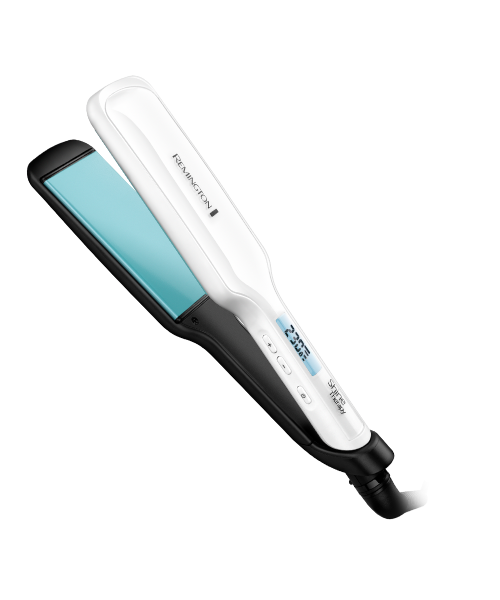
Around $30, and it consistently outperforms its price in comparisons.
Argan-oil-infused ceramic plates, an LCD display showing actual temperature rather than vague settings, adjustable heat up to 450°F, and a turbo mode. The display matters more than it sounds — a lot of cheap irons have “low/medium/high” markings that correspond to nothing you can verify.
For normal hair at moderate temperatures, it does the job.
The drawbacks: heat consistency is basic. You’ll feel cool spots and need more passes than a premium iron, particularly on thick hair. The build quality is what you’d expect at the price, and it won’t last the way a professional iron does.
Buy it if: you straighten occasionally, your hair is normal rather than fine or coarse, or you want a second iron for travel.
Skip it if: you straighten daily, or your hair is fine and damaged — the inconsistency will cost you.
ghd Platinum+ Styler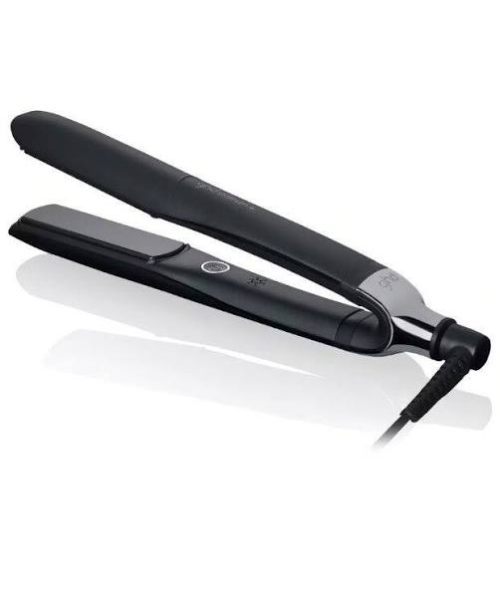
Around $279 to $319, and the pick if hair health is the priority.
The fixed 365°F temperature with ultra-zone predictive heat control is the whole proposition. Multiple sensors across the plates read temperature continuously and adjust, so the heat your hair sees is the heat you expected — no overshoot, no cold spots, no extra passes.
It’s ionic ceramic, which reduces static and frizz, and it has auto shut-off. The plates are highly polished, which affects glide more than people expect — a plate that snags makes you pull, and pulling damages hair independently of heat.
For fine, colour-treated or already-damaged hair, this is the sensible purchase.
The drawbacks: the price is steep. The fixed temperature means no adjustment — if your hair is very coarse, 365°F may not be enough, and you have no option to go higher. And some comparisons quote a temperature range for this model, so verify the spec on the exact version you’re buying, as the range has differed across generations and markets.
Buy it if: your hair is fine, coloured, bleached or damaged, and you straighten regularly.
Skip it if: your hair is very coarse, or you want temperature flexibility.
BaBylissPRO Nano Titanium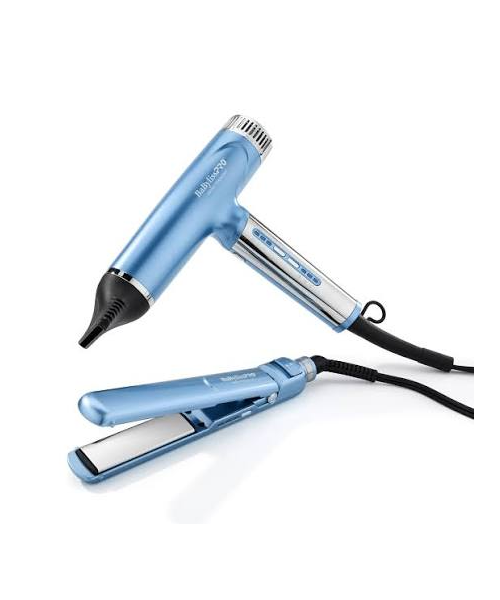
Around $100 to $210 depending on model and retailer.
Titanium plates reaching 450°F with digital control and a memory function. This is the iron for hair that other irons don’t straighten — thick, coarse, tightly curly or high-density hair that reverts.
Titanium’s fast heating and aggressive transfer mean fewer passes on hair that would otherwise need several, which is the right trade for this hair type. The digital control and memory mean you set your temperature once and it returns to it.
It’s also the professional standard, which shows in build quality and longevity.
The drawbacks: it’s genuinely too aggressive for fine hair — the combination of titanium and 450°F will cause damage fast. It’s heavier than consumer irons. And the memory function returning to a high setting is a hazard if anyone else in the house uses it.
Buy it if: your hair is thick, coarse or tightly curly and resists straightening.
Skip it if: your hair is fine, bleached or damaged. This is the wrong tool.
Two premium alternatives worth knowing: the Dyson Corrale (~$499) uses flexible copper alloy plates that gather hair, allowing effective styling at lower temperatures, and it’s cordless — excellent for thick hair, heavy and expensive. The Dyson Airstrait (~$499) straightens wet hair with airflow rather than hot plates, which is the lowest-damage approach available if the price is acceptable.
How to use it without wrecking your hair
Always use heat protectant. Non-negotiable at these temperatures, and it works.
Completely dry hair only — unless you’ve bought a tool specifically designed for wet-to-dry. Water in the hair shaft turns to steam under a hot plate and damages the cuticle from the inside.
Small sections, one pass. A one-inch section at a time, moving steadily. If one pass doesn’t straighten it, your temperature is too low or your sections are too thick — fix that rather than going over it again.
Don’t clamp and hold. Keep the iron moving. Pausing concentrates heat in one spot.
Start at the lowest temperature that works and only go up if it doesn’t.
Clean the plates. Product residue builds up, creates drag, and burns onto the hair. Wipe them cold with a damp cloth regularly.
Give your hair heat-free days. Damage is cumulative, and nothing repairs it — damaged hair is cut off, not healed.
Mistakes worth avoiding
Using the maximum temperature by default. Fine hair straightens at 250–300°F. 450°F on fine hair causes visible damage quickly.
Buying on plate material alone. Heat consistency determines passes, and passes determine damage.
Going over the same section repeatedly. That’s where the damage happens. Fix the temperature or section size instead.
Using it on damp hair. Steam inside the hair shaft damages the cuticle. Only wet-to-dry tools are designed for this.
Skipping heat protectant. It genuinely reduces damage.
Buying titanium for fine hair. Fast, aggressive heat transfer is the wrong property for fragile hair.
Buying a 2-inch plate for versatility. It’s faster on long hair and can’t curl or reach the roots.
Ignoring plate smoothness. A snagging plate makes you pull, and pulling breaks hair regardless of heat.
Frequently asked questions
Ceramic or titanium?
Ceramic for fine to normal hair — it transfers heat gently and evenly. Titanium for thick, coarse or curly hair that needs fast, aggressive heat.
What temperature should I use?
250–300°F for fine or damaged hair, 300–380°F for normal, 380–450°F for thick and coarse. Use the lowest that straightens in one pass.
Why does my cheap straightener need three passes?
Inconsistent plate temperature with cool spots. Multiple heat sensors in better irons hold temperature evenly so one pass works.
Is tourmaline a plate material?
No — it’s a coating that generates negative ions to reduce frizz, applied over ceramic or titanium.
Is a fixed-temperature iron a disadvantage?
Not if the fixed temperature suits your hair. A precisely held 365°F does less damage than a nominal 400°F that swings.
What plate width should I buy?
One inch for versatility — it straightens and curls and suits most hair lengths.
Can I straighten damp hair?
Only with a tool designed for wet-to-dry. On a conventional iron it damages the hair from inside.
The recommendation
If your hair is fine, coloured or damaged, buy the ghd Platinum+ Styler. The multi-sensor heat control at a precisely held 365°F is exactly what fragile hair needs, and fewer passes is the whole game.
If your hair is thick, coarse or tightly curly, buy the BaBylissPRO Nano Titanium. It reaches and holds the temperature your hair actually requires, and it’ll outlast consumer irons.
If you straighten occasionally and your hair is normal, buy the Remington Shine Therapy at around $30 and spend the difference elsewhere.
Then set it to the lowest temperature that works, use heat protectant, and aim for one pass. The number on the dial matters far less than how many times you go over the same piece of hair.

Leave a comment