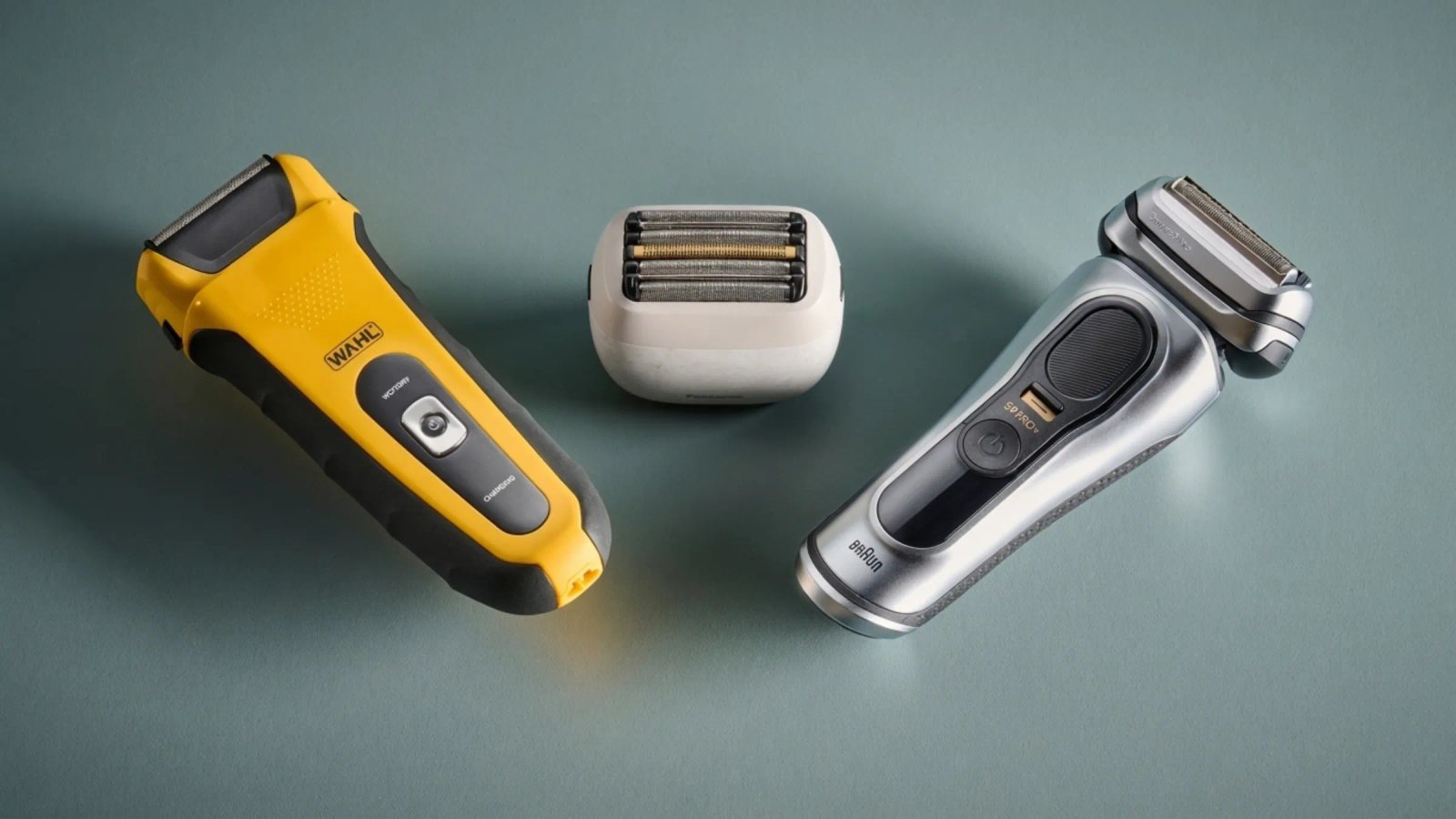
Every electric shaver guide opens with the foil versus rotary question and then answers it badly — usually by declaring one better and moving on.
They’re not competing for the same job. Foil and rotary shavers cut hair using different mechanisms, and which one suits you is determined by two things that have nothing to do with price: how your hair grows, and how often you shave.
A man with straight hair who shaves every morning will get a closer, more comfortable shave from a $60 foil shaver than from a $460 rotary. A man with coarse, curly growth who shaves every third day will get the reverse.
Buy the wrong type and no amount of money fixes it. Here’s how to tell which you are, and the cost nobody factors in.
The short version
Foil for daily shaving, straight hair, flat facial planes, and sensitive skin. Rotary for shaving every few days, coarse or curly growth, and strong facial contours.
Braun Series 9 Pro+ (~$320–450) — the best foil shaver available, and the closest shave of any electric in side-by-side testing.
Philips Norelco Series 9000 / i9000 Prestige (~$280–460) — the best rotary, and the best answer for coarse multi-directional growth and sensitive skin.
Braun Series 3 ProSkin 3040s (~$60) — the budget foil that does the fundamentals properly.
And price your replacement heads before you buy. Over five years they often cost more than the shaver.
How the two types actually work
Foil shavers
A thin perforated metal foil sits over oscillating blades. Hair pokes through the holes in the foil, the blades cut it off against the inside of the foil, and the foil itself keeps the blades from touching your skin.
The characteristics that follow from this:
It cuts very close, because the foil holds hair at a consistent angle and the blade cuts right at the foil surface.
It works in straight lines. You move it in back-and-forth strokes, with the grain or against it, and it performs best on flat planes — cheeks, the flat of the neck, the sides of the jaw.
It’s better on shorter stubble. The foil holes are sized for hair that’s a day or two old. Longer growth lies flat and doesn’t enter the holes well, which is why foil shavers struggle after a week’s growth.
It’s generally gentler because the foil acts as a barrier and you don’t need to press.
It’s louder — a high-pitched buzz rather than a hum.
Rotary shavers
Three circular heads, each containing spinning cutters under a slotted guard. The heads pivot independently so each one follows the surface it’s on.
The characteristics that follow:
It works in circular motions, and because the heads pivot, it follows contours — the curve of the jaw, the chin, the neck — far better than a flat foil head.
It handles multi-directional growth. Because the cutters spin rather than oscillating in one axis, hair growing in different directions gets cut regardless of which way you move.
It handles longer stubble better. The slots catch longer hairs that a foil would flatten.
It’s usually quieter, a lower hum rather than a buzz.
The head is bulky, which makes tight areas — under the nose, around the lip — more awkward.
The decision
Foil | Rotary | |
Shave frequency | Daily | Every 2–3 days |
Hair type | Straight, fine to medium | Coarse, curly, multi-directional |
Face shape | Flat planes | Strong contours |
Closeness | Closer on flat areas | Good overall |
Noise | Buzzy, louder | Quieter hum |
Tight spots | Better | Awkward |
Sensitive skin | Generally better | Good with the right model |
If you’re still unsure: think about whether your hair grows in one consistent direction or swirls. Consistent direction points to foil; swirls, cowlicks and growth that changes direction across your neck point to rotary.
Wet and dry matters more than it sounds
Almost every shaver above entry level offers wet and dry operation, and it’s worth understanding why it matters rather than treating it as a bullet point.
Dry shaving is faster — three minutes, no preparation, no cleanup. That’s the main reason people use electric shavers at all.
Wet shaving with gel or foam significantly reduces irritation. The lubricant lets the head glide instead of dragging, and dragging is what causes the redness and razor burn people blame on the shaver.
If your skin reacts, wet-and-dry capability is close to essential, and you should use it wet at least some of the time. A fully waterproof shaver also rinses clean under a tap, which removes the need for a cleaning station.
One practical note: use a shaving gel designed for electric shavers if you can. Thick traditional foams clog the heads.
The cost nobody calculates
Replacement heads are the real expense in this category, and they’re rarely mentioned until you need one.
Foil shavers need the foil and cutter cassette replaced, typically every 12 to 18 months. Braun cassettes commonly run $40 to $80.
Rotary shavers need the head set replaced on a similar schedule, at similar prices.
Work it out over five years: three or four replacements at $60 each is $180–240 — frequently more than the shaver cost in the first place.
Before buying, do three things:
Look up the replacement head price for that specific model. It varies more than you’d expect between ranges within the same brand.
Check availability. Discontinued models can become expensive or impossible to supply.
Add five years of replacements to the purchase price before comparing.
On cleaning stations: automatic alcohol-based cleaning docks are genuinely convenient, and the cartridges are another recurring cost — typically $5 to $10 each, replaced every month or two. If you have a waterproof shaver, rinsing under a tap works almost as well for free. Buy the dock if you’ll value the convenience, not because it sounds premium.
And don’t run heads past their life. Dull blades don’t cut cleanly — they pull. Most of the “this shaver has got worse” complaints are worn heads, and most irritation complaints on an old shaver are the same thing.
The specs that matter beyond the type
Battery and charging. Sixty minutes of runtime is standard at the premium end, 45 at the budget end. Total runtime matters less than quick charge — five minutes giving you one full shave is the feature you’ll actually use.
Motor speed and cutting elements. More cutting elements (Braun’s Series 9 has five, Series 7 has four) and higher cuts per minute help with dense growth. Panasonic’s Arc range, which runs at high CPM, is specifically favoured for coarse hair.
Head flex. The number of directions the head pivots. More flex means better contact on the jaw and neck, which means fewer passes.
Skin-contact coatings. Philips uses what it calls SkinGlide — a coating with very high microbead density intended to reduce friction against the skin. It’s a real comfort feature rather than marketing, and it’s one of the reasons Philips rotaries get recommended for sensitive skin.
Pop-up trimmer. For sideburns and the edges of a beard. Standard on most models, and the quality varies.
Travel lock. Prevents it running in a bag. Trivial until it’s flattened the battery in your luggage.
The three picks
Braun Series 3 ProSkin | Braun Series 9 Pro+ | Philips Norelco Series 9000 | |
Price | ~$60 | ~$320–450 | ~$280–460 |
Type | Foil | Foil | Rotary |
Cutting elements | 3 | 5 Pro Shave Elements | 3 rotary heads |
Wet & dry | Yes | Yes | Yes |
Runtime | ~45 min | ~60 min | ~60 min |
Cleaning station | No | 6-in-1 SmartCare | Quick Clean Pod |
Best for | Budget, daily shaving | Closest shave, daily use | Coarse/curly growth, sensitive skin |
Braun Series 3 ProSkin 3040s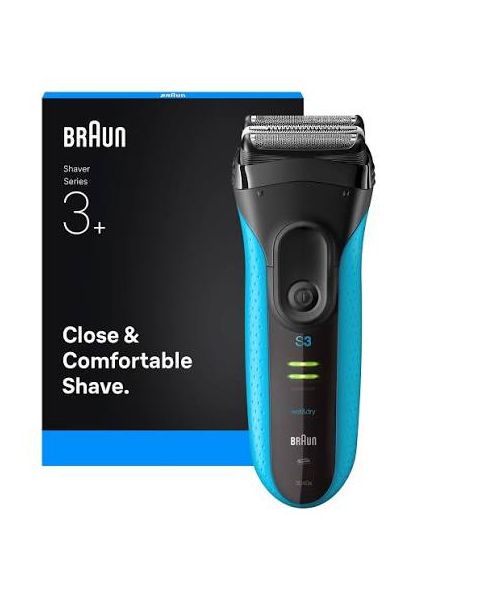
Around $60, and the answer to “what’s the cheapest shaver worth buying.”
It’s a three-element foil shaver, fully wet and dry, with around 45 minutes of runtime and a quick-charge function. No cleaning station — you rinse it under the tap, which on a waterproof shaver is perfectly adequate.
What it gets right is the fundamentals. It cuts close on flat surfaces, it’s light, it’s genuinely durable, and Braun’s replacement cassettes for this range are cheaper than for the premium lines. For a daily shaver with straight hair and no particular sensitivity, the gap to a $400 shaver is smaller than the price difference suggests.
The drawbacks: three cutting elements rather than five means more passes on dense growth. It handles multi-day stubble poorly. Head flex is limited, so the jaw and neck need more work. And there’s no cleaning dock if you want one.
Buy it if: you shave daily, your hair is straight and not especially coarse, or you want to find out whether electric shaving suits you before spending real money.
Skip it if: you shave every few days, or your growth is coarse — you’ll be going over the same areas repeatedly.
A near-equivalent worth knowing: the Wahl Lifeproof at around $48 is a foil shaver with roughly 90 minutes of runtime, which is the longest at this price and useful if you travel.
Braun Series 9 Pro+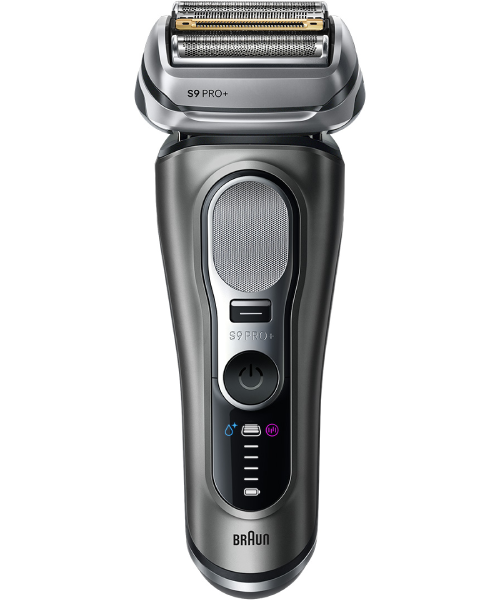
Around $320 to $450 depending on which configuration you buy, with several SKUs at different prices offering essentially the same shaving performance and different accessories.
It’s the benchmark. Five Pro Shave Elements — more cutting surfaces than any competing foil shaver — with titanium-coated foils, a precision long-hair trimmer, and wet and dry operation at around 60 minutes of runtime. In extended side-by-side testing it has produced the closest shave of any electric model, edging out both the Panasonic Arc 5 and the Philips flagship.
The ProComfort head stretches the skin before cutting, which is the feature that makes a shaver this aggressive tolerable — it’s the reason it gets recommended for sensitive skin despite being the most powerful option here.
The 6-in-1 SmartCare Center cleans, lubricates, dries and charges.
The drawbacks: it’s expensive, and the multiple SKUs make it genuinely confusing to work out which one you’re buying. Reviews split on sensitivity — the ProComfort head helps, but some users with reactive skin still find it too aggressive, so if your skin is very easily irritated this is a gamble. Replacement cassettes are at the expensive end. And the cleaning station takes up counter space and consumes cartridges.
Buy it if: you shave daily or near-daily, you want the closest electric shave available, and your hair is straight to medium.
Skip it if: your growth is coarse and multi-directional, or your skin reacts to everything.
The value alternative in the same family: the Braun Series 8 at around $230 gets you most of the Series 9 experience for substantially less, and the Series 7 around $150 is the sensible step up from budget.
Philips Norelco Series 9000 / i9000 Prestige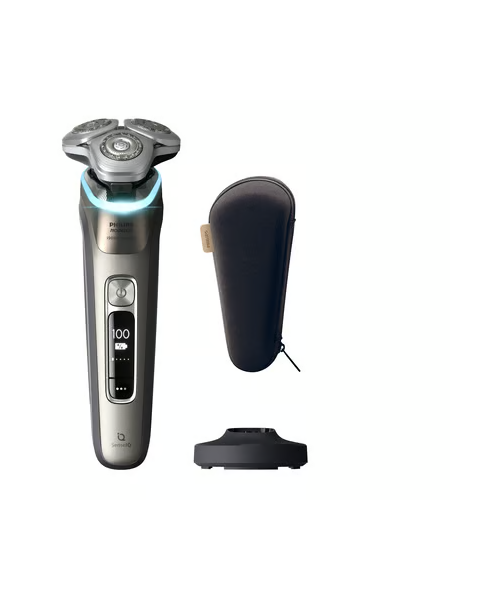
Around $280 for the Series 9000 and up to around $460 for the i9000 Prestige Ultra.
This is the best rotary shaver made, and the right answer for a specific and common situation: coarse, curly or multi-directional growth, particularly on sensitive skin.
The three heads rotate through 360 degrees and pivot independently, following the contours of the jaw and neck. SenseIQ technology reads beard density and skin contact and adapts cutting power continuously — more power where growth is dense, less where it isn’t. The SkinGlide coating uses an extremely high density of microbeads to cut friction against the skin, which is the single biggest contributor to comfort.
Wet and dry, around 60 minutes of runtime, a Quick Clean Pod, and a five-year warranty on the premium models.
The drawbacks: it’s noisy — consistently noted in reviews. The head is bulky, which makes under the nose and around the lip genuinely awkward compared with a foil. It’s less close than the Braun on flat surfaces. Replacement head sets are expensive. And the Philips range has an unusually large number of similar model numbers, which makes comparison shopping tedious.
Buy it if: your beard is coarse, curly or grows in multiple directions, you shave every few days, or you’ve had irritation problems with foil shavers.
Skip it if: you shave daily with straight hair — a foil will be closer and faster.
For the closest possible shave on very coarse hair, the Panasonic Arc5 (~$210) and Arc6 (~$500) are foil shavers running at very high cutting speeds and are specifically favoured for dense, thick growth.
Switching from blades: what to expect
This catches people out and causes a lot of returns.
There’s an adjustment period of two to three weeks. Skin accustomed to a blade behaves differently under an electric shaver, and the first week or two can involve irritation that then settles. Judging the shaver in week one is judging the adjustment, not the product.
The technique is the opposite of wet shaving. With a blade you go with the grain and apply light pressure. With an electric:
Go against the grain. Electric shavers are designed to lift and cut hair growing toward them.
Use short strokes, and go over an area from more than one direction.
Don’t press. This is the most common error and the main cause of irritation. The shaver cuts at the surface; pressing just grinds the head into your skin. Let the weight of the tool do the work.
Hold the skin taut with your free hand, especially on the neck.
For dry shaving, shave before showering, not after — skin is slightly swollen after a hot shower, which means hair sits lower.
A pre-shave lotion stiffens the hair and reduces drag for dry shaving, and it makes a bigger difference than most people expect.
Mistakes worth avoiding
Buying the type that doesn’t suit your hair. The most expensive rotary won’t beat a mid-range foil if your hair is straight and you shave daily, and vice versa.
Pressing hard. The main cause of irritation. Let the shaver do the work.
Not replacing heads. Dull blades pull rather than cut. Most “it’s got worse” complaints are worn cassettes.
Ignoring replacement head costs. Over five years they often exceed the shaver price.
Judging it in the first week. Switching from blades takes two to three weeks of adjustment.
Using thick traditional foam. It clogs the heads. Use an electric-specific gel.
Shaving straight after a hot shower if dry shaving. Swollen skin means hair sits lower and you get a less close result.
Buying a cleaning station you won’t use. If the shaver is waterproof, rinsing works and costs nothing.
Frequently asked questions
Foil or rotary — which is better?
Neither. Foil suits daily shaving, straight hair and flat facial planes. Rotary suits shaving every few days, coarse or curly growth and strong contours.
Which is better for sensitive skin?
Foil is generally gentler, but a good rotary with a friction-reducing coating is excellent for sensitive skin with coarse growth. More important than type: use it wet with gel, and don’t press.
How often do I need to replace the heads?
Typically every 12 to 18 months. Running them longer causes pulling and irritation.
Is a cleaning station worth it?
Convenient, not necessary. A waterproof shaver rinses clean under a tap, and cartridges are a recurring cost.
Why does electric shaving irritate my skin?
Usually pressing too hard, worn heads, or shaving dry when your skin needs lubrication. Try wet shaving with gel and lighter pressure.
How close is an electric shave compared to a blade?
Not quite as close. The best foil shavers get very near, but a blade cuts at or just below skin level in a way an electric doesn’t.
How long until I get a good shave with a new electric?
Two to three weeks if you’re switching from blades. Skin and technique both need to adapt.
The recommendation
Work out your type first. Daily shaver, straight hair, flat planes — foil. Every few days, coarse or curly growth, strong contours — rotary. This decides more than your budget does.
If you’re a daily foil candidate on a budget, buy the Braun Series 3 ProSkin 3040s at around $60. It does the fundamentals properly and the replacement cassettes are cheap.
If you want the closest electric shave available, buy the Braun Series 9 Pro+ — five cutting elements and a skin-stretching head, and genuinely the benchmark.
If your growth is coarse, curly or multi-directional, buy the Philips Norelco Series 9000. Three pivoting heads that follow your face and adapt to density is the right mechanism for that hair, and no foil shaver will match it.
Then price five years of replacement heads, use it wet when your skin complains, stop pressing, and give it three weeks before you decide.


Leave a comment